
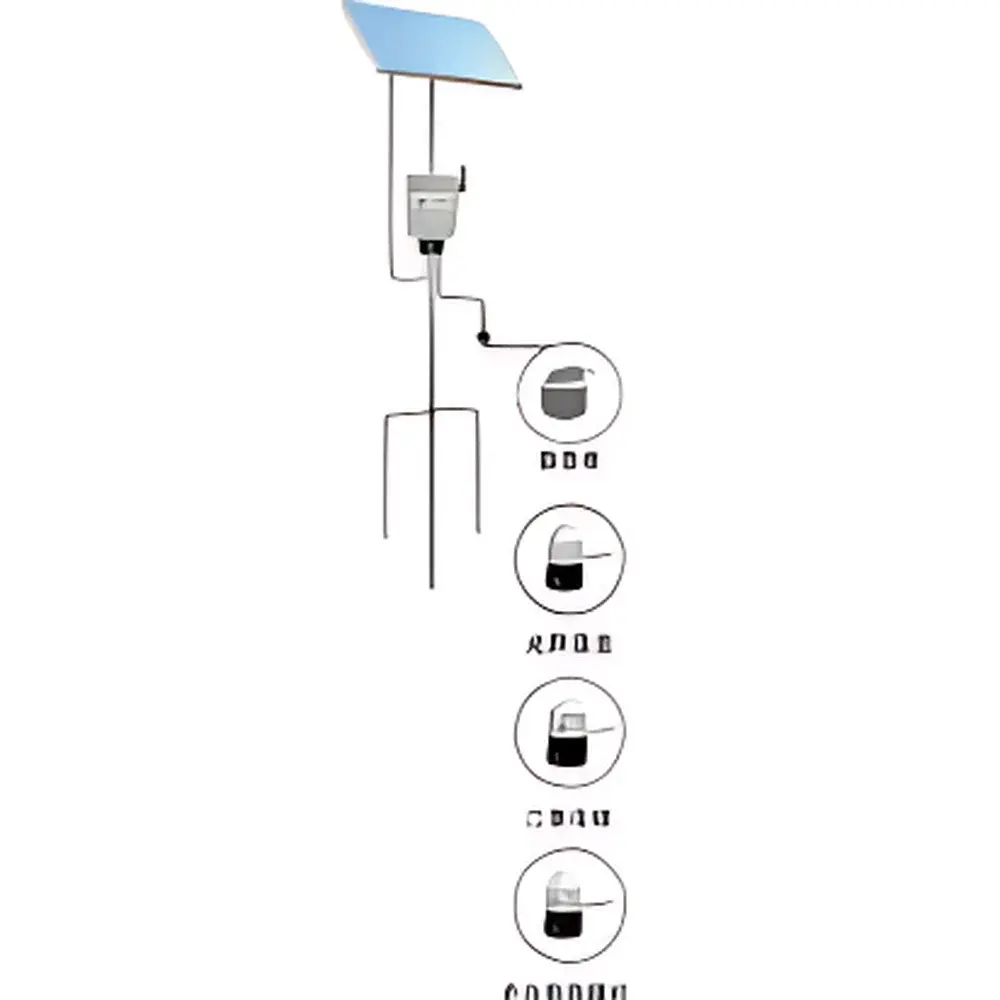
Top Cloud-agri TPFS-WSL-1 Online Temperature, Humidity & Dew Point Monitor
| Brand | Top Cloud-agri |
|---|---|
| Origin | Zhejiang, China |
| Manufacturer Type | Direct Producer |
| Country of Origin | China |
| Model | TPFS-WSL-1 |
| Pricing | Upon Request |
| Operating Temperature Range | −20 °C to +70 °C |
| Enclosure Rating | IP67 |
| Battery Capacity | 20 Ah / 3.7 V Li-Polymer |
| Air Temperature Range | −40 °C to +120 °C |
| Air Temperature Accuracy | ±0.4 °C |
| Air Temperature Resolution | 0.1 °C |
| Relative Humidity Range | 0–100 % RH |
| RH Accuracy | ±3 % RH |
| RH Resolution | 0.1 % RH |
| Dew Point Range | −40 °C to +120 °C |
| Dew Point Accuracy | ±0.4 °C |
| Dew Point Resolution | 0.1 °C |
Overview
The Top Cloud-agri TPFS-WSL-1 is an industrial-grade, solar-powered online environmental monitoring instrument engineered for continuous, unattended measurement of ambient air temperature, relative humidity, and dew point temperature. It operates on the principle of capacitive polymer sensing for humidity and precision thermistor or RTD-based thermal detection for temperature—enabling simultaneous derivation of dew point via real-time Magnus formula computation. Designed for long-term deployment in agricultural microclimates, greenhouse environments, post-harvest storage facilities, and outdoor agro-meteorological networks, the TPFS-WSL-1 delivers high reproducibility under variable solar irradiance and wide thermal gradients. Its ruggedized architecture supports stable operation across −20 °C to +70 °C ambient conditions, with sensor elements rated from −40 °C to +120 °C—ensuring fidelity in both frost-prone and high-heat field scenarios.
Key Features
- Solar-rechargeable power system: Integrated monocrystalline solar panel + 20 Ah/3.7 V lithium-polymer battery enables >200 days of autonomous operation per full charge; dual-power support (solar + optional 220 V AC input) ensures uninterrupted data continuity.
- Multi-sensor expandability: Modular interface supports up to 32 third-party analog or digital sensors (e.g., CO₂, PAR, soil moisture, light intensity), enabling unified platform-level aggregation without external gateways.
- Robust environmental protection: IP67-rated waterproof enclosure with corrosion-resistant mounting hardware; sealed sensor housing prevents condensation ingress during rapid dew formation cycles.
- Embedded wireless telemetry: Built-in LTE-M/NB-IoT module with pre-installed SIM (data plan included) enables secure MQTT/HTTP(S) transmission to cloud infrastructure; supports remote firmware updates and configuration push.
- On-device intelligence: Real-time GPS geotagging (±5 m CEP), configurable threshold-based alerting (SMS/email/web dashboard/LED/voice), and dynamic data buffering (up to 500,000 records) ensure resilience during intermittent connectivity.
- Low-power edge processing: Onboard microcontroller performs dew point calculation using the WMO-standard August-Roche-Magnus equation, eliminating dependency on cloud-side post-processing for time-critical applications.
Sample Compatibility & Compliance
The TPFS-WSL-1 is intended for gaseous atmospheric sampling only—no liquid or particulate-phase measurements. It complies with IEC 60529 (IP67), RoHS Directive 2011/65/EU, and CE marking requirements for electromagnetic compatibility (EN 61000-6-3, EN 61000-6-4). While not certified for ATEX or IECEx hazardous locations, its low-voltage design (≤12 V DC operating bus) meets general safety standards for non-classified outdoor environments. Data integrity protocols align with GLP-aligned logging practices: all measurements are timestamped with UTC-synced RTC, include sensor serial identifiers, and support audit-trail export in CSV/JSON formats suitable for regulatory review (e.g., ISO 22000 traceability frameworks).
Software & Data Management
The device integrates natively with Top Cloud-agri’s Instrument Cloud Platform—a browser- and mobile-accessible SaaS environment supporting role-based access control (RBAC), multi-site dashboarding, and automated report generation. Raw sensor data is stored with millisecond-level granularity and retained for ≥18 months by default. The platform implements configurable alarm logic—including min/max deviation thresholds, rate-of-change triggers, and crop-specific preset profiles (e.g., “tomato flowering stage”, “rice panicle initiation”)—with notification routing across SMS, email, and in-app alerts. All user actions (parameter edits, calibration logs, firmware deployments) are recorded with immutable timestamps and operator IDs, satisfying FDA 21 CFR Part 11 requirements for electronic records and signatures when deployed in GxP-compliant agricultural trials.
Applications
- Greenhouse climate optimization: Continuous dew point monitoring informs condensation risk modeling and ventilation scheduling to suppress fungal pathogen proliferation (e.g., Botrytis cinerea, Pseudoperonospora cubensis).
- Agronomic research: Long-term microclimate profiling across experimental plots for evapotranspiration (ET₀) modeling, irrigation scheduling validation, and phenological stage correlation studies.
- Post-harvest logistics: Real-time ambient condition tracking inside cold storage units and transport containers to verify compliance with Codex Alimentarius temperature-humidity specifications for perishables.
- National agro-meteorological networks: Scalable node deployment for spatial interpolation of dew point depression—serving as proxy indicator for atmospheric stability and fog formation forecasting.
- Smart irrigation control systems: Integration with PLCs or LoRaWAN actuators to trigger drip line activation when dew point depression falls below crop-specific dew formation thresholds.
FAQ
What communication protocols does the TPFS-WSL-1 support?
It uses MQTT over TLS 1.2 and HTTP(S) RESTful APIs for secure cloud upload; no proprietary protocols are required.
Can the device operate without cellular coverage?
Yes—it continues local logging and GPS tagging offline; buffered data uploads automatically upon network recovery.
Is sensor calibration traceable to NIST or other national standards?
Factory calibration certificates reference ISO/IEC 17025-accredited labs; field recalibration kits and procedures are available upon request.
How is data security ensured during transmission and storage?
All communications use AES-256 encryption; stored data resides in ISO 27001-certified cloud infrastructure with daily encrypted backups and RBAC-enforced access segregation.
Does the platform support integration with third-party SCADA or ERP systems?
Yes—via standardized JSON/CSV exports, Webhook endpoints, and optional OPC UA gateway add-on modules.







