
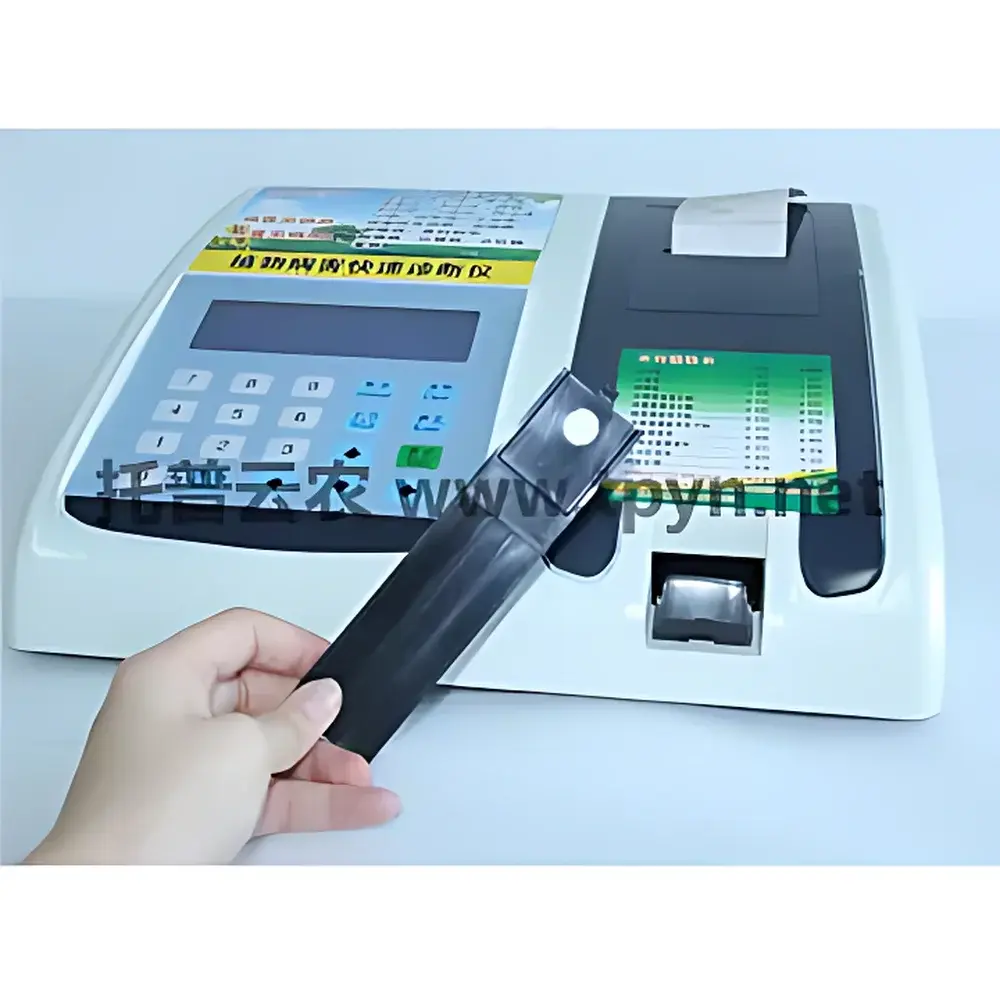
Top Cloud-agri TPH-II Plant Pathogen Rapid Diagnostic Analyzer
| Brand | Top Cloud-agri |
|---|---|
| Origin | Zhejiang, China |
| Manufacturer Type | Direct Manufacturer |
| Country of Origin | China |
| Model | TPH-II |
| Pricing | Upon Request |
| Sample Throughput | 60 samples/hour (single test), 120 samples/hour (continuous mode) |
| Display | Backlit Chinese LCD interface |
| Printing | Integrated thermal printer |
| Power Supply | AC 220 V ±10%, 50 Hz ±2 Hz |
| Power Consumption | ≤30 W |
| Net Weight | ≤3 kg |
Overview
The Top Cloud-agri TPH-II Plant Pathogen Rapid Diagnostic Analyzer is a benchtop immunoassay-based detection system engineered for field-deployable and laboratory-grade identification of plant-pathogenic microorganisms. It operates on the principle of lateral flow immunochromatography (LFIA), leveraging highly specific monoclonal and polyclonal antibodies immobilized on nitrocellulose membranes to capture target antigens from crude plant extracts. Unlike nucleic acid–based methods requiring RNA/DNA extraction and thermal cycling, the TPH-II delivers qualitative or semi-quantitative results within 10–15 minutes per test—without refrigerated reagents, electrophoresis, or specialized molecular infrastructure. Designed for integration into integrated pest management (IPM) workflows and early-warning surveillance systems, it supports rapid triage of symptomatic tissue prior to confirmatory testing by ELISA, PCR, or sequencing. Its architecture conforms to ISO/IEC 17025–aligned operational rigor when used in conjunction with validated extraction protocols and reference standards.
Key Features
- Automated assay execution: Integrated fluidic control ensures consistent sample migration, antibody–antigen binding kinetics, and signal development across test strips.
- Multi-pathogen panel compatibility: Pre-configured test cassettes support simultaneous detection of fungal, bacterial, and viral pathogens—including Botrytis cinerea, Pseudomonas syringae, Tobacco mosaic virus, and Rice black-streaked dwarf virus.
- Standardized sample preparation: Accommodates homogenized extracts from stems, leaves, fruits, roots, and floral tissues using proprietary lysis buffer formulations optimized for matrix interference reduction.
- Thermal-printed result documentation: On-device thermal printer generates time-stamped, operator-annotated reports compliant with GLP documentation requirements.
- Low operational cost per test: Each lateral flow strip is single-use and calibrated for ≥95% analytical sensitivity against WHO-recommended reference strains (e.g., ATCC 11568 for Xanthomonas campestris).
- Modular data export: USB 2.0 interface enables transfer of test logs (CSV format) to LIMS or farm management software for longitudinal disease incidence mapping.
Sample Compatibility & Compliance
The TPH-II accepts raw or minimally processed plant matrices—including leaf discs (≥5 mm²), stem cross-sections, fruit pulp suspensions, and root exudate concentrates—provided they meet defined turbidity (<50 NTU) and pH (5.5–7.5) thresholds. All included test strips are manufactured under ISO 13485-certified conditions and validated per AOAC Official Method 2015.01 for lateral flow pathogen detection. The instrument itself complies with IEC 61010-1 (Safety Requirements for Electrical Equipment for Measurement, Control, and Laboratory Use) and meets EMC Directive 2014/30/EU emission limits. While not FDA-cleared as an in vitro diagnostic device, its use aligns with USDA APHIS guidelines for preliminary quarantine screening and FAO Crop Protection Handbook recommendations for decentralized diagnostics in resource-limited settings.
Software & Data Management
No embedded operating system is required; the TPH-II functions as a standalone hardware platform. However, optional PC-connected operation (via USB) enables synchronization with Top Cloud-agri’s proprietary *AgriTrace* desktop application (Windows 10/11 compatible). This software provides audit-trail-enabled data logging, batch-level statistical summaries (positive/negative ratios, confidence intervals), and customizable reporting templates aligned with ISO 22000 food safety documentation frameworks. All stored records include timestamp, operator ID, sample ID, and environmental metadata (temperature/humidity if externally logged). Data exports satisfy 21 CFR Part 11 requirements when paired with user-defined electronic signatures and role-based access controls.
Applications
- Early detection of Fusarium oxysporum f. sp. lycopersici in tomato nurseries prior to transplanting.
- Routine monitoring of Erwinia amylovora in apple orchards during bloom and post-harvest storage.
- Verification of pathogen-free status in certified seed potato lots before distribution.
- On-site validation of biocontrol agent efficacy (e.g., Bacillus subtilis suppression of Alternaria solani in field trials).
- Supporting phytosanitary certification for export shipments under IPPC ISPM 36 compliance protocols.
FAQ
What types of pathogens does the TPH-II detect?
It detects antigenic epitopes from 28 priority plant pathogens—including 15 fungal species (e.g., Blumeria graminis, Phytophthora infestans), 7 bacterial taxa (e.g., Ralstonia solanacearum, Xanthomonas oryzae), and 6 viral agents (e.g., CMV, TMV, PVY).
Is sample preparation standardized across crop types?
Yes—manufacturer-supplied extraction kits include crop-specific lysis buffers and centrifugation protocols validated for rice, wheat, maize, tomato, cucumber, tea, and citrus.
Can results be exported for regulatory submission?
Yes—CSV-formatted datasets include all metadata required for inclusion in NPPO phytosanitary dossiers or third-party audit packages.
What is the shelf life of test strips at ambient temperature?
18 months when stored unopened at 4–30 °C in low-humidity conditions (<60% RH); desiccant packs are included in each cassette box.
Does the instrument require routine calibration?
No—calibration is performed automatically at power-on using internal optical reference standards; annual verification with control strips is recommended per ISO/IEC 17025 clause 7.7.





