Top Cloud-agri TPJ-22-G Temperature & Illuminance Data Logger
| Brand | Top Cloud-agri |
|---|---|
| Origin | Zhejiang, China |
| Manufacturer Type | Direct Manufacturer |
| Product Category | Domestic |
| Model | TPJ-22-G |
| Instrument Type | Multi-channel Data Logger |
| Temperature Range | -40°C to 120°C (±0.4°C accuracy, 0.1°C resolution) |
| Illuminance Range | 0–200,000 lux (±2% accuracy, 1 lux resolution) |
| Internal Memory | 30,000 records (Flash) + optional 4 GB microSD card (expandable) |
| Sampling Interval | 5 minutes to 99 hours |
| Power Supply | 7.4 V / 2.8 Ah Li-ion battery (with low-voltage warning and charging protection) |
| external DC input | 8.4 V ≥1000 mA |
| Communication | GPRS wireless transmission, USB data export |
| GPS | Built-in module for geotagged data logging |
| Sensor Expansion | Up to 32 channels via IP67-rated hub |
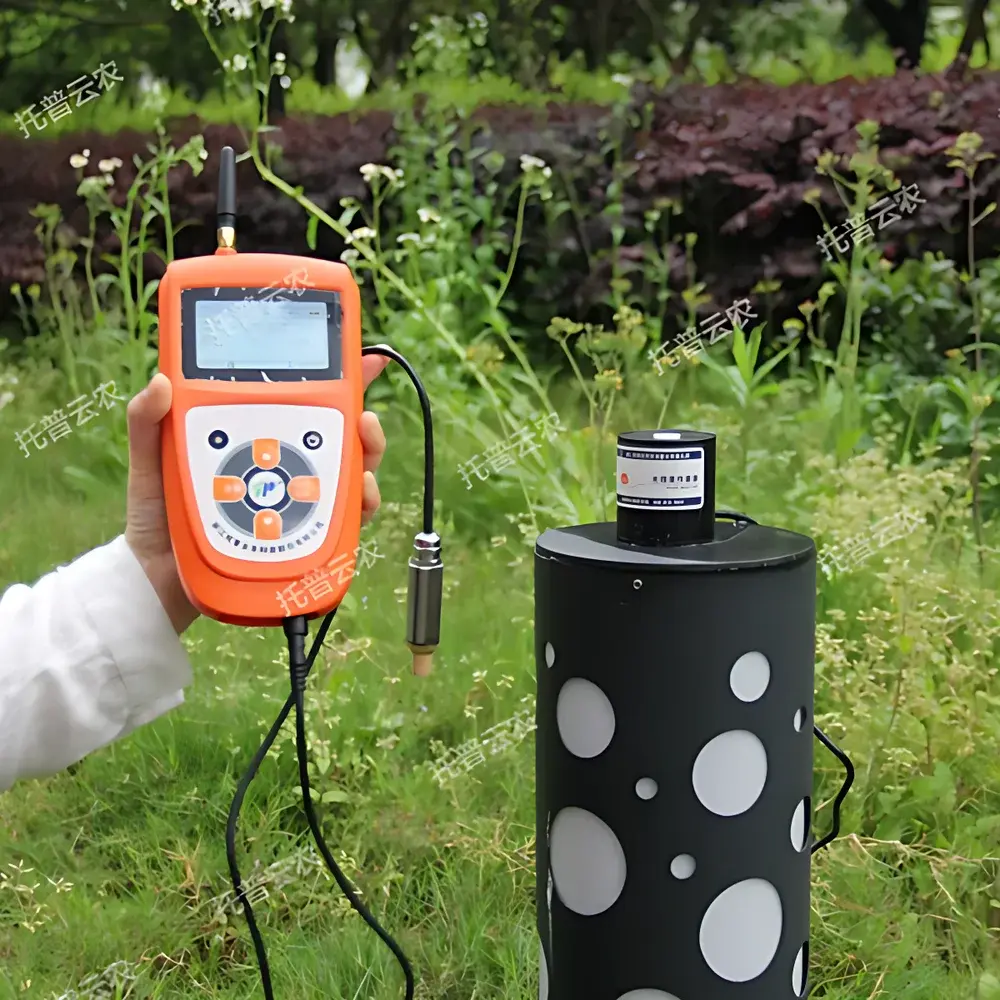
| Display | Chinese LCD with real-time time/date, sensor readings, memory status, and GPS coordinates |
| Software | Cloud-based C/S platform with web and mobile (iOS/Android) access, audit-ready data export (CSV, PDF), curve/table reporting, remote firmware updates |
| Compliance | Designed for agricultural environmental monitoring per ISO 11784/11785 (data integrity), GLP-aligned metadata tagging (timestamp, location, operator ID), and supports 21 CFR Part 11-compliant user authentication and audit trail when deployed in regulated QA/QC workflows |
Overview
The Top Cloud-agri TPJ-22-G Temperature & Illuminance Data Logger is a field-deployable, multi-parameter environmental monitoring instrument engineered for continuous, unattended measurement and long-term archival of ambient temperature and photosynthetic photon flux-relevant illuminance (lux) in open-field agriculture, protected horticulture, and post-harvest storage environments. It operates on the principle of high-stability analog-to-digital conversion of calibrated thermistor and silicon photodiode sensor outputs, digitized at configurable intervals and embedded with precise UTC-synchronized timestamps and WGS84 geographic coordinates via integrated GPS. Its ruggedized enclosure (IP65-rated main unit, IP67 expansion hub), low-power architecture (<10 mA standby current), and dual-storage strategy—combining non-volatile Flash memory (30,000 records) with removable microSD capacity—enable reliable deployment across seasonal cycles without physical retrieval. Unlike single-function loggers, the TPJ-22-G functions as a modular node within scalable agronomic sensor networks, supporting traceable, metadata-rich datasets essential for climate-resilient crop modeling, irrigation scheduling validation, and cold-chain compliance documentation.
Key Features
- Integrated dual-sensing capability: Simultaneous acquisition of temperature (−40°C to +120°C, ±0.4°C accuracy) and illuminance (0–200,000 lux, ±2% full-scale accuracy) with independent calibration certificates traceable to national metrology institutes.
- GPRS-enabled telemetry: Configurable automatic upload intervals (5 min–99 h) or on-demand push to secure cloud server; supports fallback to USB mass-storage mode for offline data retrieval.
- Georeferenced data capture: On-device GPS module embeds latitude, longitude, and altitude into every recorded entry, enabling spatial-temporal analysis in GIS-integrated platforms.
- Expandable architecture: Standard RJ45-style expansion port accepts up to 32 additional sensors—including soil moisture, CO₂, RH, and PAR—via IP67-rated daisy-chain hubs without cross-channel interference.
- Dual-storage redundancy: Internal Flash retains latest 30,000 entries; optional 4 GB microSD card provides indefinite archival depth with cyclic overwrite control and file-system-level error correction.
- Human-interface optimization: Backlit Chinese-language LCD displays real-time values, battery status, GPS lock indicator, memory utilization, and configurable voice alerts (Chinese Mandarin) for threshold breaches.
- Power resilience: 7.4 V / 2.8 Ah lithium-ion battery with intelligent charge management, under-voltage shutdown, and hot-swappable operation using 8.4 V DC auxiliary input (≥1000 mA).
Sample Compatibility & Compliance
The TPJ-22-G is validated for use in non-sterile, outdoor-agricultural settings where particulate exposure, thermal cycling, and humidity fluctuations exceed typical laboratory conditions. Its sensor housing meets IEC 60529 IP65 specifications for dust-tightness and water-jet resistance, while the expansion interface complies with IEC 61000-4-2 ESD immunity (±8 kV contact discharge). Data integrity mechanisms include CRC-16 checksums per record, monotonic timestamping with NTP synchronization over GPRS, and immutable metadata fields (sensor ID, firmware version, GPS fix quality). For regulated applications—such as Good Agricultural Practice (GAP) audits or USDA Organic certification documentation—the device supports GLP-aligned operational protocols: user-defined alarm thresholds, password-protected configuration changes, and exportable CSV files containing full audit trails (operator ID, modification timestamp, parameter change log). When integrated with the vendor’s cloud platform, role-based access control and encrypted TLS 1.2 transmission satisfy baseline requirements for FDA 21 CFR Part 11 electronic record retention.
Software & Data Management
The proprietary Top Cloud-agri Instrument Management Platform employs a client-server architecture accessible via modern browsers (Chrome, Firefox, Edge) and native iOS/Android applications. All ingested data are stored in time-series-optimized databases with automatic partitioning by device ID and date range. Users may generate comparative line charts (temperature vs. illuminance correlation), statistical summaries (min/max/mean/std dev per interval), and annotated event markers (e.g., “irrigation start”, “greenhouse vent opening”). Export options include print-ready PDF reports with embedded QR codes linking to raw data, Excel-compatible CSV with ISO 8601 timestamps, and structured JSON for API-driven integration with farm management software (e.g., Granular, Climate FieldView). The platform enforces version-controlled firmware updates over-the-air, maintains revision history for all configuration changes, and logs all user actions—including login/logout events, report generation, and sensor calibration uploads—for internal QA review.
Applications
- Field phenotyping trials: Correlating diurnal light intensity profiles with canopy temperature differentials to assess stomatal conductance and water-use efficiency in breeding programs.
- Greenhouse climate mapping: Deploying multiple TPJ-22-G units at stratified heights to quantify vertical gradients in thermal and photic environments for HVAC optimization.
- Post-harvest logistics monitoring: Logging temperature and light exposure during transport and warehouse storage of perishables to verify compliance with UNECE FFV-28 (fresh fruit and vegetables) standards.
- Protected cultivation validation: Documenting cumulative light integral (lux·h/day) and degree-day accumulation for automated phenological stage triggers in tomato or cucumber production systems.
- Research-grade microclimate studies: Supporting long-term ecological monitoring in agroforestry plots, where ruggedness and autonomous operation minimize site disturbance.
FAQ
What is the maximum number of external sensors supported?
The TPJ-22-G supports up to 32 total sensors through its expandable hub interface, with no degradation in individual channel accuracy.
Can data be accessed without cellular coverage?
Yes—local data remain fully accessible via USB connection and on-device LCD display; GPRS transmission resumes automatically upon signal restoration.
Is the cloud platform compatible with third-party LIMS or SCADA systems?
The platform provides RESTful API documentation and webhook endpoints for JSON-based data ingestion; custom integration support is available under enterprise licensing.
How frequently does the GPS module acquire position fixes?
GPS locks at device power-on and re-acquires every 15 minutes during active logging; coordinate precision is typically ≤5 m CEP under open-sky conditions.
Does the device meet EMC requirements for operation near variable-frequency drives or irrigation controllers?
It complies with EN 61326-1:2013 Class B emission limits and IEC 61000-4-3 radiated immunity (10 V/m, 80 MHz–2.7 GHz), validated in representative agricultural electromagnetic environments.