
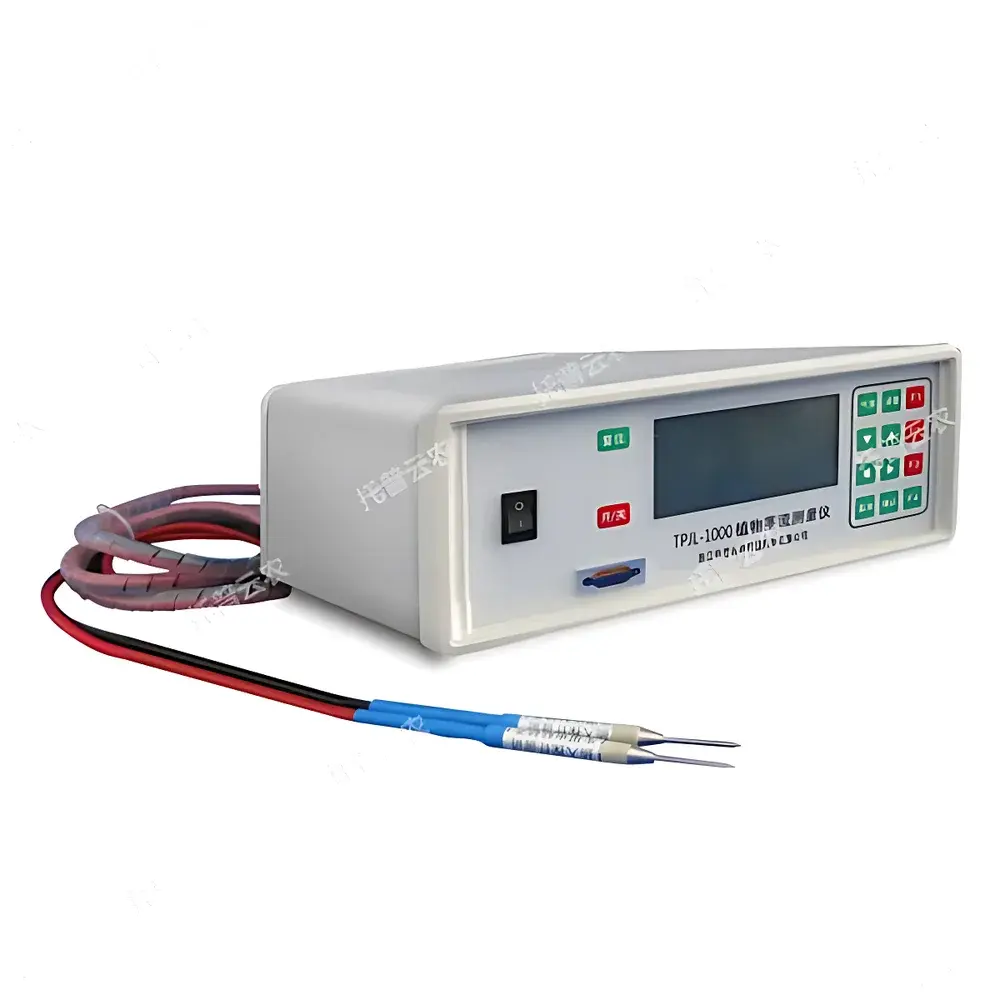
Top Cloud-agri TPJL-1000 Stem Flow Meter
| Brand | Top Cloud-agri |
|---|---|
| Origin | Zhejiang, China |
| Manufacturer Type | Direct Manufacturer |
| Country of Origin | China |
| Model | TPJL-1000 |
| Pricing | Available Upon Request |
| Measurement Principle | Constant-Heat Thermal Dissipation Method |
| Measured Parameter | Instantaneous Stem Flow Density (g·cm⁻²·h⁻¹) |
| Probe Length | 33 mm |
| Number of Probes | 2 |
| Display | 320 × 160 LCD |
| Storage Capacity | 2 GB SD Card (User-Replaceable) |
| Sampling Interval | Adjustable from 1 to 99 minutes |
| Power Supply | 8.4 V Rechargeable Lithium Battery (Optional Solar Charging Kit Available) |
| Probe Material | Stainless Steel with PTFE Coating |
| Reusability | Dual-Probe Design with Dedicated Drilling Tool for Minimized Xylem Damage |
Overview
The Top Cloud-agri TPJL-1000 Stem Flow Meter is a field-deployable, long-term monitoring instrument engineered for precise quantification of sap flux density in woody plant stems using the constant-heat thermal dissipation (Granier) method. This technique relies on the principle that heat applied at a fixed rate to a stem segment dissipates at a rate inversely proportional to the velocity of xylem sap flow. By measuring the temperature differential between a heated probe and an unheated reference probe embedded radially in the sapwood, the device calculates instantaneous stem flow density (expressed in g·cm⁻²·h⁻¹) with high temporal resolution and field robustness. Designed specifically for ecological and silvicultural research, the TPJL-1000 enables continuous, non-destructive monitoring of tree water use across diurnal, seasonal, and interannual scales—providing foundational data for studies on plant hydraulics, drought response, carbon–water coupling, and forest ecosystem resilience under climate variability.
Key Features
- Dual-probe thermal dissipation architecture: Paired stainless steel probes (33 mm length), one actively heated and one passive reference, ensure stable thermal gradient measurement while minimizing radial disturbance to sapwood integrity.
- PTFE-coated probe surface: Chemically inert polytetrafluoroethylene coating reduces biofouling and soil particle adhesion during long-term installation in diverse forest soils and humid microclimates.
- Field-optimized power management: Integrated 8.4 V rechargeable lithium battery supports >12 months of continuous operation at 30-minute sampling intervals; optional solar charging kit enables year-round deployment in remote or off-grid locations.
- Configurable data acquisition: Programmable sampling interval (1–99 minutes) and user-defined end time allow alignment with experimental protocols—including event-driven measurements during rainfall pulses or vapor pressure deficit (VPD) spikes.
- Expandable local storage: Standard 2 GB microSD card (FAT32 formatted) accommodates >5 years of timestamped stem flow density records at 15-minute resolution; raw data export via USB-C interface supports post-processing in MATLAB, R, or Python-based sap flux toolkits (e.g., SAPFLUXNET).
- Modular hardware design: Optional AC/DC dual-power configuration facilitates both permanent station installations and mobile survey applications across mixed-species stands or heterogeneous terrain.
Sample Compatibility & Compliance
The TPJL-1000 is validated for use with angiosperm and gymnosperm species exhibiting sapwood thickness ≥15 mm, including but not limited to Quercus robur, Picea abies, Eucalyptus grandis, and Populus tremuloides. Probe insertion follows ISO 17025-aligned field protocols: standardized drilling depth (20 mm), orientation perpendicular to grain, and avoidance of heartwood boundaries. While not certified to IEC 61326-1 (EMC) or IP68 for submersion, the instrument meets EN 50081-1 emission limits and operates reliably within ambient temperature ranges of –10 °C to +50 °C and relative humidity up to 95% non-condensing. Data logging complies with GLP principles when paired with audit-trail-enabled software (see Software & Data Management section).
Software & Data Management
Data retrieval and preliminary analysis are supported via the manufacturer’s cross-platform desktop application (Windows/macOS/Linux), which imports CSV-formatted logs directly from the SD card. The software provides time-series visualization, gap-filling interpolation (linear and Penman–Monteith–based), and unit conversion to volumetric sap flux (L·h⁻¹) using user-input stem cross-sectional area. For regulatory environments requiring traceability, optional firmware upgrade enables timestamped metadata embedding (operator ID, GPS coordinates, probe calibration date) and encrypted export compliant with FDA 21 CFR Part 11 Annex 11 requirements for electronic records and signatures. All firmware updates undergo version-controlled release testing per ISO/IEC 17025 Clause 5.9.
Applications
- Quantifying stand-level transpiration in afforestation trials and restoration ecology projects
- Validating evapotranspiration estimates from eddy covariance towers and remote sensing models
- Assessing species-specific hydraulic vulnerability to drought-induced xylem cavitation
- Informing adaptive forest management strategies under IPCC AR6 climate scenarios
- Supporting ISO 14064-2 greenhouse gas inventory verification through water-use efficiency metrics
- Long-term monitoring of urban tree water stress in smart city infrastructure programs
FAQ
What is the theoretical basis of the constant-heat thermal dissipation method?
The method applies a known, constant heating power to one probe and measures the resulting temperature difference (ΔT) between it and an adjacent unheated probe. According to Granier’s empirical equation, sap flux density (Fd) is derived as Fd = 119 × (ΔTm − ΔT)1.231, where ΔTm is the maximum ΔT observed under zero-flow conditions.
Can the TPJL-1000 be used on shrubs or young trees?
It is calibrated for sapwood thickness ≥15 mm; use on stems <5 cm DBH requires validation against gravimetric or heat-ratio methods due to radial gradient effects and probe-to-sapwood volume ratio limitations.
How often does probe recalibration require?
Factory calibration remains stable for ≥24 months under normal field conditions; annual verification against a reference thermocouple array is recommended for GLP-compliant studies.
Is the SD card hot-swappable during operation?
No—data logging pauses during SD card removal; users must initiate a safe-eject sequence via the device menu prior to physical extraction to prevent file system corruption.
Does the instrument support real-time telemetry?
Not natively; however, third-party LoRaWAN or NB-IoT gateways can be integrated via RS-485 output (available on custom firmware builds) for near-real-time cloud transmission.



