
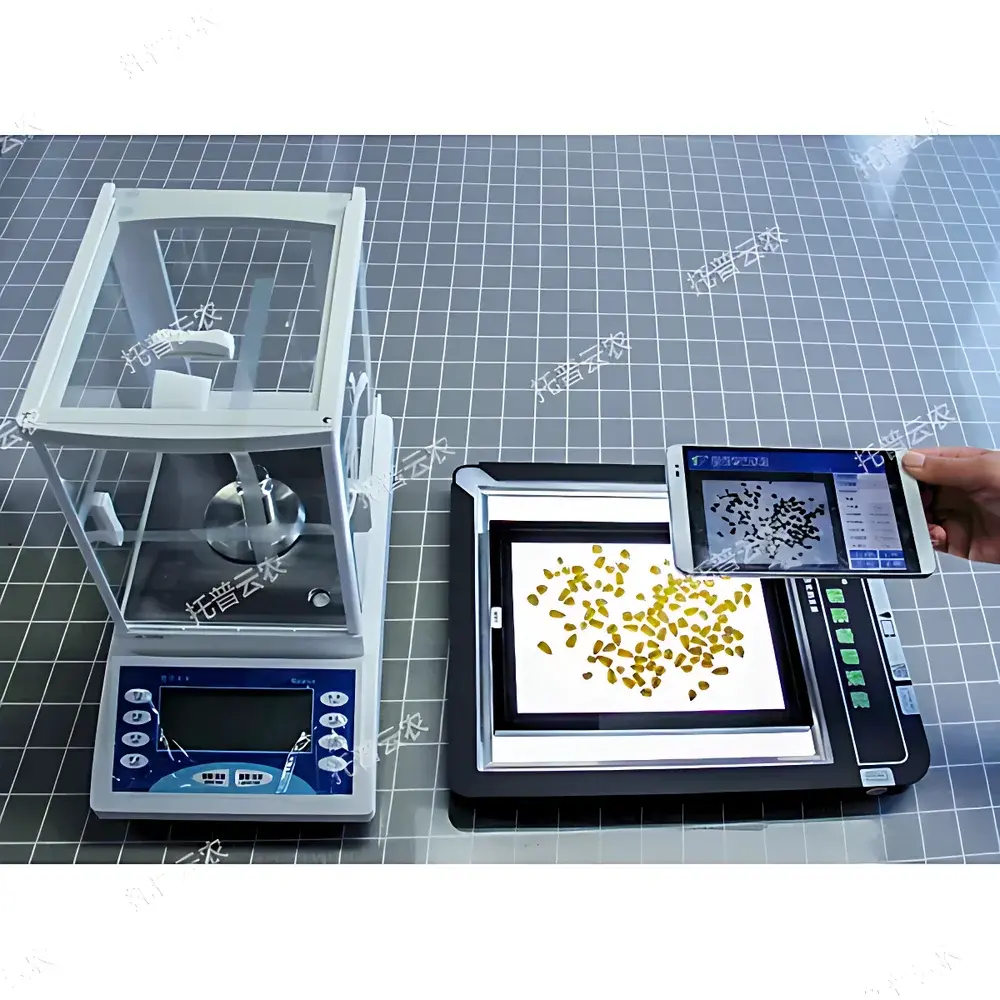
Top Cloud-agri TPKZ-2 Smart Seed Analysis System
| Brand | Top Cloud-agri |
|---|---|
| Origin | Zhejiang, China |
| Manufacturer Type | Direct Manufacturer |
| Product Origin | Domestic (China) |
| Model | TPKZ-2 |
| Instrument Type | Benchtop |
| Sample Types | Dehulled seeds of rice, wheat, maize, rapeseed, legumes, peanut, sesame, sorghum, etc. |
| Sample Capacity | 5–1,500 grains for conventional seeds (e.g., rice, wheat) |
| Grain Counting Accuracy | ±0.1% for round seeds, ±0.5% for elongated seeds (≥1,000 grains) |
| Morphometric Measurement Error | ≤0.3% for individual grain shape parameters |
| Standard Configuration | A3-sized adjustable LED backlight plate with auto-calibration, transparent sample tray, 11-inch 13-megapixel tablet PC, precision electronic balance |
Overview
The Top Cloud-agri TPKZ-2 Smart Seed Analysis System is a benchtop digital phenotyping instrument engineered for high-throughput, non-destructive morphometric characterization of dehulled agricultural seeds. It operates on the principle of high-resolution digital image acquisition combined with calibrated machine vision algorithms to extract quantitative seed traits—including count, thousand-kernel weight (TKW), length, width, length-to-width ratio, perimeter, and projected area—from single or batched samples. Designed specifically for plant breeding programs, germplasm evaluation, and quality control in seed production facilities, the system eliminates manual counting and vernier-based measurements, reducing operator bias and inter-laboratory variability. Its optical architecture integrates geometric calibration, uniform illumination control, and sub-pixel edge detection to ensure metrological traceability in seed trait quantification—critical for QTL mapping, variety registration trials, and compliance with national seed certification protocols (e.g., GB/T 3543.3–1995, NY/T 2846–2015).
Key Features
- 11-inch industrial-grade tablet PC with 13-megapixel rear-facing camera and fixed-focus macro lens optimized for seed-scale imaging (working distance: 25–35 cm).
- A3-format ultra-thin LED backlight plate with continuous brightness adjustment (0–100%) and built-in auto-calibration reference grid—eliminates manual scale bar input and supports field-deployable operation via USB power bank or AC adapter.
- Real-time image zoom (1×–8×) with lossless interpolation and interactive annotation overlay for visual verification of segmentation boundaries and outlier grain exclusion.
- Cloud-integrated data pipeline: raw images, measurement logs, and metadata synchronize automatically to the Top Cloud-agri AgriData Platform via TLS-encrypted HTTPS, enabling remote audit, multi-site collaboration, and longitudinal trait tracking across breeding cycles.
- Local data management: analysis results export directly to .xlsx format with configurable column headers (e.g., sample ID, grain count, TKW, mean length ± SD, CV of width); supports batch export and timestamped local storage on tablet internal memory or microSD card.
- Firmware and algorithm updates delivered over-the-air (OTA) with version-controlled changelogs and backward-compatible data schema migration.
Sample Compatibility & Compliance
The TPKZ-2 accommodates a broad spectrum of dehulled dicot and monocot seeds without mechanical preprocessing. Validated species include Oryza sativa (rice), Triticum aestivum (wheat), Zea mays (maize), Brassica napus (rapeseed), Glycine max (soybean), Arachis hypogaea (peanut), Sesamum indicum (sesame), and Sorghum bicolor (sorghum). The system meets ISO/IEC 17025:2017 requirements for testing laboratory competence when operated within defined environmental conditions (temperature: 15–30°C; relative humidity: 30–70%; ambient light <50 lux). Measurement uncertainty budgets are documented per GUM (JCGM 100:2008) and align with national seed testing guidelines for morphometric repeatability (RSD ≤1.2% across five replicates under controlled lab conditions).
Software & Data Management
The embedded AgriSeedVision™ software (v4.2+) implements ISO/IEC 27001-aligned access controls, including role-based user permissions (operator, supervisor, administrator), encrypted local database (SQLite with AES-256), and full audit trail logging of all measurement events—including timestamp, operator ID, device serial number, and parameter configuration. Exported Excel files embed digital signatures compliant with FDA 21 CFR Part 11 for electronic records and signatures in regulated environments. Cloud synchronization includes automatic backup retention (90 days), granular sharing permissions (view-only or edit), and RESTful API endpoints for integration with LIMS or breeding management systems (BMS) such as BreedBase or Fieldbook.
Applications
- Rapid TKW determination for yield potential estimation and seed lot grading prior to commercial distribution.
- Morphometric profiling of segregating populations in early-generation breeding to identify shape-associated markers (e.g., grain plumpness in wheat, seed coat thickness in soybean).
- Phenotypic validation of CRISPR/Cas9-edited lines where grain dimension shifts serve as proxy indicators of gene function.
- Quality assurance in certified seed production, supporting compliance with ISTA Rules for seed sampling and testing.
- Teaching laboratories for plant science curricula requiring hands-on experience with digital phenotyping workflows and statistical analysis of biological variation.
FAQ
Does the TPKZ-2 require external calibration standards for routine operation?
No—the integrated backlight plate performs automatic geometric calibration before each imaging session using its embedded reference grid. NIST-traceable ceramic calibration tiles are optional for annual metrological verification.
Can the system analyze seeds with surface irregularities or partial occlusion?
Yes—adaptive thresholding and contour-smoothing algorithms handle minor overlaps and surface texture variations typical of unpolished rice or cracked peanut kernels. For >15% overlap, manual pre-separation is recommended.
Is raw image data stored alongside analytical outputs?
Yes—each analysis session saves the original TIFF image, segmented binary mask, and JSON-formatted metadata in a synchronized folder structure, ensuring full data provenance and reproducibility.
What regulatory frameworks does the cloud platform support?
The AgriData Platform complies with GDPR for EU-based users and implements SOC 2 Type II controls for data confidentiality, availability, and integrity. Audit reports available upon NDA.
How is measurement traceability maintained across firmware updates?
All algorithm versions are digitally signed and logged. Legacy analyses retain original processing logic; new measurements use updated models with version-tagged output fields to preserve longitudinal comparability.





