
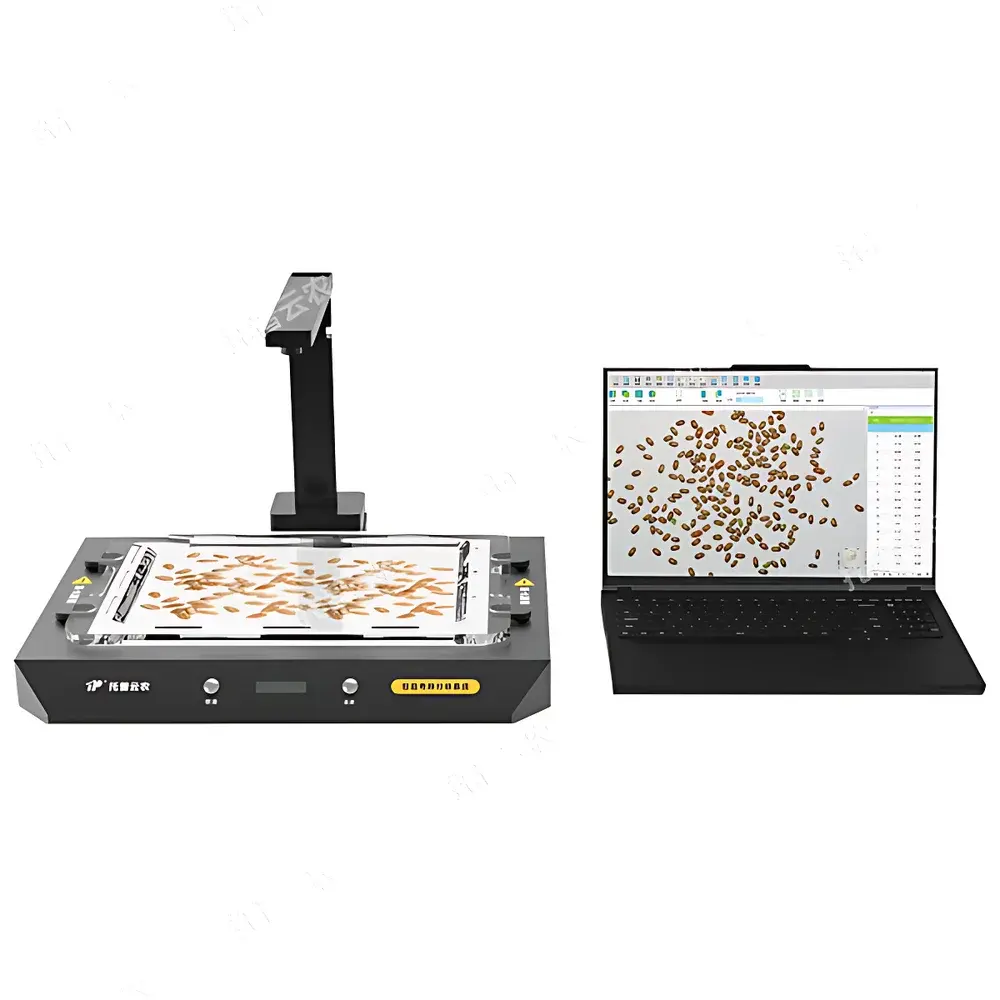
Top Cloud-agri TPKZ-3 Smart Seed Characterization System
| Brand | Top Cloud-agri |
|---|---|
| Origin | Zhejiang, China |
| Manufacturer Type | Direct Manufacturer |
| Product Origin | Domestic (China) |
| Model | TPKZ-3 |
| Pricing | Upon Request |
Overview
The Top Cloud-agri TPKZ-3 Smart Seed Characterization System is an automated, image-based seed analysis platform engineered for high-throughput phenotypic assessment of cereal and maize seeds. It operates on the principle of high-resolution digital imaging combined with calibrated gravimetric measurement to extract morphometric and mass-based traits—including seed count, thousand-kernel weight (TKW), hundred-kernel weight (HKW), and individual kernel dimensions (length, width, length-to-width ratio, perimeter, projected area, and color profile). Designed specifically for maize breeding programs, agronomic research, and seed quality control laboratories, the system replaces manual counting and vernier-based measurements with reproducible, operator-independent quantification—fully compliant with standardized seed testing protocols under ISO 5647 (Cereal seeds — Determination of thousand-kernel mass) and ISTA Rules (International Seed Testing Association).
Key Features
- A3-format high-fidelity imaging: 22 MP resolution (4896 × 3672 pixels) overhead camera with uniform LED backlighting and auto-calibrating transparent seed tray—eliminates shadow artifacts and ensures sub-pixel edge detection for accurate morphometric segmentation.
- Integrated weighing module: Precision load cell (0–5 kg range) co-located beneath the imaging stage enables concurrent mass acquisition and image capture; TKW/HKW values are computed automatically upon seed count confirmation.
- OLED real-time weight display: 2.1-inch monochrome OLED screen embedded in the weighing platform provides immediate visual feedback during sample loading—supporting dynamic adjustment of seed quantity prior to analysis.
- Multi-mode operation: Standalone balance functionality (0–5 kg, ±0.1 g repeatability) and PC-connected mode via USB 2.0 or Ethernet—enabling flexible deployment across field stations, seed processing labs, and centralized QA facilities.
- Adaptive image segmentation: Deep learning–enabled classification engine trained on spectral and geometric features allows unsupervised clustering by color, shape, or size—supporting varietal differentiation and impurity detection without pre-defined templates.
- Interactive correction tools: Manual split/merge operations via mouse-driven ROI editing ensure 100% verification accuracy—even for touching, overlapping, or fragmented kernels.
- Region-of-interest (ROI) counting: User-defined rectangular or freehand selection zones permit targeted enumeration within heterogeneous samples—critical for purity testing or hybrid segregation analysis.
Sample Compatibility & Compliance
The TPKZ-3 supports analysis of all smooth-surfaced, opaque or semi-translucent seeds with diameters ≥1.5 mm and aspect ratios ≤5:1—including maize, wheat, rice, sorghum, barley, and soybean. Its optical design minimizes specular reflection and accommodates minor surface texture variations. All hardware components meet CE safety standards (EN 61000-6-3, EN 61000-6-1). Software architecture conforms to GLP data integrity requirements: full audit trail, user authentication, electronic signature support, and exportable metadata (EXIF + custom XML schema). Data outputs comply with ISO 22005 traceability frameworks and are compatible with LIMS integration via CSV/Excel export (XLSX format with embedded formulas and version-stamped headers).
Software & Data Management
- Proprietary Windows-based application with dual-layer encryption: dynamic QR-code license binding + hardware dongle authentication.
- Batch-level data persistence: automatic timestamped project archiving with incremental save and append functionality.
- Cloud synchronization optional via secure TLS 1.3 API endpoints—supports role-based access control (RBAC), remote dataset retrieval, and cross-site comparative analytics.
- Barcode integration: USB HID-compliant scanner interface enables one-touch variety ID entry using GS1-128 or Code 128 symbologies—reducing transcription errors in multi-trial experiments.
- Thermal printer support (ESC/POS protocol): direct export of summary reports including statistical summaries (mean, SD, CV%), raw images, and annotated overlays.
Applications
The TPKZ-3 serves core functions across public and private agricultural R&D infrastructures: maize hybrid yield trial phenotyping; seed lot certification per national seed law (e.g., USDA Federal Seed Act, China’s Crop Seed Quality Supervision Regulations); QTL mapping studies requiring precise TKW heritability estimates; post-harvest quality grading (e.g., broken kernel detection, size distribution profiling); and regulatory submission packages for variety registration (UPOV Test Guidelines TG/12/8). Its throughput—1,500–3,000 maize kernels per minute with ≤±0.5% counting error—meets ISO 5647 repeatability thresholds for official seed testing laboratories accredited under ISO/IEC 17025.
FAQ
What seed types are validated for use with the TPKZ-3?
Maize, wheat, rice, barley, sorghum, and soybean—provided seeds are dry, non-oily, and exhibit minimal surface gloss or translucency.
Does the system support FDA 21 CFR Part 11 compliance?
Yes—the software includes electronic signature capability, audit trail logging, and password-protected user roles required for regulated environments.
Can I integrate the TPKZ-3 with our existing LIMS?
Yes—CSV and Excel exports contain structured metadata fields; custom API connectors are available upon request for enterprise-grade LIMS interoperability.
Is calibration traceable to NIST or equivalent national standards?
The integrated scale is factory-calibrated against certified weights traceable to CNAS-accredited reference standards (GB/T 27418–2017); annual recalibration service is offered.
What is the minimum recommended sample size for statistically robust TKW calculation?
Per ISO 5647, ≥1,000 kernels are required; the system validates count accuracy before computing mass-derived metrics and flags low-count batches automatically.





