
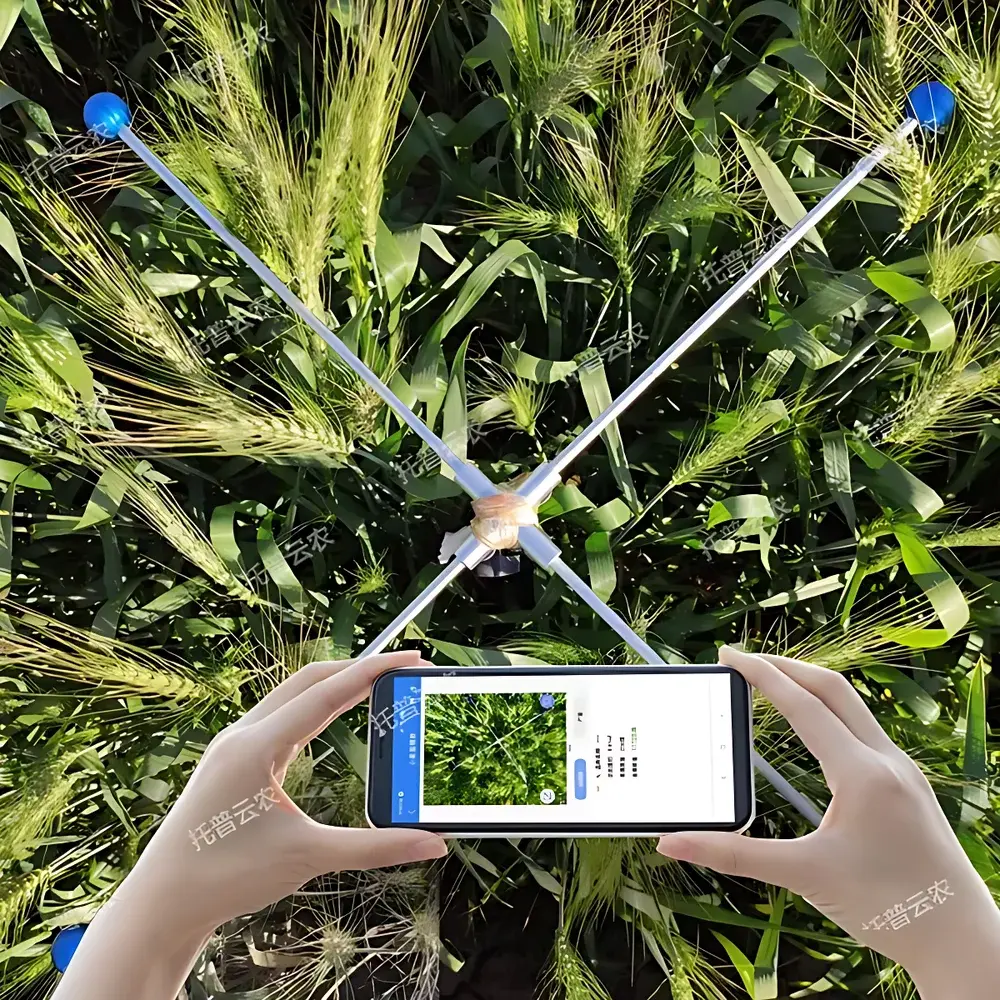
Top Cloud-agri TPMS-1 Wheat Panicle Counting System
| Brand | Top Cloud-agri |
|---|---|
| Origin | Zhejiang, China |
| Manufacturer Type | Manufacturer |
| Region of Origin | Domestic (China) |
| Model | TPMS-1 |
| Pricing | Upon Request |
Overview
The Top Cloud-agri TPMS-1 Wheat Panicle Counting System is a field-deployable, image-based phenotyping instrument engineered for rapid, non-destructive quantification of wheat panicle density per mu (≈667 m²), theoretical yield estimation, seed count, and thousand-kernel weight (TKW) derivation. It operates on the principle of computer vision–driven morphological segmentation and deep learning–enhanced object detection, trained specifically on diverse wheat cultivars across varying growth stages, planting densities, and lighting conditions. Designed for in situ deployment during the grain-filling to late-milk stage—when panicles are fully emerged but before lodging or shattering—the system delivers field-level phenotypic resolution aligned with quantitative trait locus (QTL) mapping, breeding program throughput requirements, and agronomic trial monitoring. Its architecture integrates hardware-standardized calibration references with software-embedded geometric normalization, enabling cross-device reproducibility without reliance on fixed-mount imaging rigs or controlled-environment chambers.
Key Features
- Two calibrated reference geometries: Cross-shaped calibrator (0.25 m² effective area, height-adjustable 750–1600 mm) and square calibrator (0.5 m², 707 × 707 mm) — enabling dual-method validation and density-adaptive deployment for sparse vs. dense stands.
- Augmented Reality (AR)-assisted acquisition: Integrated AR glasses + Bluetooth selfie stick workflow supports real-time framing guidance, horizon alignment, and optimal vertical perspective—critical for tall-statured varieties where occlusion and parallax limit conventional handheld capture.
- Batch processing capability: Simultaneous analysis of up to 48 geotagged RGB images; results include per-image counts, mean panicle density per mu, standard deviation, and coefficient of variation — all computed with pixel-level spatial normalization.
- Auto-perspective correction: Proprietary lens distortion compensation and vanishing-point estimation correct for off-axis tilt and variable focal lengths across Android smartphones (no proprietary camera required).
- Interactive manual refinement: Touch-enabled pixel-level editing allows operators to add, delete, or merge detected panicles — ensuring traceable, auditable final counts compliant with GLP-aligned data integrity standards.
- Integrated TKW calculation: Input of sample mass (g) and automatically counted grain number yields thousand-kernel weight via ISO 5209-compliant arithmetic, with uncertainty propagation documented in export logs.
Sample Compatibility & Compliance
The TPMS-1 is validated for Triticum aestivum L. across winter and spring wheat ecotypes under field conditions typical of North China Plain, Yangtze River Basin, and Loess Plateau agroecozones. It accommodates canopy heights from 60 cm to 120 cm and row spacings from 15 cm to 30 cm. Calibration protocols conform to ASTM E2918–22 (Standard Practice for Image-Based Plant Phenotyping) and align with FAO CropWatch protocol thresholds for panicle visibility scoring. All image metadata (GPS, timestamp, device model, exposure settings) is embedded and preserved in EXIF headers, supporting traceability under ISO/IEC 17025 and national agricultural data governance frameworks.
Software & Data Management
The Android application (v3.2+) supports offline operation with on-device inference acceleration via TensorFlow Lite. PC desktop software (Windows 10/11) enables batch import, spectral noise filtering, and region-of-interest (ROI) masking for edge-case scenarios (e.g., partial lodging, overlapping tillers). All processed datasets generate audit-ready Excel (.xlsx) exports containing raw counts, confidence scores, calibration parameters, operator ID, and revision timestamps. Data synchronization to Top Cloud-agri’s secure cloud platform (TLS 1.3 encrypted) permits role-based access control, versioned backups, and API-driven integration with LIMS or breeding management systems (BMS). Audit trails comply with FDA 21 CFR Part 11 requirements for electronic records and signatures.
Applications
- High-throughput phenotyping in national wheat breeding programs for yield component trait dissection.
- Field-scale validation of QTLs associated with panicle architecture and fertility stability.
- On-farm advisory services quantifying yield potential pre-harvest for precision input recommendations.
- Academic research in plant developmental biology, source-sink relationships, and environmental plasticity modeling.
- Seed certification and variety registration trials requiring standardized, repeatable panicle density metrics.
FAQ
What growth stage is optimal for data collection?
Data acquisition is recommended between mid-grain filling and early dough stage (Zadoks scale GS 73–83), when panicles are fully exserted, minimally obscured by flag leaves, and before senescence-induced drooping.
Does the system require internet connectivity during field measurement?
No — image capture, on-device AI inference, and local storage operate entirely offline. Cloud sync and report generation occur post-fieldwork.
Can the TPMS-1 be used for other small-grain cereals?
While trained and validated exclusively on wheat, preliminary transfer learning tests show >85% detection accuracy on barley (Hordeum vulgare) under similar canopy architectures; formal validation for oats or rye is pending.
How is measurement uncertainty reported?
Each analysis output includes a ±5% relative error band derived from inter-calibrator consistency checks, intra-image repeatability testing (n=120 fields), and cross-device reproducibility studies across 17 Android models.
Is raw image data retained after analysis?
Yes — original JPEGs, annotated overlays, and metadata logs are stored locally until manually purged, satisfying FAO-recommended data retention policies for agricultural R&D.



