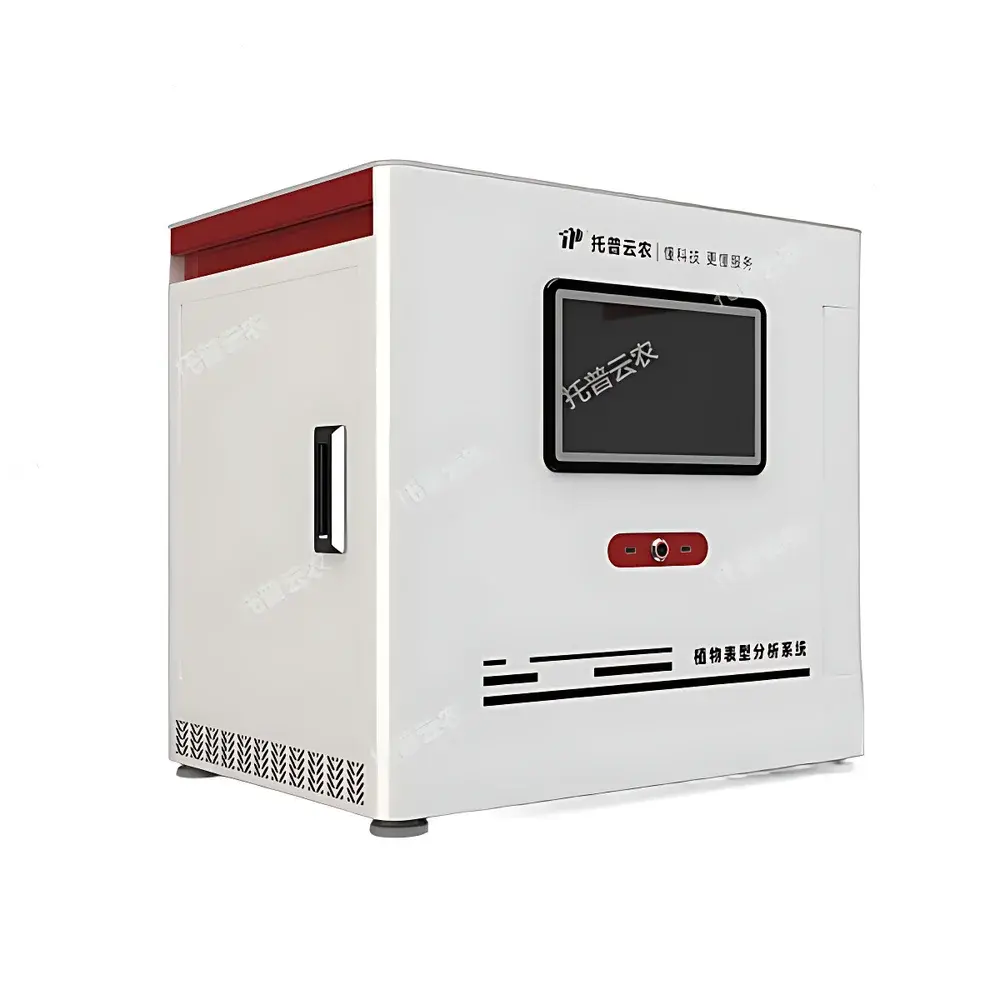
Top Cloud-agri TPN-Pheno-ZM1 In Situ Seed Germination and Root Phenotyping System
| Brand | Top Cloud-agri |
|---|---|
| Origin | Zhejiang, China |
| Manufacturer Type | Direct Manufacturer |
| Region of Origin | Domestic (China) |
| Model | TPN-Pheno-ZM1 |
| Imaging Sensor | 30 MP (configurable resolutions: 6960×4640, 4800×3200, or 3472×2320) |
| Pixel Size | 14.8 µm |
| Camera Enclosure Dimensions | 800 × 300 × 400 mm |
| Power Supply | AC 220 V |
| Power Consumption | 50 W |
| Weight | 10 kg |
| Operating Temperature | −10 °C to 60 °C |
| Relative Humidity | 30–80% RH (non-condensing) |
| Throughput | 1000 seeds per 2 hours |
| Data Transmission | Secure encrypted protocol |
| Software Platform | Windows-based proprietary phenotyping suite with remote server synchronization |
Overview
The Top Cloud-agri TPN-Pheno-ZM1 In Situ Seed Germination and Root Phenotyping System is a non-destructive, time-resolved imaging platform engineered for high-resolution morphological and dynamic phenotypic quantification during early seedling establishment. It operates on the principle of automated visible-light macro-imaging combined with calibrated geometric and intensity-based image segmentation algorithms to extract quantitative root and shoot traits directly from germinating seeds under controlled environmental conditions. Unlike destructive sampling or manual measurement approaches, the system enables longitudinal tracking of individual seedlings across multiple developmental stages—from imbibition through radicle emergence, coleoptile extension, and primary root elongation—without physical intervention. Its design adheres to standardized germination assay protocols defined by ISTA (International Seed Testing Association) and supports alignment with OECD and FAO guidelines for seed quality assessment and varietal evaluation.
Key Features
- Integrated hardware-software architecture: Combines a high-sensitivity 30-megapixel industrial camera module with embedded illumination control, motorized stage positioning (optional), and real-time image acquisition triggered by user-defined time intervals (e.g., every 30 min over 120 h).
- Multi-trait phenotypic output: Quantifies both static and kinetic parameters including germination percentage, germination energy (germination rate at peak velocity), number of seminal roots, maximum primary root length, total root length, root angle distribution (relative to gravity vector), projected root surface area, volumetric root estimate (via grayscale thresholding and pixel volume modeling), coleoptile length, shoot-to-root length ratio, and growth velocity profiles derived from first-order numerical differentiation of time-series length data.
- Calibration-ready optical path: Includes built-in reference scale targets and optional stage-mounted calibration plates compliant with ISO/IEC 17025 traceability requirements for dimensional metrology in biological imaging.
- Secure data pipeline: Implements TLS 1.2–encrypted transmission between acquisition station and centralized server; local storage uses AES-256 encryption; audit logs record all user actions, parameter modifications, and software updates in accordance with GLP-compliant documentation practices.
- Extensible software framework: The Windows-native application supports API access for integration with LIMS (Laboratory Information Management Systems) and third-party statistical platforms (e.g., R, Python via RESTful endpoints); custom algorithm modules can be deployed without recompilation using plugin architecture.
Sample Compatibility & Compliance
The TPN-Pheno-ZM1 accommodates standard germination substrates—including filter paper, agar plates, rolled towels (ISTA Method 5), and hydroponic mesh trays—within its modular sample chamber. It supports monocot (e.g., rice, wheat, maize) and dicot (e.g., Arabidopsis, soybean, tomato) species with seed diameters ranging from 0.5 mm to 12 mm. All imaging protocols are compatible with OECD Test Guideline 208 (Terrestrial Plant Toxicity) and ASTM D5664–22 (Standard Guide for Evaluating Seedling Vigor). System validation reports include repeatability (CV 0.98), meeting criteria outlined in ISO 5725-2 for precision of measurement methods.
Software & Data Management
The proprietary Phenolink™ v4.x software provides synchronized multi-channel image acquisition, batch processing pipelines, and trait-specific segmentation masks generated via supervised U-Net convolutional neural networks trained on annotated datasets of >12,000 manually validated seedling images. Raw TIFF sequences and processed CSV exports include timestamps, environmental metadata (ambient temperature/humidity logged via integrated sensors), and version-stamped analysis parameters. Data archives conform to MIAPPE (Minimum Information About a Plant Phenotyping Experiment) v1.1 specifications and support FAIR (Findable, Accessible, Interoperable, Reusable) principles. Server-side deployment options include on-premise NAS integration or cloud-hosted instances compliant with GDPR and HIPAA-compliant data handling frameworks.
Applications
This system serves as a core instrumentation platform for academic and industrial plant science laboratories engaged in quantitative genetics, QTL mapping of germination-related traits, abiotic stress screening (drought, salinity, heavy metal exposure), hormonal response profiling (e.g., ABA, GA3 dose–response curves), seed priming efficacy assessment, and pre-breeding germplasm evaluation. It has been deployed in collaborative projects aligned with CGIAR’s Excellence in Breeding Platform and national crop improvement programs requiring high-throughput, standardized phenotyping infrastructure meeting GCP (Global Crop Protection) benchmarking standards.
FAQ
Does the system require darkroom conditions or specialized lighting fixtures?
No—integrated LED illumination ensures consistent spectral output (CCT 5500 K, CRI > 90) and uniform irradiance (±5% across field of view); ambient light rejection is achieved via mechanical shutter synchronization and temporal noise filtering.
Can root architecture metrics be exported in formats compatible with WinRHIZO or EZ-Rhizo?
Yes—root skeletonization outputs are provided in SWC (Simple Worm-like Contour) format and segmented binary TIFF stacks, fully interoperable with established root analysis toolchains.
Is remote monitoring supported for long-duration experiments?
Yes—web-based dashboard access allows real-time status checks, live preview streaming (H.265 encoded), and push notifications for event-triggered anomalies (e.g., stalled germination, condensation detection).
What level of technical support and software maintenance is included?
All units ship with 3-year comprehensive service agreement covering firmware updates, algorithm refinements, remote diagnostics, and annual on-site calibration verification per ISO/IEC 17025 Annex A.3 requirements.
Related Products