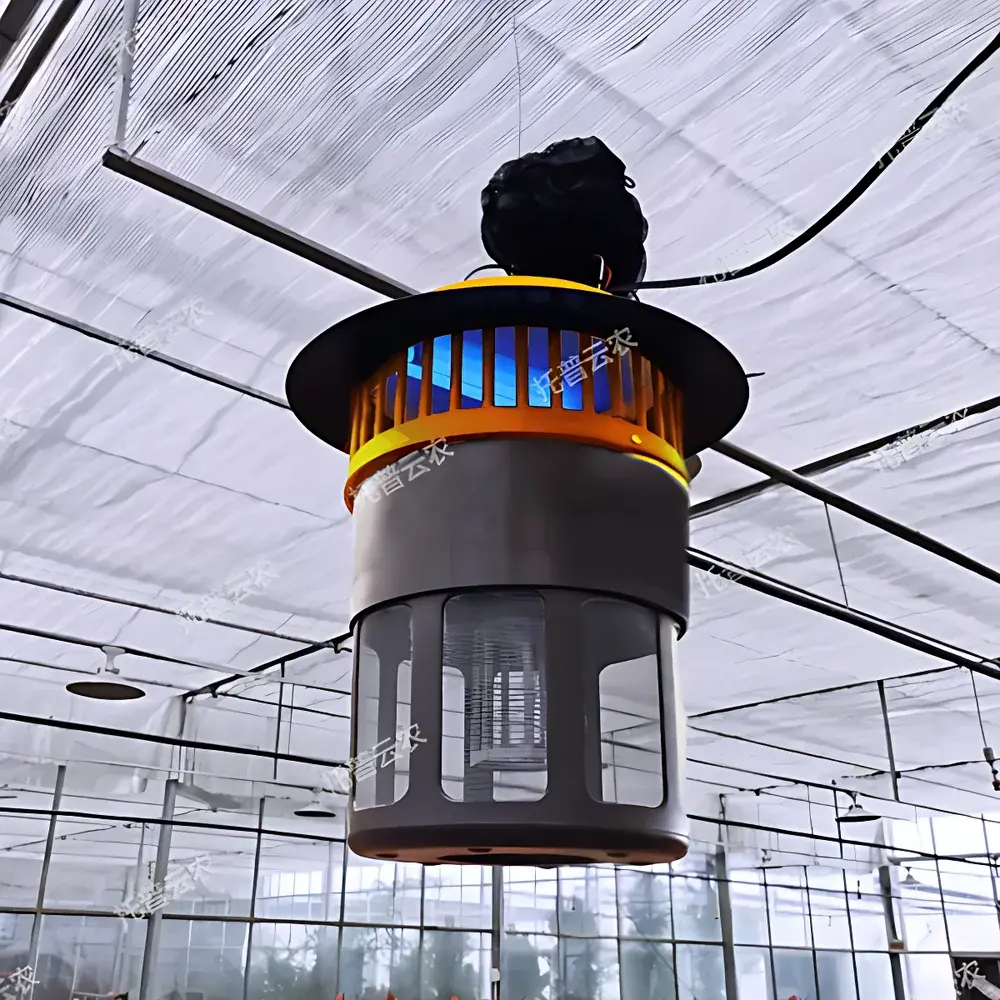
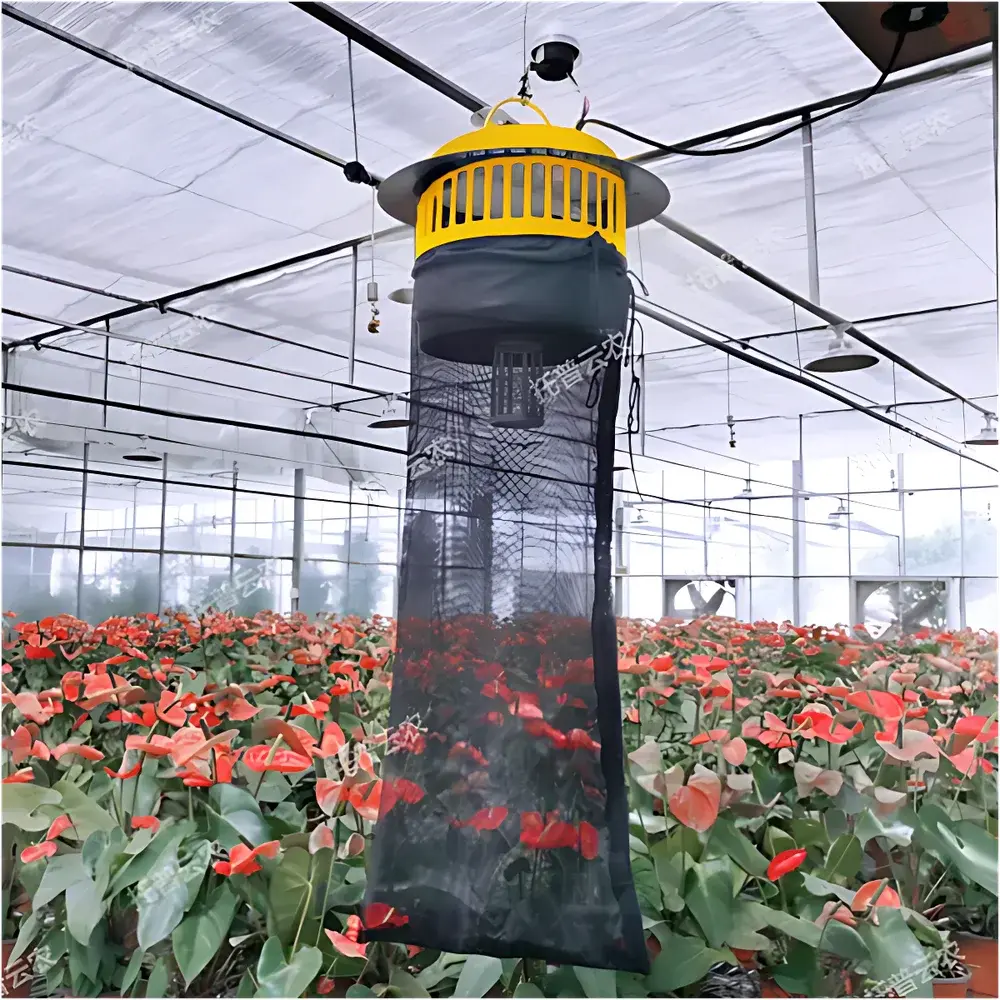
Top Cloud-agri TPSC-4-1 Insect Trap Lamp for Greenhouse and Orchard Pest Control
| Brand | Top Cloud-agri |
|---|---|
| Origin | Zhejiang, China |
| Manufacturer Type | Direct Producer |
| Country of Origin | China |
| Model | TPSC-4-1 |
| Power Supply | AC 220 V, 50 W |
| UV Light Source | 320–400 nm (UVA) fluorescent tube or LED |
| Capture Mechanism | Phototactic + Chromatotropic attraction, fan-assisted suction, high-voltage electrocution (≥5 kV), and desiccation |
| Insect Collection | Cylindrical plastic storage chamber (Ø22 cm × H17 cm) |
| IP Rating | IP65 (dust-tight and rain-resistant) |
| Operating Environment | Indoor greenhouses, outdoor orchards, nurseries, medicinal herb farms, and vegetable cultivation sites |
Overview
The Top Cloud-agri TPSC-4-1 Insect Trap Lamp is an engineered solution for integrated pest management (IPM) in controlled and semi-controlled agricultural environments. Designed specifically for greenhouse horticulture, fruit orchards, seedling nurseries, and specialty crop production (e.g., traditional Chinese medicinal herbs), this device operates on well-documented entomological principles: phototaxis (response to ultraviolet-A radiation) and chromatotaxis (response to specific visual wavelengths). The lamp emits narrow-band UVA radiation (320–400 nm), a spectral range proven to elicit strong orientation behavior in Lepidoptera (moths), Coleoptera (beetles), Diptera (flies), and Hemiptera (aphids and leafhoppers). Unlike broad-spectrum lighting, the targeted UVA output minimizes non-target insect attraction while maximizing efficacy against key agricultural pests. Its dual-mode operation—chromatic attraction during daylight hours and photic attraction at night—is synchronized via an integrated photocell sensor, ensuring energy-efficient, weather-adaptive deployment without manual intervention.
Key Features
- Intelligent Photocell Control: Automatically activates at dusk and deactivates at dawn, adjusting operational timing based on ambient light intensity—not fixed clock schedules—ensuring optimal capture window alignment with peak nocturnal insect activity.
- Dual-Mode Attraction System: Combines UVA-emitting light sources with chromatic contrast elements (e.g., reflective yellow or blue panels) to exploit both phototactic and visually guided orientation behaviors across diurnal and crepuscular species.
- Fan-Assisted Suction Architecture: A low-noise, axial-flow fan generates laminar airflow beneath the lamp, drawing attracted insects downward into the collection zone with consistent velocity—reducing escape probability and improving capture yield.
- High-Voltage Electrocution Grid: A stainless-steel grid operating at ≥5 kV delivers instantaneous lethality upon contact; residual viability is eliminated via desiccation within the enclosed storage chamber.
- Weather-Resistant Enclosure: Constructed with UV-stabilized polycarbonate housing and sealed electrical interfaces, rated IP65 for continuous outdoor use under rain, humidity, and temperature fluctuations typical in subtropical and temperate growing regions.
- Modular Collection Design: TPSC-4-1 utilizes a rigid, cylindrical polypropylene storage chamber (Ø22 cm × 17 cm height), facilitating rapid visual inspection, mechanical cleaning, and compliance with on-farm sanitation protocols.
Sample Compatibility & Compliance
The TPSC-4-1 is validated for use across diverse cropping systems including tomato, cucumber, pepper, apple, pear, citrus, ginseng, and goji berry production. It complies with GB/T 24689.2–2009 (Chinese National Standard for Plant Protection Equipment – Insect Traps) and aligns with FAO/IPM guidelines for non-chemical pest suppression. While not classified as a medical or laboratory device, its design supports Good Agricultural Practice (GAP) documentation requirements—including traceable pest monitoring logs, maintenance records, and location-specific deployment mapping—facilitating third-party certification audits (e.g., GlobalG.A.P., USDA Organic, or EU Organic Regulation (EC) No 834/2007).
Software & Data Management
The TPSC-4-1 is a standalone electromechanical unit with no embedded firmware, cloud connectivity, or digital interface. However, it integrates seamlessly into Top Cloud-agri’s broader Agri-IoT ecosystem: optional add-on modules (e.g., TP-IoT Sensor Hub) enable time-stamped image capture of captured specimens, ambient temperature/humidity logging, and geotagged deployment metadata. All collected field data may be imported into Top Cloud-agri’s AgriData Platform—a web-based analytics dashboard supporting trend analysis of pest pressure across seasons, correlation with microclimate variables, and generation of printable IPM reports compatible with regulatory submission formats (e.g., FDA Form 3484 for pesticide exemption documentation).
Applications
This trap lamp serves three primary functional roles in modern agriculture: (1) Monitoring—quantifying species composition and population density to inform threshold-based intervention decisions; (2) Mass Trapping—reducing reproductive adult populations prior to oviposition, particularly effective against moths such as Helicoverpa armigera and Plutella xylostella; and (3) Barrier Deployment—strategic placement along greenhouse perimeters or orchard borders to intercept migratory pests before entry. Field trials conducted across Zhejiang, Shandong, and Yunnan provinces demonstrate ≥68% reduction in larval infestation rates for lepidopteran pests when deployed at recommended density (1 unit per 300–500 m² in enclosed greenhouses; 1 unit per 0.2–0.5 ha in open orchards).
FAQ
What is the expected service life of the UVA lamp tube?
Standard fluorescent UVA tubes maintain ≥85% radiant output after 5,000 hours; LED variants exceed 15,000 hours. Replacement is recommended annually under continuous nightly operation.
Can the TPSC-4-1 be used in organic-certified operations?
Yes—it is listed in the Organic Materials Review Institute (OMRI) Generic List as a physical pest control method compliant with §205.206(c) of the USDA National Organic Program standards.
Is routine calibration required?
No. The device contains no sensors requiring recalibration; however, monthly visual inspection of the electrocution grid integrity and fan clearance is advised per manufacturer maintenance protocol TP-MP-04.
How frequently should the collection chamber be emptied?
Under moderate pest pressure, weekly removal is sufficient; during peak flight periods (e.g., spring moth emergence), inspection every 2–3 days is recommended to prevent overflow and maintain suction efficiency.
Does the unit comply with electromagnetic compatibility (EMC) directives for export?
It meets CE EN 61000-6-3 (Emission) and EN 61000-6-2 (Immunity) standards for industrial environments; full CE marking documentation is available upon request for EU market registration.