
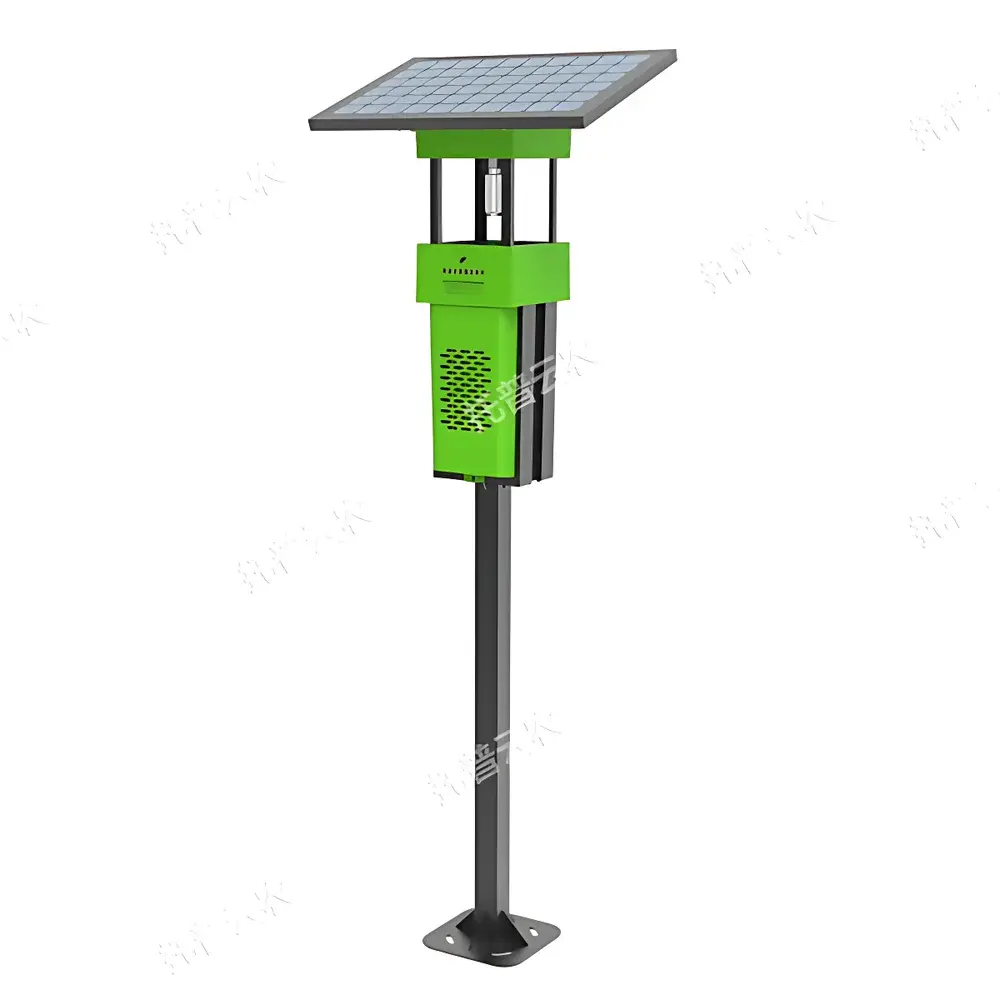
Top Cloud-agri TPSC-5ZP Wind-Suction Solar-Powered Insect Trap
| Brand | Top Cloud-agri |
|---|---|
| Origin | Zhejiang, China |
| Manufacturer Type | Direct Manufacturer |
| Country of Origin | China |
| Model | TPSC-5ZP (General-Purpose) |
| Power Supply | 12 VDC LiFePO₄ battery |
| Rated Power Consumption | <20 W |
| Solar Panel | 40 W monocrystalline |
| UV LED Lamp | ≤5 W, wavelength customizable (typically 365 nm peak) |
| Effective Coverage | 15–50 mu per unit (≈1–3.3 ha), field-dependent |
| Control Radius | ≥120 m in open farmland, ≥80 m in forested areas |
| IP Rating | IP65 |
| Operating Mode | Photocell-controlled + programmable timer (on/off scheduling, sleep mode with active communication) |
| Insect Collection | Removable mesh collection bag, high-capacity design |
| Structural Design | Modular two-part assembly (lamp body + mounting pole), lightweight (<15 kg) |
Overview
The Top Cloud-agri TPSC-5ZP Wind-Suction Solar-Powered Insect Trap is an autonomous, off-grid pest monitoring and suppression device engineered for sustainable integrated pest management (IPM) in agricultural, silvicultural, horticultural, pastoral, and municipal sanitation applications. Unlike traditional electrocution- or glue-based traps, the TPSC-5ZP employs a phototactic attraction mechanism combined with active negative-pressure aspiration. It emits targeted ultraviolet-A (UVA) radiation—centered at 365 nm—to exploit the innate positive phototaxis of nocturnal flying insects, including Lepidoptera, Coleoptera, Diptera, and Hemiptera. Once attracted to the light source, insects are drawn into the lamp housing via a precisely calibrated axial fan generating consistent airflow and sub-atmospheric pressure within the internal chamber. This wind-suction principle ensures rapid immobilization and retention without physical impact damage, preserving specimen integrity for subsequent morphological identification or DNA barcoding—critical for regulatory reporting and resistance monitoring.
Key Features
- Self-sustaining solar operation: Integrated 40 W monocrystalline photovoltaic panel charges a maintenance-free 12 V LiFePO₄ battery, enabling continuous 24/7 functionality under variable irradiance conditions.
- Intelligent dual-mode control: Photocell-based dusk-to-dawn activation complements programmable time-scheduled operation, supporting configurable on/off windows and low-power sleep mode with persistent LoRaWAN or NB-IoT telemetry (in networked variants).
- Robust environmental resilience: IP65-rated enclosure ensures operational reliability during rainfall, high humidity, dust exposure, and temperature fluctuations from −20 °C to +60 °C.
- Optimized insect capture architecture: Large-volume removable mesh collection bag minimizes servicing frequency; modular lamp body and pole assembly supports rapid deployment and transport across heterogeneous terrain.
- Scalable coverage performance: Validated field data indicate effective pest suppression radii of ≥120 m in open-field cropping systems and ≥80 m in semi-shaded orchard or forest understory environments—subject to local microclimate, vegetation density, and target species flight behavior.
Sample Compatibility & Compliance
The TPSC-5ZP is designed for non-selective, broad-spectrum capture of flying arthropods attracted to UVA wavelengths. Its mechanical capture method avoids chemical residues, making it compliant with organic certification standards (e.g., USDA NOP, EU Regulation (EC) No 834/2007) and suitable for use in proximity to harvest zones without pre-harvest intervals. The device conforms to IEC 60529 (IP65), GB/T 26572-2011 (Chinese national standard for solar insect traps), and aligns with FAO/IPM guidelines for ecologically sound monitoring infrastructure. All electrical components meet CE Low Voltage Directive (2014/35/EU) and RoHS 2 (2011/65/EU) requirements.
Software & Data Management
While the TPSC-5ZP standalone variant operates autonomously without connectivity, its firmware architecture supports optional integration into centralized agronomic IoT platforms. When deployed as part of a networked TPSC-8ZP ecosystem, trap status (battery voltage, solar charge efficiency, fan runtime, ambient temperature/humidity) and event logs are transmitted via secure MQTT protocol with TLS 1.2 encryption. Data ingestion complies with ISO/IEC 17025 traceability principles and supports audit-ready export for GLP-aligned pest surveillance records. Firmware updates are delivered over-the-air (OTA) with cryptographic signature verification.
Applications
- Agricultural IPM programs: Real-time population trending for key pests such as rice stem borers (Chilo suppressalis), cotton bollworms (Helicoverpa armigera), and corn earworms (Spodoptera frugiperda).
- Forestry health monitoring: Early detection of invasive species including emerald ash borer (Agrilus planipennis) and spotted lanternfly (Lycorma delicatula).
- Urban vector surveillance: Municipal mosquito (Aedes albopictus, Culex pipiens) and moth monitoring in green belts and peri-urban buffer zones.
- Research-grade entomological sampling: Standardized, non-lethal (non-electrocution) collection for biodiversity assessment, phenology studies, and pesticide resistance bioassay preparation.
- Organic farm certification documentation: Provides verifiable, chemical-free pest pressure metrics required by certifying bodies.
FAQ
Does the TPSC-5ZP require grid electricity or external wiring?
No. It operates exclusively on solar-charged battery power and requires no AC connection or trenching.
Can the UV wavelength be adjusted for specific pest spectra?
Yes. The LED module supports custom spectral output configurations (e.g., 350–400 nm range) upon request to optimize attraction for taxon-specific monitoring objectives.
How often must the collection bag be emptied?
Under typical summer field conditions in high-pest-pressure regions, servicing intervals average 5–7 days; capacity allows up to 14 days in low-density environments.
Is the device compatible with third-party GIS or farm management software?
Yes—when equipped with optional telemetry hardware, geotagged trap metadata integrates via RESTful API with platforms including FarmLogs, Granular, and open-source AgriStack instances.
What maintenance procedures are recommended for long-term reliability?
Biannual inspection of solar panel surface cleanliness, fan blade integrity, and battery state-of-health (SOH) via diagnostic mode; no lubrication or calibration required.




