
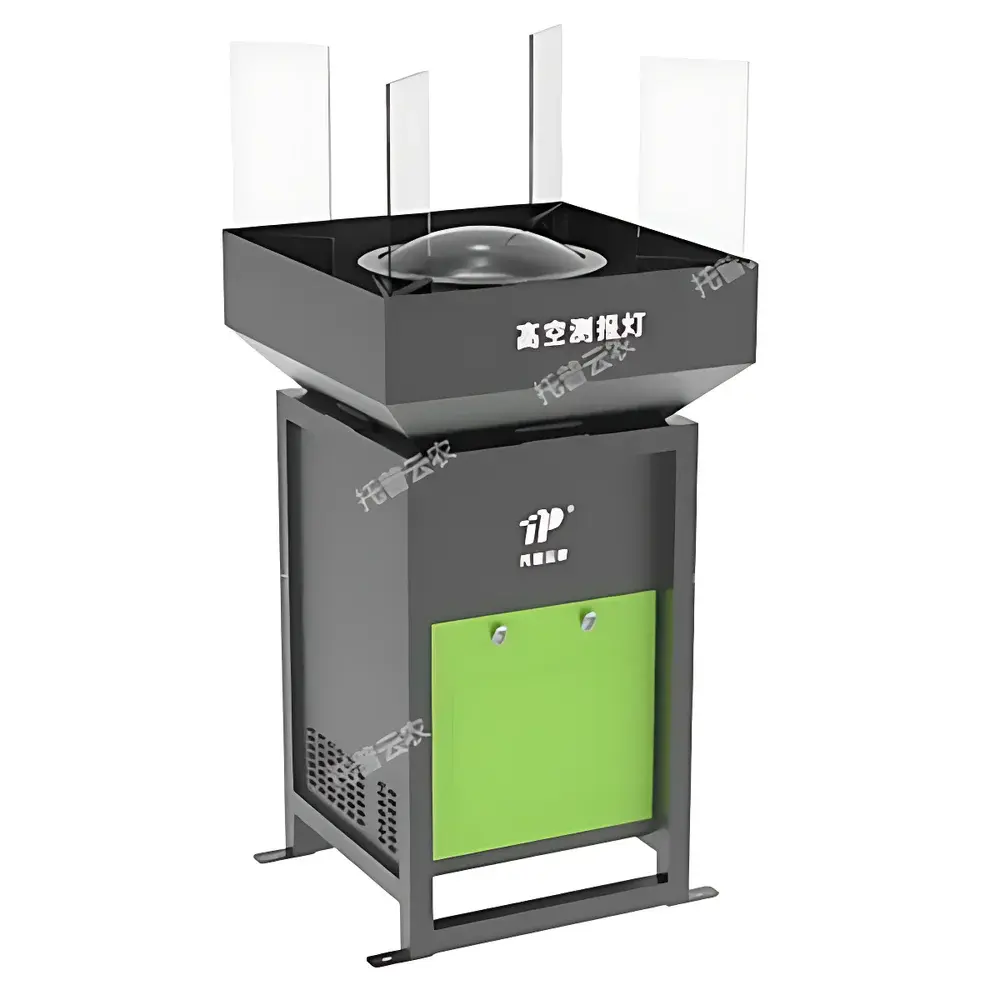
Top Cloud-agri TPSC-II-G3.0 High-Altitude Pest Monitoring Trap
| Brand | Top Cloud-agri |
|---|---|
| Origin | Zhejiang, China |
| Manufacturer Type | Direct Manufacturer |
| Country of Origin | China |
| Model | TPSC-II-G3.0 |
| Instrument Category | Pest Surveillance System |
| Light Source | 1000W Metal Halide Lamp |
| Operating Voltage | AC 220V, ≤1500W Power Consumption |
| Temperature Control Range | 120±5°C (Adjustable up to 150±5°C) |
| Insect Mortality Rate | ≥90% |
| Insect Integrity Rate | ≥85% |
| Effective Illumination Height | ≥500 m |
| Illumination Radius at Apex | ≥450 m |
| Spectral Peak | 500–600 nm |
| Environmental Operating Range | 0–60°C, RH ≤95% |
| Storage Temperature | -20–70°C |
| Insulation Resistance | ≥2.5 MΩ |
| Connectivity | Tri-band LTE (China Unicom & China Mobile Recommended) |
| Drainage System | Integrated Rainwater Separation Structure |
| Control Modes | Photocell Mode, Time-Scheduled Mode, Sleep Mode, Manual Override |
Overview
The Top Cloud-agri TPSC-II-G3.0 High-Altitude Pest Monitoring Trap is an automated, vertically oriented entomological surveillance instrument engineered for large-scale, long-term monitoring of migratory nocturnal pests—particularly Spodoptera frugiperda (fall armyworm)—at altitudes exceeding 500 meters. Unlike conventional ground-level traps, this system leverages upward-directed phototactic stimulation using a high-intensity, narrow-spectrum metal halide lamp (peak emission 500–600 nm), generating a conical light column optimized for vertical insect interception in open-field and border-zone agricultural landscapes. Its operational principle integrates phototaxis-driven attraction, thermal lethality via controlled far-infrared heating (120±5°C), and mechanical separation of rainwater from collected specimens—enabling continuous, unattended operation under variable climatic conditions including rainfall and high humidity. Designed for integration into national or regional pest early-warning networks, the TPSC-II-G3.0 supports real-time telemetry, geospatial mapping, and compliance-ready data logging.
Key Features
- Vertical illumination architecture with 1000W metal halide lamp emitting a defined conical beam (≥500 m height, ≥450 m apex radius) to intercept high-altitude insect migration corridors.
- Far-infrared insect processing chamber with programmable temperature control (120±5°C standard; adjustable up to 150±5°C), achieving ≥90% mortality and ≥85% specimen integrity for morphological and molecular identification.
- Automated multi-bag collection system with motorized carousel and moisture-resistant receptacles, enabling time-resolved sampling across extended deployment periods.
- Intelligent dual-mode environmental adaptation: photocell-based dusk-to-dawn activation with hysteresis thresholding (immune to transient ambient light fluctuations) and user-configurable time-scheduled operation aligned with target pest circadian behavior.
- Integrated rainwater drainage and separation structure ensuring operational continuity during precipitation events—no internal water accumulation observed under sustained rainfall (IPX5-rated enclosure).
- Tri-band LTE module supporting China Unicom and China Mobile networks for persistent remote connectivity; enables secure firmware updates, configuration push, and alarm notifications.
- Manual override capability for lamp and heating functions—highest priority control layer, independent of scheduled or ambient-light-triggered logic.
- Stainless steel structural frame with electrostatic powder coating, rated for outdoor exposure (UV resistance, corrosion protection, IK08 impact rating).
Sample Compatibility & Compliance
The TPSC-II-G3.0 is validated for capture and preservation of macro-moths, noctuid moths, and other phototactic Lepidoptera species exhibiting strong positive phototaxis in the 500–600 nm range. Specimen integrity supports downstream taxonomic analysis (morphological keys), DNA barcoding (COI gene amplification), and population genotyping. The device meets GB/T 24689.1–2009 (Chinese National Standard for Pest Monitoring Equipment), complies with electromagnetic compatibility requirements per GB 9254–2008, and incorporates electrical safety design aligned with IEC 61000-4 series. Data transmission protocols support audit-trail generation for GLP-aligned field surveillance programs, with timestamped event logs exportable in CSV/JSON format for integration into national pest information systems.
Software & Data Management
Remote management is enabled via a dedicated web portal and cross-platform mobile application (iOS/Android). Real-time status dashboard displays lamp status, heating chamber temperature, bag position index, signal strength, battery backup status (if equipped), and environmental sensor readings (optional ambient temperature/humidity add-on). GIS-enabled map view overlays trap locations with operational status icons, color-coded by uptime, last communication timestamp, or alert severity. All control actions, mode transitions, and environmental triggers are logged with ISO 8601 timestamps and device-specific UUIDs. Data exports include daily catch summaries, temporal heatmaps of activity onset/offset, and raw telemetry streams compatible with Python/Pandas or R-based entomological analytics pipelines.
Applications
- Regional-scale monitoring of Spodoptera frugiperda seasonal migration pathways across maize-growing belts in southern and central China.
- Border surveillance at ecological transition zones to detect incursion events of invasive lepidopteran species.
- Validation of atmospheric transport models by correlating trap catch data with wind trajectory analysis (HYSPLIT integration supported).
- Time-series analysis of pest phenology shifts under climate variability—supporting adaptive pest forecasting algorithms.
- Calibration reference for lower-cost passive traps and AI-powered image-based field sensors.
- Long-term ecological monitoring of nocturnal insect biodiversity in agroecosystems and adjacent natural habitats.
FAQ
What is the effective detection altitude of the TPSC-II-G3.0?
The lamp’s optical design generates a vertically oriented conical light column with verified insect interception capability up to 500 meters above ground level, as confirmed through synchronized drone-based flight-path validation studies.
How does the system handle rainfall without compromising specimen quality?
An integrated sloped drainage manifold separates rainwater from the collection chamber via gravity-fed channels and hydrophobic baffles—ensuring no standing water accumulates in specimen bags or heating zones.
Can the device operate independently of cloud infrastructure?
Yes. Local control remains fully functional via onboard keypad or IR remote; all core trapping, heating, and bag rotation sequences execute autonomously even during network outages.
Is temperature calibration traceable to national standards?
The embedded PT100 sensor is factory-calibrated against NIM (National Institute of Metrology, China) reference standards, with calibration certificate available upon request.
Does the system support integration with existing pest management platforms?
Yes. RESTful API endpoints and MQTT protocol support enable bidirectional integration with national pest information systems (e.g., China National Crop Pest Forecasting Platform) and third-party GIS or decision-support tools.







