
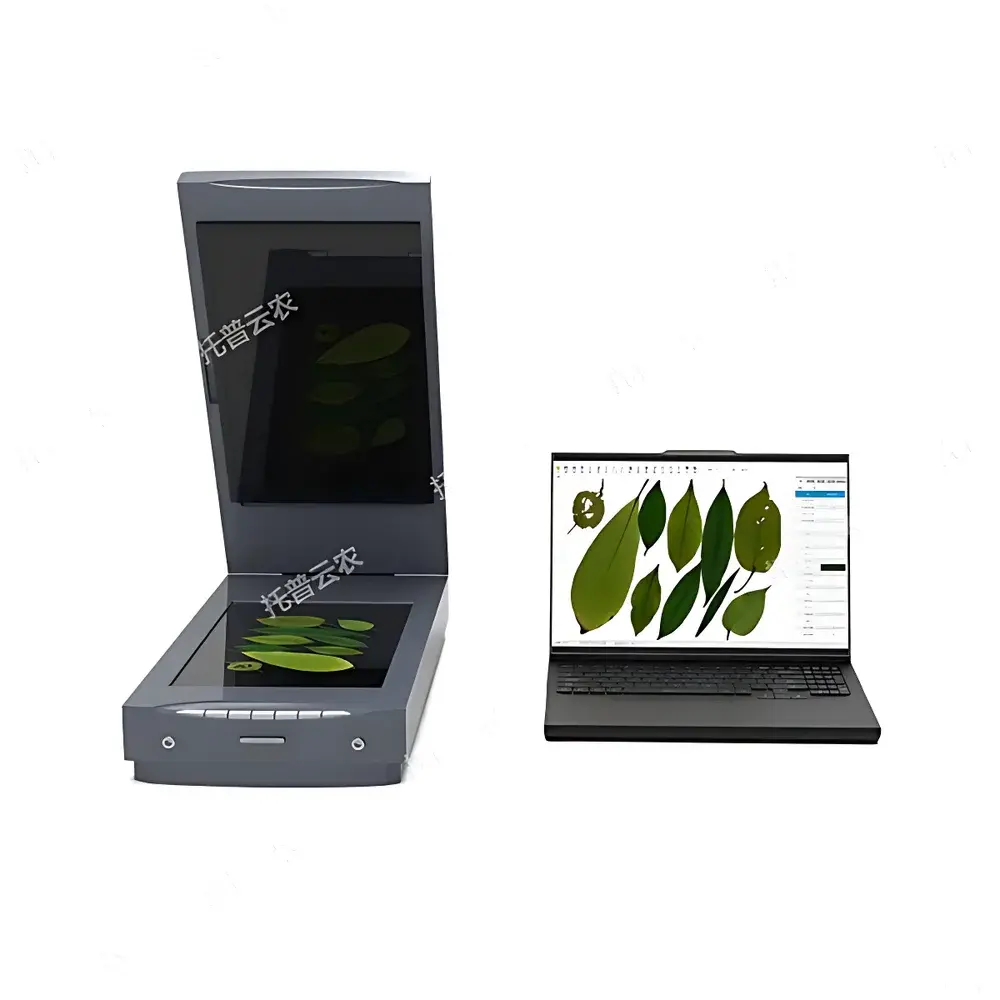
Top Cloud-agri TPSC-II-G5.0 Leaf Area Analyzer System with Machine Vision-Based Phenotypic Imaging
| Brand | Top Cloud-agri |
|---|---|
| Origin | Zhejiang, China |
| Manufacturer Type | OEM Manufacturer |
| Product Origin | Domestic (China) |
| Model | TPSC-II-G5.0 |
| Pricing | Upon Request |
| Leaf Length Range | 0–355 mm, Accuracy: ±1% |
| Leaf Width Range | 0–215 mm, Accuracy: ±1% |
| Aspect Ratio Accuracy | ±2% |
| Perimeter Accuracy | ±2% |
| Area Accuracy | ±2% |
| Shape Factor & Shape Coefficient Accuracy | ±2% |
| Tooth Count Accuracy | ±1% |
| Perforation Area & Perimeter Accuracy | ±2% |
| Lesion Area & Deficit Area Accuracy | ±2% |
| Scanner Optical Resolution | 4800 dpi |
Overview
The Top Cloud-agri TPSC-II-G5.0 Leaf Area Analyzer System is a high-precision, machine vision–driven phenotyping platform engineered for quantitative leaf morphometric analysis in plant physiology, agronomy, and ecological research. It operates on the principle of calibrated digital image acquisition followed by pixel-based geometric and chromatic segmentation, enabling non-destructive, reproducible measurement of structural and colorimetric leaf traits. Unlike manual or analog leaf area meters, this system integrates industrial-grade flatbed scanning with algorithmic image processing to deliver standardized, traceable metrics compliant with international plant phenotyping best practices. Its architecture supports both single-leaf and multi-leaf image analysis workflows, making it suitable for controlled-environment studies, field-collected sample screening, and longitudinal monitoring of leaf development, stress response, or disease progression.
Key Features
- Multi-parameter morphometric quantification: Measures ≥16 standardized leaf traits—including projected area, length, width, aspect ratio, perimeter, convex hull area, solidity (area concavity ratio), circularity, rectangularity, sphericity, serration area, perforation area, lesion area, petiole length, and chlorophyll-relative index—within a single automated workflow.
- High-throughput batch processing: Supports concurrent analysis of >100 scanned images per session; progress tracking and auto-save functionality ensure audit-ready data continuity.
- Adaptive segmentation and correction: Implements dual-mode petiole separation (auto-detection or user-defined ROI), interactive contour refinement, hole-filling for complete area estimation, and residual-leaf matching algorithms for severely fragmented specimens.
- Pathology-informed defect analytics: Enables semi-automated segmentation of necrotic lesions, herbivory damage, or fungal spots with quantifiable area, perimeter, and spatial distribution metrics—exportable as annotated overlays or tabular metadata.
- Standardized colorimetry: Integrates Royal Horticultural Society (RHS) Colour Charts, Pantone® Solid Coated Library, and user-configurable RGB/HSV/Lab color palettes for objective leaf hue, saturation, and brightness classification—correlatable with SPAD-equivalent chlorophyll proxies.
Sample Compatibility & Compliance
The TPSC-II-G5.0 accommodates fresh, pressed, or dried leaf samples up to A4 dimensions (210 × 297 mm), with optimal performance for dicotyledonous and monocotyledonous species exhibiting planar geometry. It complies with ISO 5725 (accuracy and precision of measurement methods), adheres to GLP-aligned data integrity principles, and generates timestamped, operator-logged analysis records suitable for internal quality assurance protocols. While not FDA 21 CFR Part 11–certified out-of-the-box, its encrypted software architecture (dynamic QR + hardware dongle licensing) and immutable result export (CSV/Excel with embedded metadata) support integration into regulated environments where audit trails are required.
Software & Data Management
The proprietary PC-based application features a modular GUI supporting ROI masking, manual distance/area annotation, customizable filtering thresholds (e.g., minimum detectable leaf length, serration height sensitivity), and hierarchical project organization. All outputs include raw image thumbnails, binary masks, measurement tables, and statistical summaries (mean, SD, CV%). Export formats include .xlsx (with formula-free values), .csv (UTF-8 encoded), and .pdf reports containing method parameters and calibration logs. Cloud synchronization is implemented via TLS-encrypted HTTPS API to Top Cloud-agri’s secure SaaS platform, enabling remote access through web browsers or dedicated mobile applications—without storing raw data on third-party infrastructure.
Applications
This system serves core use cases across academic, breeding, and regulatory domains: high-throughput varietal screening for leaf architecture QTL mapping; drought or nutrient-stress phenotyping via dynamic area loss tracking; post-inoculation assessment of biotic stress symptoms (e.g., rust, blight, mosaic virus); validation of spectral vegetation indices against ground-truth morphology; and standardization of herbarium digitization pipelines. Its precision and repeatability make it appropriate for inter-laboratory comparison studies referenced in publications aligned with Plant Phenomics (Oxford University Press) or Functional Plant Biology (CSIRO Publishing) reporting standards.
FAQ
What calibration standards does the system support?
The software includes built-in reference scale bar detection during scanning and supports user-defined calibration targets (e.g., metric rulers or certified calibration slides) for cross-device reproducibility.
Can the system analyze leaves with overlapping layers or translucency?
It requires fully flattened, non-overlapping specimens; translucent regions may require threshold adjustment or manual mask refinement—results should be validated against gravimetric or planimeter-based references for critical applications.
Is offline operation supported without cloud connectivity?
Yes—full local analysis, storage, and export functions operate independently; cloud sync is optional and configurable per user preference.
How is software licensing enforced?
A USB hardware dongle combined with time-limited dynamic QR authentication ensures authorized deployment only at registered institutional sites, preventing unauthorized duplication or transfer.
Are raw image and mask files retained after analysis?
By default, original TIFF/JPEG scans and corresponding 8-bit binary masks are preserved alongside results unless manually purged—enabling reprocessing with updated algorithms or parameter sets.




