
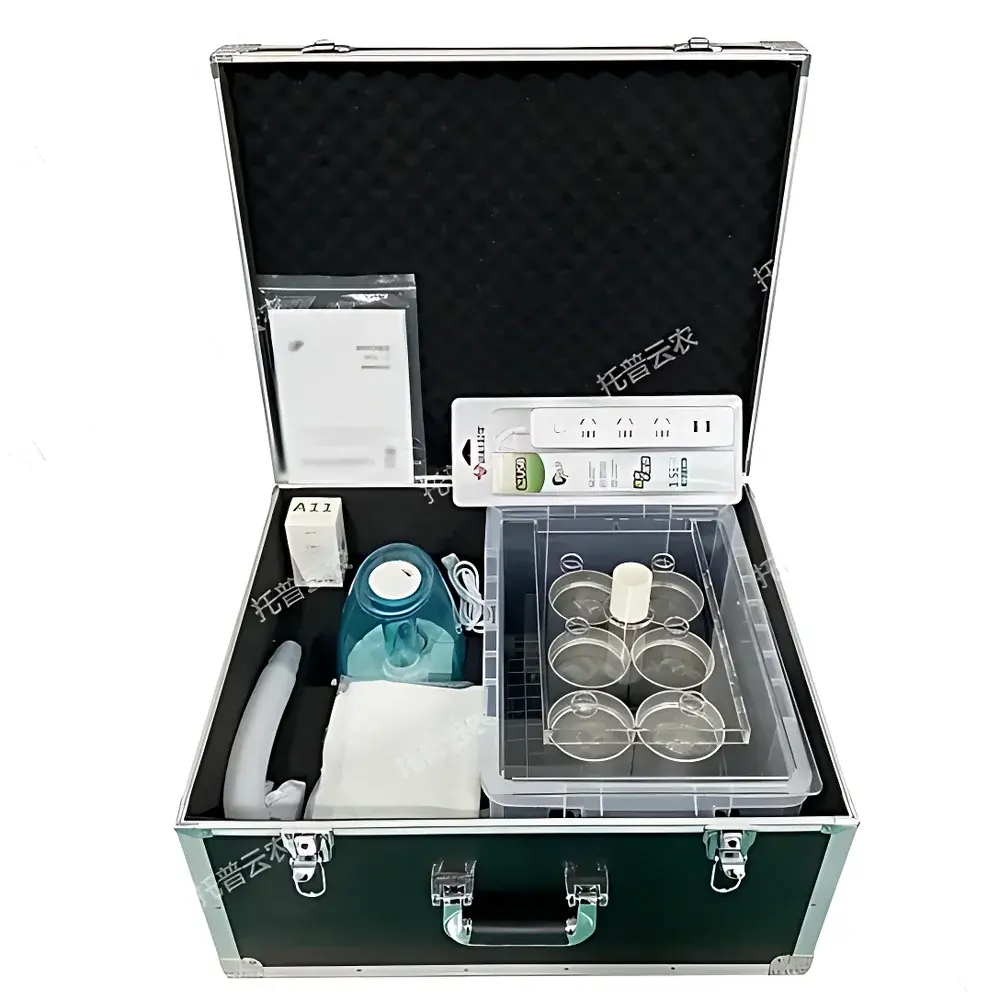
Top Cloud-agri TPXC-3A Nematode Extractor
| Brand | Top Cloud-agri |
|---|---|
| Origin | Zhejiang, China |
| Manufacturer Type | Direct Manufacturer |
| Country of Origin | China |
| Model | TPXC-3A |
| Price | USD 2,000 (approx.) |
Overview
The Top Cloud-agri TPXC-3A Nematode Extractor is a benchtop,雾-based (mist-elution) extraction system engineered for the efficient, non-destructive isolation of live plant-parasitic nematodes—particularly Bursaphelenchus xylophilus (pine wood nematode)—from woody tissue, root segments, and soil matrices. Unlike passive techniques such as tray or funnel extraction, the TPXC-3A employs controlled mist generation to exploit nematode hydrotaxis and surface film dependency: nematodes actively migrate along water films toward cooler, humidified zones, enabling their directional elution into collection vessels without mechanical shearing or thermal stress. This principle ensures high viability (>92% survival rate under standardized 48-h extraction protocols), making the instrument suitable for downstream live-culture establishment, pathogenicity assays, molecular diagnostics, and morphological identification.
Key Features
- Mist-elution architecture with six independent sample chambers, enabling parallel processing of up to six specimens (e.g., pine bark chips, root cores, or soil cores) per run.
- Integrated ultrasonic mist generator with adjustable output intensity and duty cycle, maintaining consistent humidity gradients across extraction funnels without condensation-induced sample saturation.
- Oxygen-rich mist environment sustains nematode metabolic activity during extraction—critical for preserving motility and membrane integrity in post-isolation microscopy or bioassays.
- Stainless-steel and food-grade PP construction ensures chemical resistance to common preservatives (e.g., formalin-free fixatives) and facilitates GLP-compliant cleaning validation.
- Low water consumption: average usage of ≤1.2 L per 48-h extraction cycle, minimizing operational cost and environmental footprint relative to Baermann or Cobb funnel methods.
- Ergonomic collection tray design with standardized 35-mm Petri dish compatibility—enabling direct transfer to compound microscopes or automated imaging platforms without centrifugation or filtration steps.
Sample Compatibility & Compliance
The TPXC-3A accommodates heterogeneous plant and soil matrices including but not limited to: pine stem sections (≥5 mm thickness), conifer root fragments, forest litter, mineral soils (sandy loam to clay loam), and composted organic substrates. Extraction efficiency has been validated per ISO 20286:2017 (soil nematode extraction) and aligns with FAO Plant Protection Bulletin No. 19 guidelines for quarantine-level nematode recovery. The device supports traceability requirements under national phytosanitary frameworks (e.g., China’s GB/T 29579–2013) and is routinely deployed in regional forest pest monitoring programs compliant with IUFRO Working Party 7.03.08 standards.
Software & Data Management
The TPXC-3A operates as a standalone hardware platform with no embedded firmware or proprietary software. All operational parameters—including mist duration, rest intervals, and total run time—are manually configured via front-panel rotary dials and LED indicators. This analog control architecture eliminates cybersecurity vulnerabilities, simplifies regulatory validation (e.g., FDA 21 CFR Part 11 exemption for non-electronic record systems), and ensures long-term serviceability in resource-constrained field laboratories. User logs (extraction date, sample ID, operator, matrix type) are maintained externally in laboratory notebooks or LIMS-integrated spreadsheets.
Applications
- Quarantine screening of imported timber and nursery stock for B. xylophilus detection in accordance with EPPO PM 7/24(3) diagnostic protocols.
- Ecological surveys of free-living and plant-parasitic nematode communities in forest soils and rhizospheres.
- Preparation of live nematode inocula for host resistance trials and nematicide efficacy testing (OECD Guideline 220).
- Supporting molecular workflows—including DNA barcoding (COI, ITS rDNA) and qPCR—where intact cuticles and viable specimens improve assay sensitivity.
- Teaching laboratories in plant pathology, forest entomology, and soil ecology curricula requiring reproducible, low-cost nematode isolation.
FAQ
What sample types are compatible with the TPXC-3A?
Root tissues from woody and herbaceous hosts, pine bark and wood chips, soil cores (up to 200 g per chamber), and leaf litter—provided samples are pre-sieved to ≤2 mm particle size.
Does the TPXC-3A require calibration or certification?
No routine calibration is required; performance verification is conducted annually using reference nematode-spiked soil (NIST SRM 2710a matrix) per internal SOP-NE-004.
Can the unit be used for extraction of other microfauna?
Yes—collembolans, enchytraeids, and tardigrades have been successfully recovered under modified mist-duration protocols, though species-specific optimization is recommended.
Is the device compliant with international phytosanitary regulations?
It meets technical specifications referenced in ISPM 31 (Guidelines for nematode diagnosis) and supports documentation requirements for NPPO audit trails.
What maintenance is required?
Daily rinsing of mist nozzles with deionized water; quarterly descaling with 5% citric acid solution; annual inspection of silicone gaskets for compression set.




