
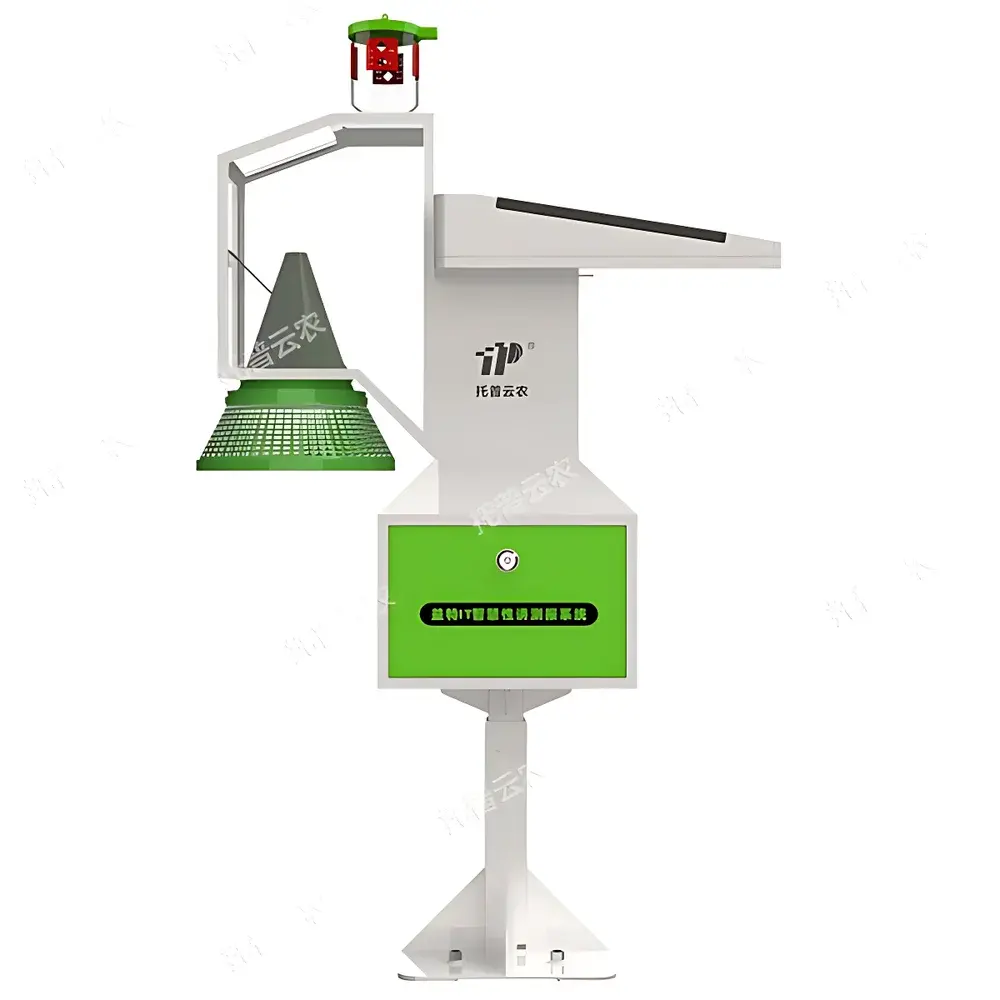
Top Cloud-agri TPXY-SA5.O Intelligent Pheromone Trapping & Monitoring System
| Brand | Top Cloud-agri |
|---|---|
| Origin | Zhejiang, China |
| Manufacturer | Yes |
| Country of Origin | China |
| Model | TPXY-SA5.O |
| Pricing | Available Upon Request |
Overview
The Top Cloud-agri TPXY-SA5.O Intelligent Pheromone Trapping & Monitoring System is an integrated IoT-enabled entomological surveillance platform engineered for precision pest monitoring in agricultural and forestry ecosystems. It operates on the principle of species-specific semiochemical attraction—primarily synthetic sex pheromones and food-based lures—combined with automated visual detection and digital data logging. Unlike conventional light-trap or manual trap surveys, this system eliminates observer bias and temporal sampling gaps by enabling continuous, unattended operation across remote field deployments. Its core architecture integrates environmental sensing (temperature, GPS), high-resolution imaging, edge-based AI inference, and cloud-synchronized data management to support evidence-based pest risk assessment, early warning generation, and IPM (Integrated Pest Management) decision-making in compliance with FAO-recommended monitoring protocols.
Key Features
- Modular trapping interface with three interchangeable trap modules optimized for distinct insect flight behaviors and morphological traits: noctuid-specific funnel traps, pyralid/moth-optimized wing-guided traps, and bucket-style traps for high-mobility defoliators.
- Dual lure compatibility—supporting both volatile pheromone dispensers and fermentative food attractants—to broaden target spectrum beyond strictly pheromone-responsive species.
- Three-stage adjustable mounting height (0.8 m, 1.2 m, 1.6 m above ground level) to align trap placement with known vertical stratification patterns of key Lepidoptera and Hemiptera pests.
- Integrated 5-megapixel auto-focus camera with scheduled and on-demand image capture; images timestamped and geotagged via embedded GPS module.
- On-device AI inference engine trained on >12 validated pest species—including Spodoptera frugiperda, Chilo suppressalis, Cnaphalocrocis medinalis, Ostrinia furnacalis, Helicoverpa armigera, and Mythimna separata—using multi-scale feature fusion and attention-weighted classification.
- Hybrid verification workflow: AI-generated counts are cross-validated against manual review via web dashboard; misclassifications can be corrected and fed back into model retraining pipelines.
- Automated adhesive roll replacement triggered by cumulative insect count thresholds, minimizing field maintenance frequency and operational downtime.
- Solar-battery hybrid power architecture: 20 Ah LiFePO₄ battery coupled with 20 W monocrystalline PV panel ensures >180 days autonomy under typical subtropical field conditions (ISO 9050 irradiance profile).
- NTC-based thermal management system: suspends non-essential peripherals below 5°C and resumes full functionality upon sustained ambient temperature rise above 10°C—extending sensor and mechanical component service life.
Sample Compatibility & Compliance
The TPXY-SA5.O is validated for deployment in open-field, orchard, vineyard, and forest-edge environments across USDA Hardiness Zones 7–11. Trap module selection follows standardized FAO/EPPO pest identification keys and aligns with ISO/IEC 17025-accredited laboratory validation reports for lure efficacy. Data output conforms to Crop Ontology (CO) and Pest Information Platform for Extension and Education (PIPE) metadata schemas. System firmware supports audit trail logging per GLP-compliant field trial requirements, with immutable timestamps and user-action records exportable in CSV/JSON formats.
Software & Data Management
Cloud-hosted analytics platform accessible via responsive web interface and native iOS/Android applications. Real-time dashboards display temporal incidence curves, spatial heatmaps (GIS-integrated), and comparative trend analysis across multi-site networks. All image and count data are encrypted in transit (TLS 1.3) and at rest (AES-256). Role-based access control (RBAC) enables hierarchical permissions for field technicians, agronomists, and regulatory reviewers. Optional integration with national pest surveillance databases (e.g., China’s National Agricultural Pest Monitoring Network) via RESTful API adheres to OGC SensorThings API v1.1 standards.
Applications
- Early detection and population threshold tracking for migratory lepidopteran pests in maize, rice, cotton, and vegetable cropping systems.
- Supporting regional pest forecasting models through high-frequency, geo-referenced occurrence data.
- Validation of biocontrol agent release timing via synchronized trap catch data and phenological modeling.
- Compliance documentation for export-oriented farms requiring phytosanitary certification (e.g., ISPM 8, ISPM 27).
- Long-term ecological monitoring of non-target insect communities in agroecological transition zones.
FAQ
What communication protocols does the TPXY-SA5.O support for data transmission?
LTE-M/NB-IoT with fallback to 4G LTE; configurable APN settings and dual-SIM redundancy for uninterrupted connectivity in low-coverage rural areas.
Can the AI model be customized for region-specific pest species not included in the default library?
Yes—custom model training is supported via secure upload of annotated image datasets; requires minimum 500 validated samples per target species.
Is the system compatible with third-party weather stations or soil moisture sensors?
Yes—Modbus RTU and RS485 interfaces enable integration with external environmental sensors; data fusion occurs at the edge gateway level.
How frequently is firmware updated, and what is the update mechanism?
Quarterly security and algorithm updates delivered over-the-air (OTA); delta-updates minimize bandwidth usage and support rollback to prior stable versions.
Does the system meet international electromagnetic compatibility (EMC) standards?
Certified to IEC 61000-6-2 (immunity) and IEC 61000-6-4 (emissions) for industrial environments; CE and RoHS declarations available upon request.





