
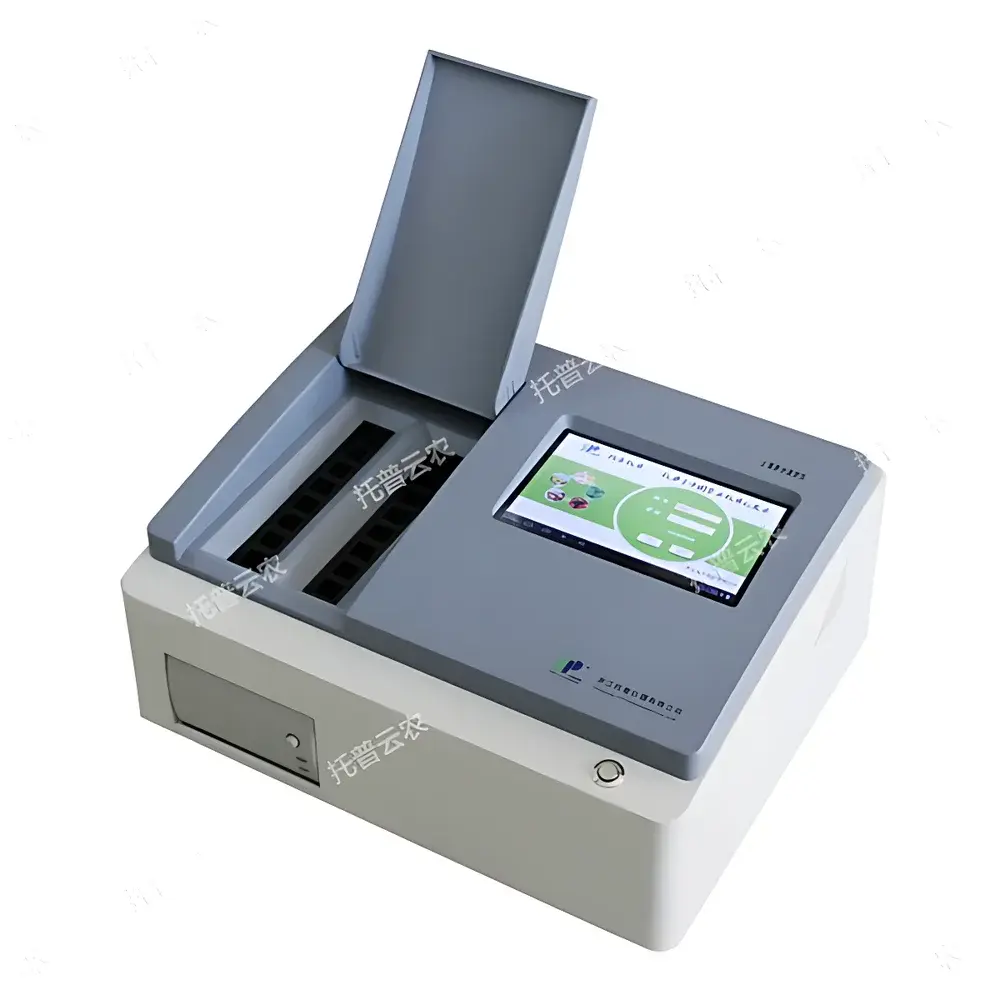
Top Cloud-agri TPY-16A Multi-Channel Soil & Fertilizer Nutrient Rapid Analyzer
| Brand | Top Cloud-agri |
|---|---|
| Origin | Zhejiang, China |
| Manufacturer Type | Direct Manufacturer |
| Instrument Category | Domestic |
| Model | TPY-16A |
| Instrument Type | Fertilizer & Plant Nutrient Analyzer |
| Detection Channels | 16 |
| Display | 7-inch Color Touchscreen (Android OS) |
| Power Supply | Built-in Rechargeable Lithium Battery + AC/DC Adapter |
| Connectivity | Wi-Fi & GPRS |
| GPS | Integrated GNSS Module (Latitude/Longitude/Altitude) |
| Data Storage | Onboard Non-Volatile Memory |
| Printing | Built-in Thermal Printer (Ribbon-Free) |
| Cloud Platform | Proprietary C/S Architecture Web & Mobile App (Android) |
| pH Range | 0–14 (±0.5 accuracy) |
| EC Range | 0–20 mS/cm (±2% FS) |
| Optical System | Dual-Wavelength Photometric Detection (Red: 620±4 nm |
| Blue | 440±4 nm) |
| Photometric Stability | ΔA ≤ 0.003 in 3 min |
| Repeatability | ΔA ≤ 0.005 |
| Linearity Error | <3.0% |
| pH Sensor Type | Solid-State Potentiometric Sensor (No Glass Electrode) |
| EC Sensor Type | Conductivity Cell with Temperature Compensation |
| Optional Sensors | Air Temp/RH, Soil Temp, Volumetric Water Content, CO₂, PAR, Illuminance |
Overview
The Top Cloud-agri TPY-16A Multi-Channel Soil & Fertilizer Nutrient Rapid Analyzer is a field-deployable, photometric-based analytical instrument engineered for quantitative determination of key agronomic parameters in soil, fertilizers, organic amendments, and plant tissues. It operates on standardized colorimetric reaction principles—specifically, the formation of chromophores following chemical derivatization of target analytes (e.g., ammonium-N via indophenol blue, orthophosphate via ascorbic acid–molybdate reduction, potassium via sodium cobaltinitrite precipitation). Unlike benchtop spectrophotometers requiring sample extraction and dilution, the TPY-16A integrates solid-state optical modules with embedded reagent protocols to deliver semi-quantitative to quantitative results within minutes. Its dual-wavelength (620 nm red / 440 nm blue) detection system enables simultaneous compensation for turbidity and background interference, enhancing measurement robustness across heterogeneous field samples. Designed for compliance with common agricultural testing frameworks—including ISO 11260 (soil phosphorus), ISO 14253-1 (measurement uncertainty), and national Chinese standards NY/T 1121 series—the instrument supports traceable, repeatable field screening aligned with Good Agricultural Practice (GAP) and extension service workflows.
Key Features
- 16-channel parallel photometric detection architecture with independent optical paths—eliminates mechanical indexing wear and ensures long-term signal stability.
- Solid-state pH and EC sensors: non-glass, ruggedized potentiometric pH probe (0–14 range, ±0.5 accuracy) and temperature-compensated conductivity cell (0–20 mS/cm, ±2% FS), both suitable for direct soil insertion without calibration drift.
- 7-inch Android-powered capacitive touchscreen with real-time step-by-step guidance, onboard clock synchronization (RTC chip), and multilingual UI support.
- Integrated GNSS module providing georeferenced metadata (latitude, longitude, elevation) for spatially explicit data logging—essential for precision agriculture mapping and longitudinal site monitoring.
- Built-in thermal printer (ribbon-free) generating audit-ready reports including sample ID, test date/time, parameter values, crop type, fertilizer recommendation, and unit annotations.
- Dual-power operation: rechargeable lithium battery pack (≥8 h continuous use) plus universal AC/DC input—enabling unattended field deployment in remote locations.
- User access control system with configurable login credentials, preventing unauthorized modification or deletion of historical datasets.
Sample Compatibility & Compliance
The TPY-16A accepts liquid extracts from air-dried or fresh soil (sieved ≤2 mm), aqueous fertilizer solutions (including water-soluble, foliar, and spray-grade formulations), and homogenized plant tissue digests. It quantifies extractable nitrogen (NH₄⁺-N, NO₃⁻-N), available phosphorus (Olsen-P or Bray-1 equivalent), exchangeable potassium (NH₄OAc-extractable), total N/P/K (via digestion-assisted protocols), organic matter (loss-on-ignition proxy), pH, and electrical conductivity (EC). All measurement methodologies align with widely adopted reference procedures used by provincial agricultural extension stations in China and harmonized with FAO-recommended rapid assessment guidelines. While not certified under ISO/IEC 17025 for accredited testing, its photometric performance (stability ΔA ≤0.003, repeatability ΔA ≤0.005, linearity error <3.0%) meets internal QA/QC thresholds for field-tier decision support. Data integrity is preserved through timestamped storage, GPS-tagged records, and encrypted cloud backup—supporting GLP-aligned documentation practices.
Software & Data Management
The instrument interfaces with the proprietary Top Cloud-agri AgriData Platform—a secure, multi-tenant C/S architecture accessible via web browser or Android application. All measurements sync automatically via Wi-Fi or GPRS, retaining full metadata: channel-specific absorbance values, calculated concentrations, environmental context (GPS, time, ambient conditions), and user-defined annotations. The platform enables temporal trend analysis, cross-location comparison, export to CSV/Excel, PDF report generation, and graphical visualization (line charts, scatter plots, heatmaps). Audit trails record user logins, data edits, and firmware updates—facilitating internal review and regulatory readiness. Over-the-air (OTA) software updates ensure continuous alignment with evolving agronomic algorithms and regional fertilizer recommendation models (e.g., 101 preloaded crop-specific nutrient balance calculators per Chinese agroecological zones).
Applications
The TPY-16A serves as a primary diagnostic tool across public and private agricultural infrastructure: provincial soil-testing laboratories conducting routine fertility surveys; research institutes evaluating fertilizer efficiency trials; cooperative extension agents delivering on-farm advisory services; commercial farm management teams implementing variable-rate application (VRA) planning; and input suppliers validating product nutrient claims. Its portability and rapid turnaround (<10 min per parameter set) make it particularly valuable during planting season scouting, post-harvest soil health assessments, and mid-season nutrient deficiency diagnostics. When paired with optional environmental sensors (soil moisture, air temperature/humidity, PAR), it functions as a modular node in distributed agro-meteorological networks—feeding contextual data into digital twin models for predictive nutrient management.
FAQ
Does the TPY-16A require laboratory-grade reagents or consumables?
No—it uses factory-preloaded, stabilized dry-reagent strips and sealed liquid reagent vials designed for field stability (18-month shelf life at ambient temperatures). No pipetting or dilution steps are required.
Can measurement data be exported in machine-readable format for integration with farm management software (FMS)?
Yes—CSV and Excel exports include ISO 8601 timestamps, WGS84 coordinates, SI units, and standardized parameter codes compatible with common FMS platforms (e.g., Climate FieldView, Granular, JD Edwards Ag).
Is the device compliant with FDA 21 CFR Part 11 or EU Annex 11 requirements?
It is not validated for regulated pharmaceutical or clinical use. However, its audit-trail functionality, electronic signature support, and data immutability features meet baseline requirements for agricultural GLP documentation and internal quality assurance systems.
What maintenance is required for the solid-state pH and EC sensors?
The sensors require only periodic rinsing with deionized water after field use. No recalibration is needed under normal operating conditions; factory calibration certificates are provided with each unit.
How does the instrument handle high-salinity or highly organic soils?
The dual-wavelength optical system and algorithmic correction factors mitigate interferences from humic substances and ionic strength effects. For extreme cases (>15 mS/cm EC or >10% OM), dilution protocols are embedded in the software with auto-concentration back-calculation.







