
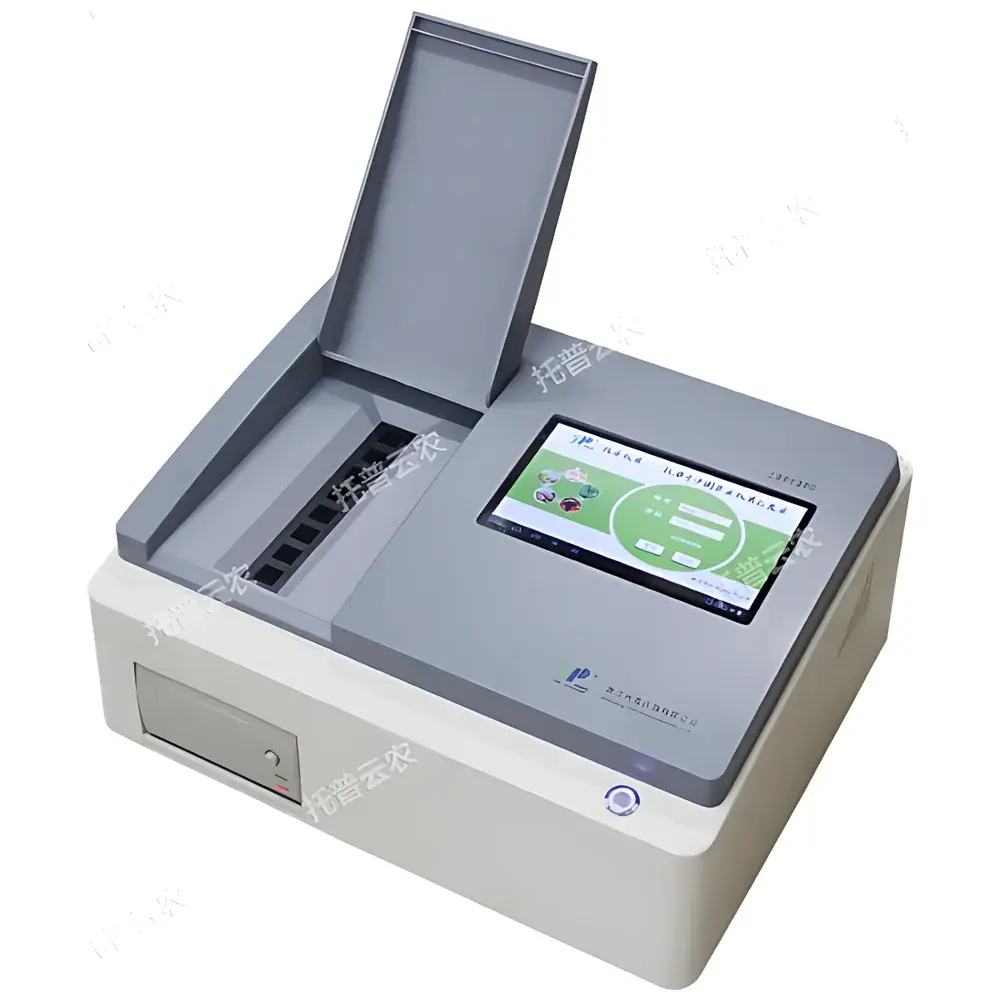
Top Cloud-agri TPY-9PC Smart Soil Nutrient Analyzer
| Brand | Top Cloud-agri |
|---|---|
| Origin | Zhejiang, China |
| Manufacturer Type | OEM/ODM Producer |
| Country of Origin | China |
| Model | TPY-9PC |
| Instrument Type | Fertilizer & Plant Nutrient Analyzer |
| Display | 7-inch Capacitive Touch LCD (Android OS) |
| Connectivity | Wi-Fi & GPRS |
| Onboard Storage | Internal Flash Memory with Timestamped Logging |
| Power Supply | Rechargeable Li-ion Battery + AC Adapter |
| GPS | Integrated GNSS Module (Latitude/Longitude/Altitude) |
| Sensor Expansion | Modular Interface for Soil Temp, VWC, EC, pH, Penetration Resistance, Air Temp/RH, PAR, CO₂ (Optional) |
Overview
The Top Cloud-agri TPY-9PC Smart Soil Nutrient Analyzer is a field-deployable, multi-parameter spectrophotometric analyzer engineered for quantitative assessment of macro- and micronutrient status in soil, fertilizers, organic amendments, and plant tissues. It operates on the principle of visible-light absorbance spectroscopy (620 ± 8 nm red channel; 440 ± 8 nm blue channel), enabling rapid quantification of extractable nitrogen (NO₃⁻–N, NH₄⁺–N), available phosphorus (Olsen-P or Bray-P equivalent), exchangeable potassium (K⁺), total N/P/K (via digestion-coupled assays), organic matter (loss-on-ignition proxy), electrical conductivity (EC), pH, and volumetric water content (VWC). Unlike conventional electrode-based systems, its solid-state pH and EC sensors are designed for direct in-situ burial—eliminating calibration drift associated with glass electrodes and enabling long-term monitoring deployments without recalibration cycles. The instrument integrates embedded environmental sensing, georeferenced data capture, and cloud-enabled traceability—making it suitable for precision agriculture trials, fertilizer efficacy studies, soil health monitoring programs, and regulatory-compliant nutrient management planning under frameworks such as the EU Nitrates Directive or USDA NRCS Conservation Practice Standards.
Key Features
- 16-channel solid-state optical module with integrated photodiode array—enabling simultaneous or sequential analysis across multiple samples without mechanical movement or optical misalignment.
- 7-inch Android-powered capacitive touchscreen interface with intuitive workflow navigation, real-time step-by-step guidance, and over-the-air (OTA) firmware updates.
- Built-in high-accuracy GNSS receiver delivering geotagged measurements (latitude, longitude, elevation) synchronized to UTC time via onboard RTC chip.
- Internal thermal-printing module (inkless, micro-thermal technology) supporting on-device report generation—including sample ID, test date/time, parameter values, crop type, fertilizer recommendation, and unit metadata.
- User-accessible database management: sort by parameter name or timestamp, filter by date range, delete individual entries or bulk-clear records, export CSV-formatted logs.
- Dual-power architecture: rechargeable lithium-ion battery pack (≥8 h field operation) plus universal AC adapter—certified for IP54-rated portable use in variable ambient conditions.
- Expandable sensor ecosystem via standardized analog/digital I/O ports—compatible with optional probes for soil temperature (−40 to +100 °C, ±0.5 °C), VWC (0–100 %VWC, ±3 % rel. error), EC (0–23 mS/cm, ±5 %), penetrometer hardness (0–89 kgf), air RH/temp, PAR, and CO₂.
Sample Compatibility & Compliance
The TPY-9PC accepts aqueous extracts prepared per standard agronomic protocols—including ammonium acetate (for K⁺), sodium bicarbonate (for Olsen-P), Kjeldahl digestion (for total N), and Walkley-Black oxidation (for organic carbon). It supports analysis of granular, liquid, and foliar fertilizers, compost leachates, tissue digests, and irrigation water. All measurement routines comply with foundational principles outlined in ISO 11265:2020 (soil pH determination), ISO 11260:2021 (soil EC), and ASTM D512-22 (chloride in water)—though final method validation remains the responsibility of the end-user laboratory. Data integrity safeguards include user authentication (role-based login), audit-trail logging of all configuration changes, and timestamped result storage—supporting alignment with GLP documentation requirements for field-based environmental testing.
Software & Data Management
The instrument ships with preloaded Android application software and connects natively to the Top Cloud-agri AgriData Platform—a secure, C/S-architected cloud service accessible via web browser or Android mobile app. All measurements—including spectral absorbance (A-value), calculated concentrations, sensor-derived environmental parameters, and GPS coordinates—are automatically uploaded upon network availability. The platform provides persistent storage (unlimited retention tier available), dynamic visualization (time-series plots, scatter matrices, spatial heatmaps), batch comparison tools, and export functionality (CSV, PDF, Excel). Administrators may assign device permissions, define custom crop-nutrient response curves, and generate compliance-ready summary reports aligned with regional nutrient budgeting guidelines. Firmware and analytical libraries receive periodic updates validated against NIST-traceable reference materials.
Applications
- On-farm variable-rate fertilizer prescription mapping using georeferenced soil test results.
- Long-term soil health monitoring across conservation tillage or cover cropping trials.
- Validation of slow-release fertilizer dissolution kinetics under controlled field conditions.
- Extension service support for smallholder farmers requiring rapid, low-cost nutrient diagnostics.
- Academic research in rhizosphere biogeochemistry where concurrent measurement of pH, EC, moisture, and nutrients is critical.
- Regulatory screening of reclaimed soils for landfill closure or brownfield redevelopment projects.
FAQ
Does the TPY-9PC require external lab calibration before field deployment?
No—factory calibration is performed using NIST-traceable standards; however, users should verify performance quarterly using certified reference solutions (e.g., 100 mg/L NO₃⁻–N, 5 mg/L P₂O₅, 100 mg/L K₂O).
Can the built-in pH sensor be used for continuous buried monitoring?
Yes—the solid-state pH probe is rated for direct soil insertion up to 30 days; extended deployment requires periodic cleaning to prevent biofilm accumulation.
Is raw absorbance (A-value) data accessible for third-party statistical analysis?
Yes—CSV exports include wavelength-specific A-values, blank-subtracted readings, and raw sensor voltage outputs for all connected peripherals.
What is the maximum cable length supported for optional soil moisture sensors?
Standard cables are 1.5 m; custom lengths up to 1000 m are available with shielded twisted-pair construction and signal conditioning.
How does the system ensure data integrity during intermittent GPRS connectivity?
All measurements are stored locally with full metadata (GPS, timestamp, operator ID); uploads resume automatically when connection is restored, with sequence-numbered packet acknowledgment.







