
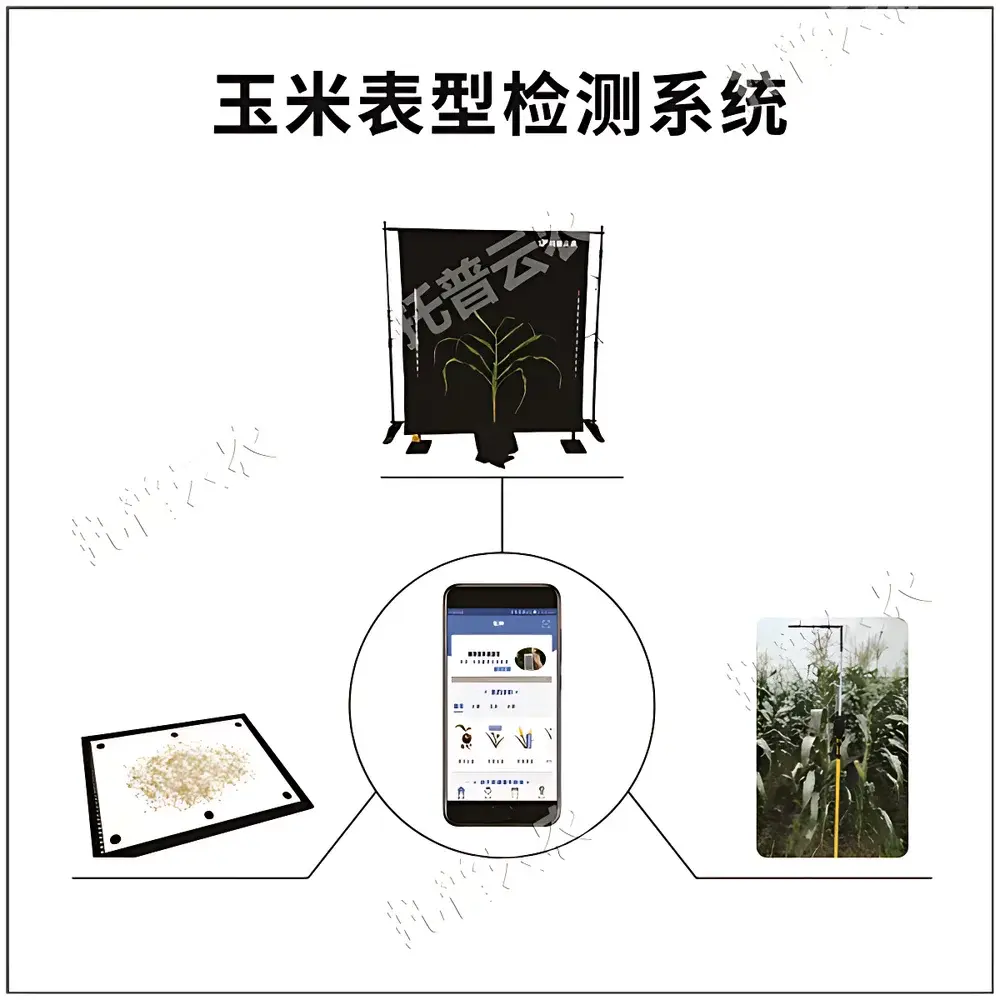
Top Cloud-agri TPY-BX-1 Corn Phenotyping System
| Brand | Top Cloud-agri |
|---|---|
| Origin | Zhejiang, China |
| Manufacturer Type | Direct Manufacturer |
| Product Origin | Domestic (China) |
| Model | TPY-BX-1 |
| Pricing | Available Upon Request |
Overview
The Top Cloud-agri TPY-BX-1 Corn Phenotyping System is a dedicated, non-destructive imaging-based platform engineered for high-throughput quantification of morphological and architectural traits in maize (Zea mays L.). It operates on computer vision principles—leveraging calibrated digital imaging, adaptive thresholding, skeletonization algorithms, and perspective-corrected geometric analysis—to extract biologically meaningful phenotypic descriptors from 2D side-view and top-view images. Unlike destructive or manual measurement methods, the TPY-BX-1 enables longitudinal monitoring across developmental stages—from seedling emergence to silking and grain filling—without compromising plant integrity. Its design addresses core challenges in modern maize breeding programs: scalability in trait capture, reproducibility under variable imaging conditions, and integration-ready data output for QTL mapping, genomic selection pipelines, and physiological modeling. The system is validated for use in controlled-environment growth chambers, greenhouse trials, and field-based phenotyping plots where portable, rapid, and operator-independent assessment is required.
Key Features
- Non-invasive in situ phenotyping: Captures whole-plant architecture—including convex hull area, bounding rectangle area, aspect ratio, lateral compactness, lateral projection area, plant height, ear height, internode length, stem diameter, leaf length, leaf curvature, and stem–leaf angle—without physical contact or tissue excision.
- Sub-10-second multi-parameter analysis: Delivers synchronized extraction of both global canopy metrics and localized anatomical features within 10 seconds post-image acquisition; outputs structured Excel-compatible datasets with timestamped metadata.
- Tri-layer image visualization: Simultaneously displays original RGB image, binarized segmentation mask, and skeletal representation—enabling visual validation of segmentation fidelity and algorithmic interpretation.
- Auto-calibrated scale correction: Compensates for lens distortion and oblique viewing angles using embedded reference geometry, eliminating dependency on fixed-height tripods or rigid camera rigs.
- Interactive manual refinement: Touch-enabled pixel-level editing allows correction of misclassified regions (e.g., soil artifacts, overlapping leaves), ensuring analytical accuracy up to 100% when verified by trained operators.
- Integrated seed counting & thousand-kernel weight (TKW) calculation: Supports high-accuracy grain enumeration (≥10 to ≤8,000 kernels per image) with ±0.2% counting error; TKW derived automatically from user-entered sample mass and detected kernel count.
Sample Compatibility & Compliance
The TPY-BX-1 is optimized for maize genotypes grown in pot-based controlled environments (height range: 0–1.8 m) and supports field-scale plant height estimation up to 5.1 m using an extendable calibration rod. It complies with standard agronomic imaging protocols referenced in ISO 21747:2022 (Plant phenotyping—General requirements for imaging-based trait measurement) and aligns with FAO/IAEA guidelines for non-destructive crop evaluation. While not certified for GxP-regulated environments, its audit-trail-capable data export (CSV/Excel), timestamped metadata logging, and user-annotated experimental fields (variety, growth stage, treatment ID) support GLP-aligned documentation practices in academic and commercial breeding programs.
Software & Data Management
The embedded Android application provides local on-device processing with zero cloud dependency unless explicitly enabled. All measurements are stored in a relational SQLite database with searchable indexing by date, genotype, and trial ID. Export functions generate ISO 8601-compliant CSV files containing raw pixel measurements, derived metrics, and image hash identifiers—facilitating traceability in multi-site collaborative studies. Data can be exported directly to desktop via USB or wirelessly via email, WeChat, DingTalk, or QQ. No proprietary file formats are used; no vendor lock-in is introduced at the data layer. Software updates are delivered OTA and include version-controlled changelogs compliant with ICH-GCP Annex 11 principles for electronic records.
Applications
- High-resolution mapping of quantitative trait loci (QTL) associated with lodging resistance, canopy architecture, and source–sink balance.
- Dynamic phenotyping across vegetative (V-stage) and reproductive (R-stage) development for growth rate modeling and thermal time integration.
- Pre-breeding screening of elite germplasm for ideotype selection—e.g., upright leaf angle, reduced internode elongation, optimal ear placement.
- Phenotypic validation of CRISPR/Cas9-edited lines targeting brassinosteroid signaling or auxin transport pathways.
- Field-to-lab correlation studies linking proximal sensing data (UAV multispectral, LiDAR) with ground-truthed structural metrics.
FAQ
Does the TPY-BX-1 require a specific smartphone model?
No—it supports Android 8.0+ devices with ≥12 MP rear cameras and auto-focus capability; calibration routines adapt to varying sensor resolutions and focal lengths.
Can it measure traits under low-light or shaded conditions?
Yes—the included ultra-thin backlight panel ensures consistent illumination intensity and spectral uniformity, minimizing shadow artifacts and improving segmentation robustness.
Is raw image data retained after analysis?
Yes—original JPEGs, binary masks, and skeleton overlays are archived locally alongside numerical outputs and remain accessible for reprocessing or third-party validation.
How is measurement uncertainty reported?
Systematic error bands are provided per parameter: ±1% for plant height (0–1700 mm with calibration rod), ±3° for angular metrics, ±5% for area- and length-derived traits, and ±0.2‰ for grain counting (post-correction).
Can multiple users share calibration profiles and analysis templates?
Yes—calibration files (.calib) and preset ROI configurations can be exported/imported across devices, enabling standardized protocols across multi-researcher trials.




