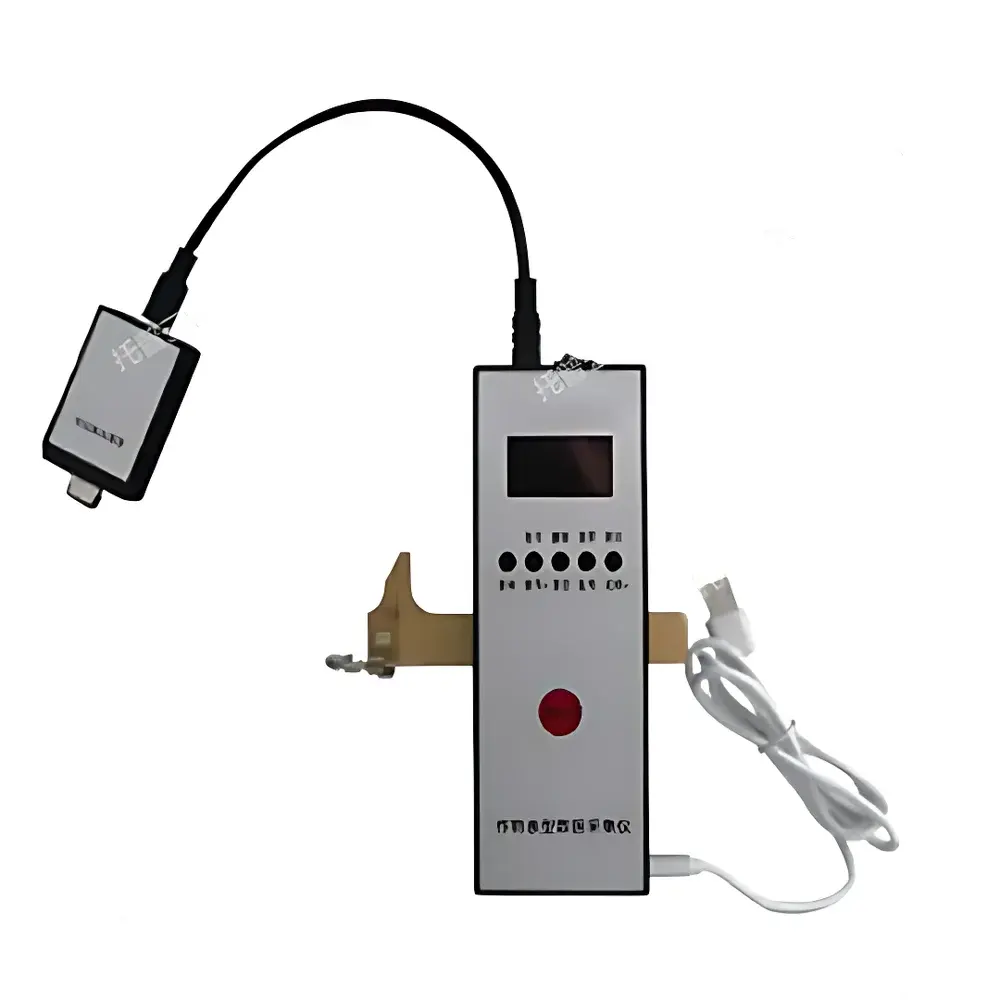
Top Cloud-agri TPZW-BX-1 Portable Field Plant Phenotyping Data Collector
| Brand | Top Cloud-agri |
|---|---|
| Origin | Zhejiang, China |
| Manufacturer Type | OEM Manufacturer |
| Country of Origin | China |
| Model | TPZW-BX-1 |
| Pricing | Upon Request |
| Material | ABS Resin |
| Length Measurement Range | 0–120 cm |
| Length Resolution | 0.01 cm |
| Length Accuracy | ±0.5% |
| Angle Measurement Range | 0° to ±180° |
| Angle Resolution | 0.01° |
| Angle Accuracy | ±1° |
| Response Time | <1 s |
| Storage Capacity | 200 measurement sets |
| Power Supply | 5 V Rechargeable Lithium Battery |
| Operating Duration | 3–4 hours continuous use |
| Measured Traits | Leaf length/width, stem length/internode length/diameter, ear length/diameter/tip barrenness, root length, fruit diameter, leaf-stem angle, tassel branch angle, ear inclination angle, flag leaf angle, leaf area (for maize, wheat, rice, etc.) |
Overview
The Top Cloud-agri TPZW-BX-1 Portable Field Plant Phenotyping Data Collector is an engineered field-deployable instrument designed for rapid, non-destructive acquisition of morphological and structural phenotypic traits in living plants under natural or semi-controlled agro-environmental conditions. It operates on a hybrid principle combining calibrated digital imaging geometry with embedded high-precision angular and linear displacement sensing—enabling direct geometric quantification of plant architecture without reliance on external calibration targets or post-acquisition image processing pipelines. Unlike laboratory-based imaging phenotyping platforms requiring controlled lighting, fixed-stage positioning, or destructive sampling, the TPZW-BX-1 supports real-time, operator-guided measurements in open-field, greenhouse, and nursery settings. Its primary design objective is to bridge the throughput gap between manual agronomic scoring and high-throughput phenomics infrastructure—delivering standardized, traceable, and audit-ready trait data compatible with downstream QTL mapping, genome-wide association studies (GWAS), and genomic selection workflows.
Key Features
- Field-optimized portability: Weighing under 1.2 kg with ergonomic handheld form factor, the device enables single-operator deployment across multiple experimental plots without auxiliary support equipment or power grid dependency.
- Multi-modal trait acquisition: Seven preconfigured measurement modes—Leaf Length/Width, Stem Internode Length/Diameter, Ear Morphology (length, diameter, tip barrenness), Root Length, Fruit Diameter, Angular Architecture (leaf-stem, tassel branch, ear inclination), and Species-Specific Leaf Area Estimation—are accessible via intuitive physical button interface.
- Digital measurement traceability: All measurements are timestamped, geotagged (via optional Bluetooth GNSS module integration), and tagged with user-defined plot identifiers (e.g., block-row-plant ID), ensuring full experimental metadata linkage per data point.
- On-device data integrity control: Internal flash memory stores up to 200 complete measurement sets with built-in checksum validation; no intermediate transcription or manual entry required.
- Low-power deterministic operation: Powered by a field-rechargeable 5 V lithium battery delivering ≥3.5 hours of continuous active measurement time, with sub-second sensor response latency and stable performance across ambient temperatures from 5°C to 40°C.
- Material robustness & environmental resilience: Housing constructed from impact-resistant ABS resin rated IP54 for dust and splash resistance—suitable for daily use in humid, dusty, and variable-light field environments.
Sample Compatibility & Compliance
The TPZW-BX-1 is validated for morphometric measurement across major agronomic species including Zea mays (maize), Triticum aestivum (bread wheat), Oryza sativa (rice), Brassica napus (oilseed rape), Solanum lycopersicum (tomato), and Arabidopsis thaliana (rosette-stage). Measurement protocols align with FAO Crop Ontology definitions and follow ASTM E2917-22 guidelines for field-based phenotypic data collection consistency. While not certified for GLP/GMP-regulated trials, its structured data export format (CSV with header metadata) supports integration into ISO/IEC 17025-compliant laboratory information management systems (LIMS) when deployed within auditable field trial frameworks. Device firmware logs all user interactions and measurement events, satisfying basic FDA 21 CFR Part 11 requirements for electronic record integrity where local regulatory policy permits.
Software & Data Management
Data output is delivered as UTF-8 encoded CSV files via standard USB-A interface—no proprietary software installation required. Each file contains column headers specifying trait name, unit, measurement method (e.g., “manual caliper-derived”, “optical triangulation”), operator ID, plot identifier, timestamp (ISO 8601), and raw sensor values. Optional Python-based CLI tools (open-source, MIT licensed) are available for batch validation, outlier detection using Tukey’s fences, and conversion to MIAPPE-compliant JSON-LD for submission to international repositories such as EURISCO or GRIN-Global. No cloud connectivity or remote telemetry is implemented—ensuring full data sovereignty and compliance with national agricultural data governance policies.
Applications
- High-resolution temporal profiling of canopy architecture dynamics during vegetative-to-reproductive transition
- Phenotypic screening of mutant or transgenic lines for altered tillering, leaf angle, or ear compactness
- Field validation of remote-sensing-derived vegetation indices (e.g., LAI, NDVI) against ground-truth morphometrics
- Supporting marker-assisted backcrossing programs through rapid progeny trait verification
- Training datasets for machine learning models predicting yield components from early-season morphology
- Standardized phenotyping in multi-location variety trials coordinated under national crop improvement networks
FAQ
Is the TPZW-BX-1 suitable for use in rain or high-humidity conditions?
Yes—the ABS housing meets IP54 ingress protection standards, permitting operation in light rain and dew-covered foliage. However, prolonged submersion or direct high-pressure water exposure is not supported.
Can measurement data be synchronized with GPS coordinates?
The base unit does not include integrated GNSS; however, it supports Bluetooth pairing with external GNSS receivers (e.g., Emlid Reach RS2, Garmin GPSMAP 66i) to embed WGS84 coordinates in exported CSV metadata.
Does the device require annual recalibration?
No scheduled recalibration is mandated. The angular and linear sensors are factory-calibrated against NIST-traceable reference standards, and stability testing confirms ≤0.3% drift over 12 months under normal field usage.
What file formats are supported for data export?
Only plain-text CSV is natively supported. No binary, encrypted, or database formats are generated.
Is technical support available outside China?
Yes—English-language documentation, firmware updates, and remote diagnostics are provided globally via secure customer portal access. On-site service is available through authorized regional partners in Southeast Asia, Latin America, and East Africa.