
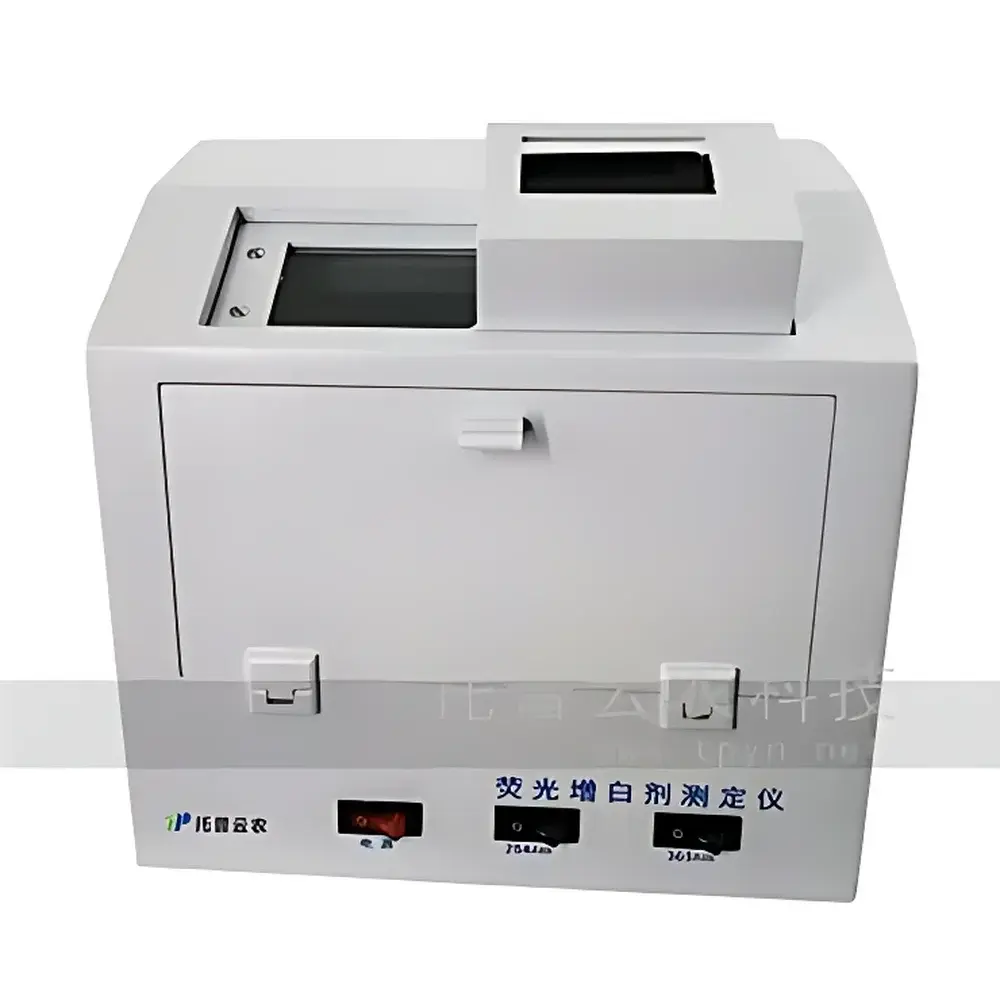
Top Cloud-agri TPZW-I Fluorescent Whitening Agent Detector for Food Safety Screening
| Brand | Top Cloud-agri |
|---|---|
| Origin | Zhejiang, China |
| Manufacturer Type | Direct Manufacturer |
| Country of Origin | China |
| Model | TPZW-I |
| UV Wavelengths | 254 nm & 365 nm (switchable) |
| UV Lamp Power | High-intensity dual-band |
| Detection Method | UV-induced fluorescence visualization |
| Image Sensor | 8 MP CMOS |
| Storage Capacity | >1000 images |
| Battery | 12.6 V / 2600 mAh Li-ion |
| Operating Temperature | 0–40 °C |
| Relative Humidity | <90% RH |
| Power Consumption | ≤20 W |
| Input Voltage | DC 12 V / 2 A |
| Interface | USB 2.0 |
| Enclosure | Light-tight dark chamber with UV-filtered viewing window |
| Display | Color LCD screen |
| Standard Accessories | Aluminum carrying case, flat-bottom petri dish |
Overview
The Top Cloud-agri TPZW-I Fluorescent Whitening Agent Detector is a portable, field-deployable screening instrument engineered for rapid qualitative assessment of illegally applied fluorescent whitening agents (FWAs) in food-related matrices—including edible fungi, fresh fruits, poultry eggs, and food packaging materials. It operates on the photophysical principle of ultraviolet-induced fluorescence: FWAs absorb incident UV radiation (primarily at 254 nm and/or 365 nm) and re-emit energy as visible blue-violet light (typically 400–450 nm), producing a characteristic luminescent signature against non-fluorescent backgrounds. This optical contrast enables immediate visual identification of FWA contamination without chemical extraction or reagent addition. Designed for frontline food safety surveillance, the TPZW-I complies with the operational logic of preliminary screening per China’s GB 5009.275–2016 (National Food Safety Standard—Determination of Fluorescent Brighteners in Food Contact Materials) and aligns with international risk-based inspection frameworks used by regulatory laboratories and third-party auditors.
Key Features
- Dual-wavelength UV excitation source (254 nm and 365 nm), independently or simultaneously selectable via front-panel switch—enabling differentiation of common FWAs (e.g., stilbene derivatives respond strongly at 365 nm; coumarin types exhibit higher sensitivity at 254 nm).
- Light-tight dark chamber architecture with integrated UV-blocking viewing window fitted with certified optical bandpass filters—ensuring operator safety and eliminating ambient interference during real-time observation.
- Integrated 8-megapixel digital imaging system with auto-exposure control and high-contrast image processing—capturing and archiving fluorescence patterns under standardized illumination conditions.
- On-device color LCD display (≥3.5″) supporting live preview, image review, and timestamped annotation—eliminating dependency on external monitors during field deployment.
- Embedded intelligent image storage with ≥1000-frame capacity and automatic file indexing—facilitating traceability and batch-level documentation for internal QA records.
- USB 2.0 interface compliant with UVC protocol—enabling lossless image export to Windows/macOS systems for further analysis, report generation, or integration into LIMS environments.
- Rechargeable 12.6 V / 2600 mAh lithium-ion battery providing ≥4 hours continuous operation—suitable for mobile inspection units, cold-chain audits, and rural market surveillance.
Sample Compatibility & Compliance
The TPZW-I is validated for direct surface screening of intact or minimally prepared samples: whole mushrooms, eggshells, fruit peels, plastic/paper packaging films, and parchment liners. No solvent extraction or derivatization is required—making it suitable for rapid pass/fail triage prior to confirmatory HPLC or LC-MS/MS analysis. While not a quantitative analytical instrument, its detection capability meets the sensitivity threshold for preliminary identification of FWAs at levels exceeding regulatory action limits defined in GB 9685–2016 (Food Contact Material Additive List) and EU Directive 2002/72/EC Annex I. The device’s optical design conforms to IEC 62471:2006 (Photobiological Safety of Lamps) for UV hazard classification, and its enclosure satisfies IP54 ingress protection for dust and splash resistance in warehouse or wet-market environments.
Software & Data Management
The TPZW-I embeds firmware supporting FAT32-formatted USB storage devices and implements ISO/IEC 17025-aligned data integrity protocols: each saved image includes embedded EXIF metadata (date/time stamp, UV mode, exposure settings) and supports optional password-protected folder partitioning. Exported JPEG files are compatible with common forensic image analysis tools (e.g., ImageJ, FIJI) for comparative intensity profiling. Though the device lacks built-in spectral quantification, its consistent illumination geometry and calibrated sensor response allow semi-quantitative ranking across sample sets when used under controlled ambient conditions. Audit trails—generated automatically upon image capture—are retained locally and transferable for GLP-compliant recordkeeping.
Applications
- Routine screening of edible fungi (e.g., *Agaricus bisporus*, *Lentinula edodes*) for unauthorized brightener use during harvest and grading.
- Verification of food-grade packaging compliance—detecting residual FWAs in polyethylene bags, waxed cardboard, or molded pulp trays.
- Field-level inspection of imported fruits (e.g., citrus, apples) and shell eggs for post-harvest treatment violations.
- Training and capacity building for municipal food safety officers, cooperative inspectors, and retail QA personnel.
- Pre-screening tool in accredited labs to prioritize samples for confirmatory chromatographic analysis—reducing instrument time and consumables cost.
FAQ
Is the TPZW-I suitable for quantitative analysis?
No. It is a qualitative screening device designed for presence/absence detection based on visible fluorescence response. Quantification requires HPLC-FLD or LC-MS/MS per GB 5009.275–2016.
Does the instrument require calibration before use?
No routine calibration is needed. However, daily verification using a certified fluorescent reference standard (e.g., quinine sulfate in 0.05 M H₂SO₄) is recommended for consistency tracking.
Can the TPZW-I detect all classes of fluorescent whitening agents?
It detects major UV-excitable FWAs—including distyrylbiphenyls, diaminostilbenes, and coumarins—but may not visualize non-fluorescent or red-shifted derivatives without supplemental excitation sources.
What safety precautions apply during operation?
Always wear UV-blocking safety goggles when opening the chamber. Never view UV-emitting surfaces directly without the filtered observation window. The device complies with Class 1 LED safety standards per IEC 62471.
Is software update support available?
Firmware updates are distributed annually via Top Cloud-agri’s authorized service portal and require USB-based installation—no internet connectivity is needed on the device itself.






