
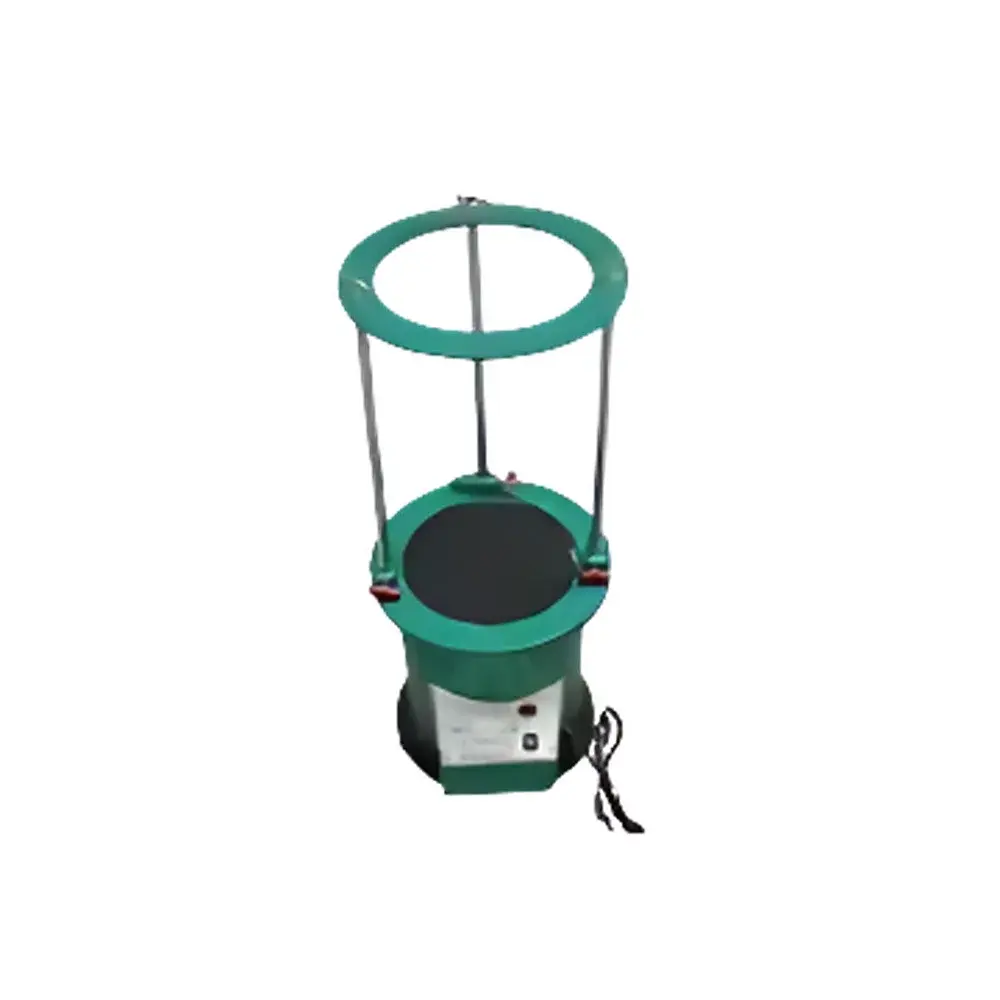
Top Cloud-agri TRX-6 Standard Sieve Shaker for Soil Particle Size Analysis
| Brand | Top Cloud-agri |
|---|---|
| Origin | Zhejiang, China |
| Manufacturer Type | Direct Manufacturer |
| Country of Origin | China |
| Model | TRX-6 |
| Instrument Type | Multi-functional Soil Sieve Shaker |
| Sieve Diameter Compatibility | φ200 mm |
| Vibration Frequency | 221 cycles/min |
| Tap Frequency | 147 taps/min |
| Rotational Radius | 12.5 mm |
| Motor Model & Power | 1A07124, 370 W |
| Weight | 107 kg |
| Dimensions (L×W×H) | 550 × 380 × 735 mm |
Overview
The Top Cloud-agri TRX-6 Standard Sieve Shaker is a mechanically driven, laboratory-grade particle size analyzer engineered for reproducible dry-sieving of soil and granular materials in accordance with standardized sieving protocols. It operates on the principle of controlled orbital motion combined with vertical tapping—mimicking manual sieving while eliminating operator variability and fatigue. Designed specifically for compatibility with standard ASTM E11 and ISO 3310-1 φ200 mm test sieves, the TRX-6 delivers consistent kinetic energy input to facilitate efficient stratification of soil aggregates across defined mesh openings (ranging from 20 mm down to 20 µm). Its dual-mode operation—simultaneous shaking and tapping, or pure orbital shaking—enables method flexibility for varying soil textures, moisture content, and cohesion characteristics. The unit is widely deployed in environmental laboratories conducting soil texture classification (e.g., USDA textural triangle analysis), contamination screening (e.g., gravel/sand/silt/clay fraction quantification prior to heavy metal extraction), and regulatory compliance testing under national soil quality standards.
Key Features
- Robust cast-iron base and precision-machined eccentric drive mechanism ensure long-term mechanical stability and minimal amplitude drift over extended operational cycles.
- Dual operational modes: (1) Combined horizontal oscillation + vertical tap for cohesive or damp soils; (2) Pure orbital shaking for free-flowing, dry samples—both selectable via front-panel toggle switch.
- Fixed-frequency drive system calibrated to 221 vibrations per minute (±2%) and 147 taps per minute (±3%), meeting repeatability requirements for inter-laboratory comparison studies.
- Integrated safety interlock prevents motor activation unless the sieve stack is fully secured with clamping ring and lid in place—compliant with IEC 61000-6-2 electromagnetic compatibility and basic functional safety expectations.
- Modular sieve support platform accommodates up to six stacked φ200 mm sieves with standardized brass or stainless-steel mesh, enabling full grain-size distribution (GSD) profiling in a single run.
Sample Compatibility & Compliance
The TRX-6 is validated for use with air-dried, non-agglomerated soil samples (moisture content <15% w/w) and mineral particulates including crushed rock, slag, fly ash, and industrial sands. It is not intended for wet sieving or highly plastic clays without pre-treatment (e.g., dispersion with sodium hexametaphosphate). The device supports method alignment with ASTM D422 (Standard Test Method for Particle-Size Analysis of Soils), ISO 11277 (Soil Quality — Determination of Particle Size Distribution), and China’s HJ 613–2011 (Environmental Monitoring Technical Specification for Soil and Sediment — Determination of Particle Size Distribution). While the instrument itself carries no CE or UL certification, its mechanical design conforms to general laboratory equipment safety guidelines referenced in ISO/IEC 17025:2017 Clause 6.4 (Equipment) when operated within specified ambient conditions (10–35°C, <80% RH, non-corrosive atmosphere).
Software & Data Management
The TRX-6 is a standalone electromechanical instrument with no embedded microprocessor or digital interface. All operational parameters are fixed at factory calibration; no firmware, software updates, or data logging capability is included. Users record sieve residue weights manually or integrate the unit into LIMS workflows via external balance interfaces (e.g., RS-232 or USB-connected analytical balances). For GLP/GMP environments requiring audit trails, laboratories commonly pair the TRX-6 with validated electronic lab notebooks (ELNs) that document sieve sequence, duration, operator ID, and mass measurements per fraction—ensuring traceability per FDA 21 CFR Part 11 principles where applicable.
Applications
- Soil texture classification for agricultural land evaluation and irrigation planning.
- Preparatory fractionation prior to XRF, ICP-OES, or leaching tests (e.g., TCLP, SPLP).
- Quality control of construction aggregates, backfill materials, and remediation amendments.
- Research-scale particle migration studies in vadose zone hydrology modeling.
- Calibration verification of laser diffraction particle analyzers using reference soil standards (e.g., NIST SRM 2709a).
FAQ
What sieve sizes is the TRX-6 compatible with?
The TRX-6 is designed exclusively for standard φ200 mm test sieves conforming to ASTM E11 or ISO 3310-1 specifications—including brass, stainless steel, and nylon mesh types with nominal apertures from 20 mm to 20 µm.
Can the TRX-6 be used for wet sieving?
No. The TRX-6 is a dry-sieving apparatus. Wet sieving requires sealed enclosures, water recirculation, and corrosion-resistant components not present in this model.
Is the vibration frequency adjustable?
No. The unit operates at fixed mechanical frequencies (221 ±2 vpm, 147 ±3 tpm) as determined by gear ratio and motor speed—no variable-speed control is provided.
Does the TRX-6 meet ISO/IEC 17025 requirements for accredited testing?
Yes—when operated within its specified environmental and procedural limits, and when paired with calibrated balances and documented SOPs, the TRX-6 satisfies Clause 6.4.1 (Equipment Suitability) and 6.4.6 (Verification) of ISO/IEC 17025:2017.
What maintenance is required?
Biannual inspection of eccentric shaft bearings, lubrication of drive linkage points, and verification of clamp torque (recommended: 15–20 N·m) using a calibrated torque wrench. No scheduled replacement parts are specified beyond normal wear items (e.g., rubber damping pads).







