
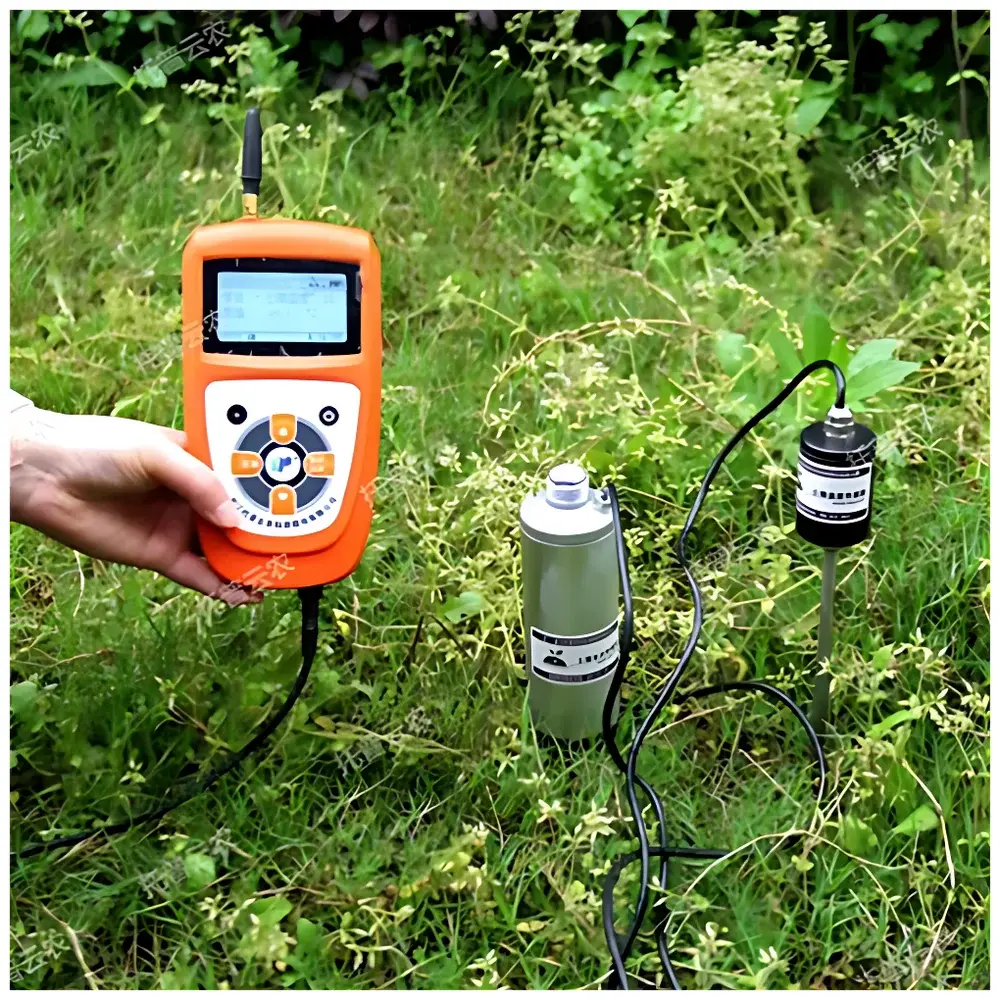
Top Cloud-agri TZS-1K-G Portable Soil Moisture Analyzer
| Brand | Top Cloud-agri |
|---|---|
| Origin | Zhejiang, China |
| Manufacturer Type | Manufacturer |
| Country of Origin | Domestic (China) |
| Model | TZS-1K-G |
| Pricing | Upon Request |
Overview
The Top Cloud-agri TZS-1K-G Portable Soil Moisture Analyzer is a field-deployable, battery-powered instrument engineered for rapid, in-situ quantification of volumetric water content (θ, m³/m³) in soil profiles. It operates on the principle of frequency-domain reflectometry (FDR), a robust and widely standardized dielectric sensing method that correlates soil permittivity with water content across a broad range of textural classes—from sandy loam to clay-rich substrates. Unlike time-domain reflectometry (TDR) systems requiring complex waveform analysis, the TZS-1K-G employs calibrated FDR circuitry optimized for low-power operation and high repeatability under variable temperature and salinity conditions (EC ≤ 4 dS/m). Designed explicitly for environmental monitoring and precision agriculture workflows, it delivers real-time, non-destructive measurements without requiring soil extraction or laboratory processing—enabling immediate decision support for irrigation scheduling, drought assessment, and soil hydrological modeling.
Key Features
- Compact handheld form factor with ergonomic hand-carried case; total system weight < 0.8 kg including integrated lithium-ion battery and sensor probe.
- High-contrast monochrome dot-matrix LCD display (128 × 64 pixels) with full Chinese menu interface and tactile membrane keypad for glove-compatible operation.
- Integrated rechargeable 3.7 V / 4 Ah Li-ion battery with overcharge/over-discharge protection; standby current draw ≤ 10 mA; continuous field operation up to 72 hours per charge (dependent on sampling interval and GPS usage).
- Configurable data logging: programmable sampling intervals from 5 minutes to 99 hours; internal Flash memory stores ≥ 30,000 records; expandable via removable 4 GB microSD card supporting FAT32 formatting.
- Optional embedded GPS module (U-Blox NEO-6M compatible) provides real-time georeferencing (WGS84 datum) with positional accuracy ≤ 2.5 m CEP; coordinates automatically tagged to each moisture record.
- Voice feedback system supports Mandarin Chinese speech synthesis for threshold alerts and live parameter readouts—configurable via host software.
- Modular sensor architecture: supports plug-and-play connection of multiple analog/digital sensors (soil temperature, EC, pH, etc.) via standardized 32-channel expansion hub; channel isolation ensures cross-talk-free measurement integrity.
- RS485 serial interface (2-wire, half-duplex) enables cable runs up to 100 m between host and remote probes; protocol compliant with Modbus RTU for third-party SCADA integration.
- Robust power management includes short-circuit protection, ESD-hardened I/O ports, and brown-out detection to prevent data corruption during voltage transients.
Sample Compatibility & Compliance
The TZS-1K-G is validated for direct insertion into mineral soils with bulk density ≤ 1.8 g/cm³ and organic matter content < 25% (w/w). Probe geometry (stainless steel electrodes, 12 cm length, 3 cm inter-electrode spacing) ensures minimal disturbance during insertion and consistent contact across loam, silt, and clay textures. Calibration is traceable to gravimetric reference standards per ISO 11274:2019 (Soil quality — Determination of water retention characteristics). While not certified for regulatory compliance under FDA 21 CFR Part 11 or EU Annex 11, its audit-ready data export (CSV/Excel), timestamped records with GPS metadata, and immutable storage architecture align with GLP-aligned field data collection practices. Firmware supports user-defined calibration offsets for site-specific soil type correction.
Software & Data Management
The proprietary PC-based desktop application (Windows 7–11 compatible) provides comprehensive post-processing capabilities: time-series visualization with adjustable X/Y scaling, statistical summary (min/max/mean ± SD), customizable threshold highlighting (color-coded deviation zones), and temporal filtering by date range or GPS coordinate bounding box. All datasets export natively to Excel (.xlsx) with embedded metadata headers (timestamp, latitude, longitude, sensor ID, unit). The software maintains an immutable local audit log tracking user login events, configuration changes, and file export actions—supporting basic traceability requirements for research-grade documentation. Raw binary logs are preserved alongside processed exports to ensure full data lineage.
Applications
- Real-time soil water deficit mapping for deficit irrigation scheduling in orchards, vineyards, and row crops.
- Long-term vadose zone monitoring in ecological restoration projects and watershed-scale hydrological studies.
- Validation of satellite-derived soil moisture products (e.g., SMAP, Sentinel-1) at ground-truth validation sites.
- Root-zone moisture profiling in controlled-environment plant phenotyping platforms.
- Geotechnical pre-assessment for slope stability analysis in landslide-prone regions.
- Forestry inventory support—correlating soil water availability with seedling survival rates and mycorrhizal colonization indices.
FAQ
What is the measurement principle used by the TZS-1K-G?
It employs frequency-domain reflectometry (FDR) at 70 MHz to measure soil dielectric permittivity, which is empirically correlated to volumetric water content using a soil-specific calibration curve.
Can the device measure soil temperature simultaneously?
Yes—when equipped with the optional integrated soil temperature sensor (PT1000, ±0.3 °C accuracy), temperature-compensated moisture readings are automatically calculated.
Is the GPS module standard or optional?
GPS functionality is factory-optional; units ordered without GPS retain full moisture measurement capability but omit geotagging.
How is data transferred from the device to a computer?
Via USB 2.0 mini-B cable (included); no drivers required on Windows systems—the device mounts as a mass-storage class drive for direct file access.
Does the instrument support external power sources in the field?
Yes—DC input jack accepts 5–12 V external supply; internal battery charging and instrument operation can occur concurrently.







