
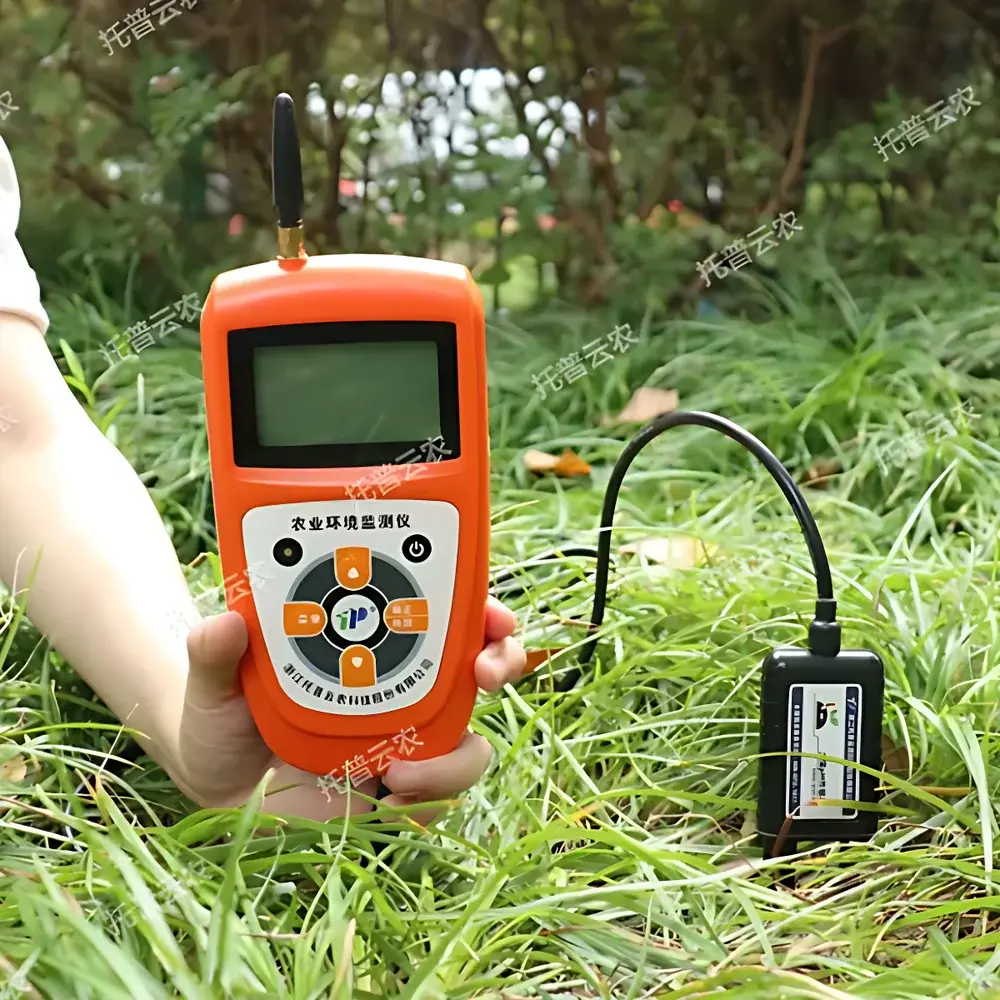
Top Cloud-agri TZS-pH-IG Portable Soil pH Meter
| Brand | Top Cloud-agri |
|---|---|
| Origin | Zhejiang, China |
| Manufacturer Type | Manufacturer |
| Country of Origin | Domestic (China) |
| Model | TZS-pH-IG |
| Price | Upon Request |
| pH Range | 0–14 |
| pH Accuracy | ±0.5 |
| Power Supply | 7.4 V / 2.8 Ah Rechargeable Lithium Battery |
| Data Storage | 30,000 records in internal Flash + expandable 4 GB microSD card |
| Connectivity | GPRS wireless transmission, USB data import, GPS geotagging |
| Sensor Interface | IP67-rated expansion hub supporting up to 32 sensor types |
| Operating System Support | Android & iOS mobile apps |
| Compliance | Designed for field-deployable environmental monitoring per ISO 10390:2022 (soil pH determination), supports GLP-aligned data traceability via timestamped, georeferenced records |
Overview
The Top Cloud-agri TZS-pH-IG Portable Soil pH Meter is a field-deployable, battery-powered instrument engineered for rapid, on-site measurement of soil acidity (pH) in accordance with ISO 10390:2022—*Soil quality — Determination of pH*. It operates on the potentiometric principle using a robust glass electrode sensor immersed directly into moist soil or soil-water slurries. Unlike laboratory benchtop pH meters requiring sample extraction and equilibrium equilibration, the TZS-pH-IG integrates a calibrated, temperature-compensated probe with an embedded data logger and real-time telemetry architecture—enabling quantitative pH assessment under variable ambient conditions without lab infrastructure. Its design targets agronomic surveying, ecological site assessment, remediation monitoring, and precision agriculture workflows where spatial resolution, operational autonomy, and regulatory-compliant data provenance are critical.
Key Features
- Integrated potentiometric pH sensor with ±0.5 pH unit accuracy across the full 0–14 range, optimized for heterogeneous soil matrices including clay, loam, and sandy substrates.
- Onboard GPS module providing automatic georeferencing of each measurement; coordinates stored alongside timestamp, sensor ID, and raw pH value.
- Dual-mode data logging: local storage (30,000 records in internal Flash memory) plus optional 4 GB microSD card for extended archival—both retaining full metadata (date/time, battery level, GPS fix status).
- GPRS-enabled remote transmission with configurable intervals (1 min to 24 h) or manual trigger; supports secure HTTP(S) POST to cloud endpoints compliant with TLS 1.2+.
- Low-power architecture featuring dynamic sleep/wake cycles, voltage monitoring, and over-discharge protection for the 7.4 V / 2.8 Ah Li-ion battery pack (typical field operation >72 h per charge).
- Expandable multi-sensor interface (IP67-rated hub) allowing concurrent integration of EC, moisture, temperature, NPK, or redox sensors—each channel independently calibrated and isolated to prevent cross-talk.
- Graphical LCD with Chinese-language UI (configurable font size), displaying real-time pH, battery status, SD card capacity, GPS lock indicator, and measurement history navigation.
- Voice feedback system supporting threshold-based audible alerts (e.g., “pH below 5.5”) and programmable voice prompts during setup or calibration verification.
Sample Compatibility & Compliance
The TZS-pH-IG is validated for direct insertion into undisturbed or minimally disturbed soil profiles at depths up to 20 cm. It accommodates soils with organic matter content ≤35%, salinity <4 dS/m, and particle sizes ranging from silt (<0.063 mm) to coarse sand (2 mm). For high-salinity or highly buffered soils (e.g., calcareous or sodic), users are advised to perform standardized slurry preparation (1:2.5 soil:water ratio, shaken 1 min, settled 30 min) prior to probe immersion. The device meets electromagnetic compatibility (EMC) requirements per IEC 61326-1:2013 and environmental protection standards per IP54 (dust-protected, splash-resistant enclosure). All logged data include immutable audit trails—timestamp, GPS coordinate, operator ID (if assigned), and sensor serial number—supporting GLP and ISO/IEC 17025 documentation requirements.
Software & Data Management
The TZS-pH-IG interfaces natively with the Top Cloud-agri Instrument Management Platform—a C/S architecture platform accessible via web browser (Chrome/Firefox/Edge) and certified mobile applications (Android 8.0+, iOS 14.0+). Data ingestion occurs via GPRS push, USB mass-storage mode, or batch CSV upload. Within the platform, users can visualize spatiotemporal trends using interactive maps overlaid with pH isocontours, generate summary statistics (mean, SD, min/max per zone), and export reports in PDF, Excel, or CSV formats. Audit logs record all user actions—including data edits, calibration events, and firmware updates—with SHA-256 hashing for integrity verification. Platform-level access controls (role-based permissions), 2FA authentication, and encrypted backups align with GDPR and FDA 21 CFR Part 11 principles for electronic records and signatures.
Applications
- Agronomic soil health mapping for lime requirement estimation and fertilizer optimization.
- Ecological restoration monitoring: tracking pH shifts during phytoremediation or wetland reestablishment.
- Landfill and brownfield site characterization, particularly for acid sulfate soil risk assessment.
- Greenhouse and nursery substrate QC, ensuring consistency across propagation media batches.
- Educational field labs requiring rugged, student-safe instrumentation with intuitive data visualization.
- Regulatory compliance sampling under national soil monitoring programs (e.g., China’s National Soil Pollution Survey framework).
FAQ
What calibration protocol does the TZS-pH-IG support?
It accepts two-point calibration using standard pH 4.01 and 7.00 buffer solutions at ambient temperature; calibration coefficients are stored per sensor and persist through power cycles.
Can the device operate in saturated or flooded soil conditions?
Yes—the probe housing and cable connector meet IP67 ingress protection; however, prolonged submersion (>30 min) is not recommended due to potential electrolyte dilution in the reference junction.
Is offline data collection possible without GPRS coverage?
Absolutely—the instrument logs all measurements locally with full metadata; GPRS functionality is optional and does not affect core measurement integrity or storage reliability.
How is sensor drift managed during long-term deployments?
The platform supports scheduled automated recalibration reminders, and the electrode includes a replaceable reference electrolyte cartridge (model-specific); drift compensation algorithms are applied during post-processing if paired with temperature and EC readings.
Does the system comply with international soil testing standards?
Yes—it implements measurement procedures consistent with ISO 10390:2022 and ASTM D4972-13 (Standard Test Method for pH of Soils); full method documentation and uncertainty budgets are available upon request for validation purposes.







