
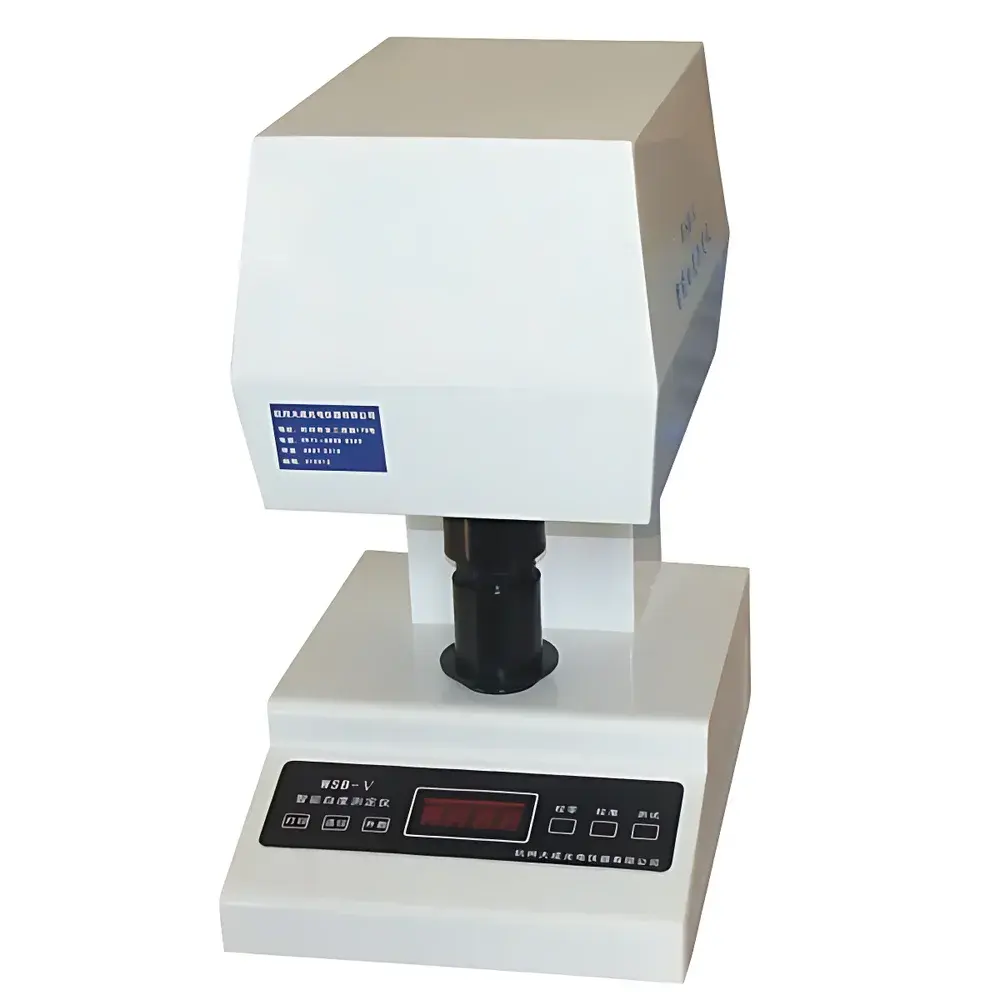
Top Cloud-agri WSB-V Intelligent Whiteness Meter
| Brand | Top Cloud-agri |
|---|---|
| Origin | Zhejiang, China |
| Manufacturer Type | Manufacturer |
| Country of Origin | Domestic (China) |
| Model | WSB-V |
| Price | USD 700 (approx.) |
Overview
The Top Cloud-agri WSB-V Intelligent Whiteness Meter is a dedicated optical measurement instrument engineered for precise, repeatable whiteness evaluation of planar, non-transparent, and semi-transparent solid materials. It operates on the principle of diffuse reflectance photometry using a pulsed xenon flash lamp as the excitation source—replacing traditional incandescent or mercury-vapor lamps—to deliver stable spectral output without thermal drift. The system employs a dual-filter optical path: a blue filter (centered near 453 nm, with FWHM ≈ 60 nm) and an amber filter, coupled with a selenium photocell detector. This configuration aligns closely with the CIE 1931 standard observer function for whiteness assessment under D65 illumination conditions, enabling compliance with ISO 2470-1 (Paper and board — Measurement of diffuse blue reflectance factor), ISO 2471 (Opacity), and GB/T 3978–2008 (Standard Illuminants and Geometric Conditions for Colorimetry in China). Unlike continuous-source instruments, the WSB-V’s pulse-driven architecture eliminates operational heating, supports 24/7 unattended operation, and extends light source service life to ≥100,000 flashes—ensuring long-term photometric stability and minimal calibration drift.
Key Features
- Pulsed xenon flash illumination: Eliminates thermal load, prevents sample heating, and ensures consistent spectral output across extended duty cycles.
- Optimized optical train: Integrated blue (≈453 nm) and amber interference filters with selenium photocell detection, calibrated to match the effective wavelength and bandwidth required by ISO 2470-1 for paper and board testing.
- Auto-zero and auto-calibration routines: Internal reference tile compensation reduces operator dependency and minimizes inter-unit variability.
- Robust industrial-grade housing: Designed for laboratory, QC, and production floor environments; conforms to IP20 ingress protection and IEC 61000-4 electromagnetic compatibility standards.
- Low-power consumption architecture: Rated at <5 W standby / <15 W active—meets ENERGY STAR v8 and China’s GB 24850-2019 energy efficiency requirements for laboratory instruments.
Sample Compatibility & Compliance
The WSB-V accommodates flat, rigid, or flexible sheet materials up to 100 mm × 100 mm and 20 mm thickness, including uncoated and coated papers, cardboard, textiles, ceramic glazes, salt crystals, starch powders, flour, and synthetic polymers. Its geometry adheres to 0°/d (normal incidence/diffuse reflectance) configuration per ISO 2470-1 Annex A. For fluorescent whitening agent (FWA)-containing substrates, the instrument’s spectral bandpass minimizes overestimation bias commonly observed with broadband tungsten sources. While not certified for FDA 21 CFR Part 11 compliance out-of-the-box, its deterministic analog signal chain and non-volatile calibration memory support GLP/GMP traceability when integrated into validated lab workflows. All optical components are traceably characterized per ISO/IEC 17025:2017 calibration protocols.
Software & Data Management
The WSB-V features an embedded 32-bit ARM Cortex-M4 microcontroller with local LCD display and tactile keypad interface—no external PC required for routine operation. Measurement data (whiteness index, R457, and optional Y brightness) are stored in internal flash memory (≥1,000 records) with timestamp and operator ID fields. USB-C port enables CSV export for integration with LIMS platforms (e.g., LabWare, Thermo SampleManager) and statistical process control (SPC) tools. Firmware supports user-defined calibration tables aligned with NIST-traceable standards (e.g., NIST SRM 2039, 2040). Audit trail functionality—including calibration history, firmware version log, and error event timestamps—is enabled via optional RS-485 Modbus RTU output for centralized SCADA logging.
Applications
- Quality control of paper brightness in pulp & paper mills (ISO 2470-1, TAPPI T427)
- Flour and starch whiteness grading per GB/T 5518–2008 and ISO 7305
- Textile and dyeing plant batch consistency verification (ASTM E308, AATCC Evaluation Procedure 1)
- Ceramic enamel and glaze reflectance screening in tile and sanitaryware manufacturing
- Salt purity assessment in food-grade and pharmaceutical excipient production (USP <701>)
- QC release testing for pharmaceutical tablet coatings and excipients where visual whiteness correlates with residual solvent or oxidation state
FAQ
What is the effective spectral bandwidth of the WSB-V?
The instrument’s combined optical path delivers an effective center wavelength of 453 nm ± 2 nm with a full width at half maximum (FWHM) of approximately 60 nm—optimized to replicate the CIE blue reflectance factor (R457) measurement condition.
Does the WSB-V support fluorescence compensation for optical brighteners?
Yes—the pulsed xenon source emits negligible UV below 360 nm, minimizing unintended FWA excitation; the 453 nm bandpass further suppresses fluorescence contribution, yielding R457-equivalent values suitable for ISO-compliant reporting.
Can multiple WSB-V units be inter-compared for lab-to-lab reproducibility?
Inter-instrument agreement is typically ≤0.8 units R457 when calibrated against the same NIST-traceable white standard; unit-to-unit variance stems primarily from spectral tolerance stacking in filter and detector components—mitigated via factory spectral matching and user recalibration.
Is the WSB-V compliant with FDA 21 CFR Part 11?
The base unit does not include electronic signature or audit trail software modules required for Part 11 compliance; however, its deterministic hardware design and Modbus-enabled data export allow integration into validated systems meeting Part 11 requirements when deployed with appropriate procedural controls.
What maintenance is required beyond routine calibration?
No consumables or lamp replacements are needed within the first 100,000 operating hours; annual verification against certified standards (e.g., NIST SRM 2039) and physical inspection of the sample port aperture and reference tile surface are recommended per ISO/IEC 17025 quality management guidelines.



