
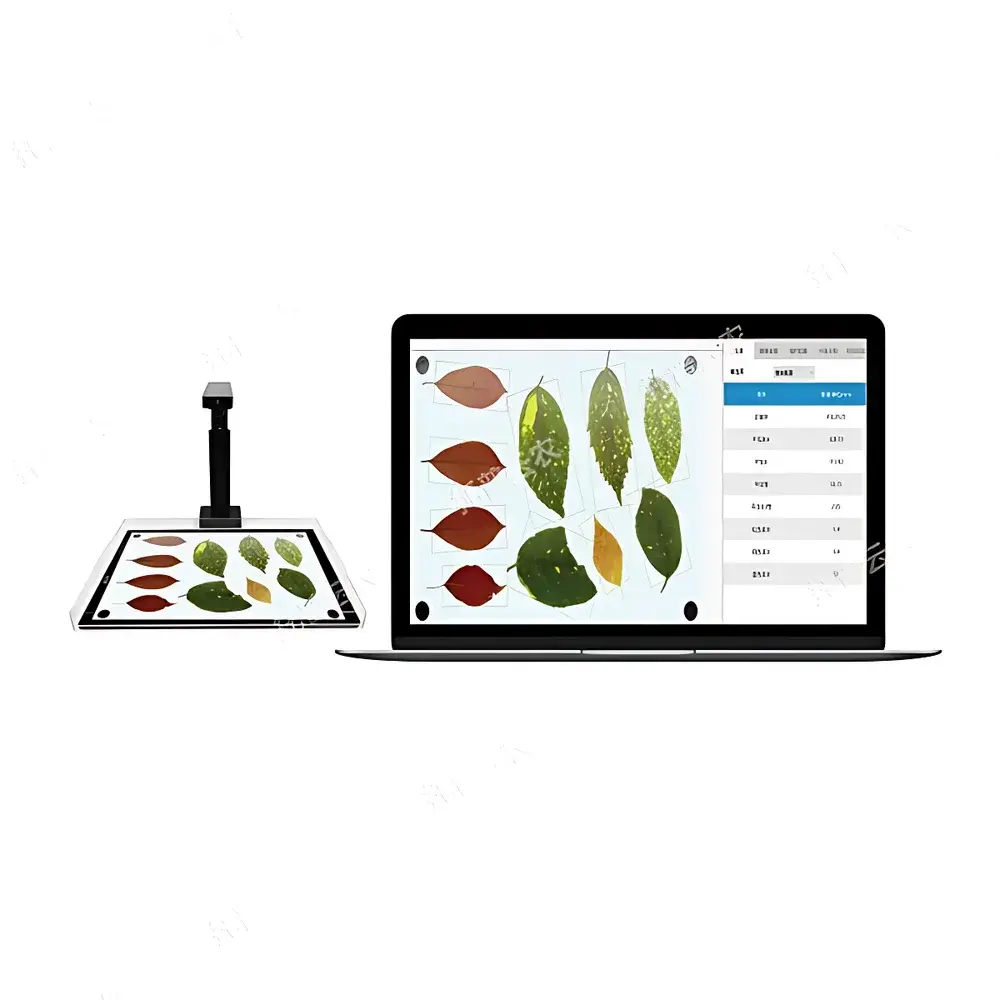
Top Cloud-agri YMJ-PC Leaf Area Meter
| Brand | Top Cloud-agri |
|---|---|
| Origin | Zhejiang, China |
| Manufacturer Type | Direct Manufacturer |
| Product Origin | Domestic (China) |
| Model | YMJ-PC |
| Pricing | Upon Request |
Overview
The Top Cloud-agri YMJ-PC Leaf Area Meter is a non-destructive, image-based phenotyping instrument engineered for high-throughput quantification of leaf morphological and pathological traits in plant science research and agricultural field applications. Operating on the principle of digital image acquisition and pixel-based geometric segmentation, the system captures backlit leaf images using a 22-megapixel overhead imaging module, then applies calibrated computer vision algorithms to extract quantitative metrics—including area, length, width, perimeter, shape factor, serration count, and hole/defect geometry. Unlike contact-based or destructive methods (e.g., leaf scanners requiring physical flattening), this system preserves sample integrity and enables rapid analysis of fresh, living leaves under field or greenhouse conditions. Its design prioritizes reproducibility across diverse species—from broad monocots (e.g., maize, rice) to complex dicots (e.g., tomato, grapevine)—and supports longitudinal monitoring of growth dynamics, stress responses, and disease progression.
Key Features
- 22-MP Adjustable Imaging Module: Foldable and telescopic high-resolution camera with motorized height adjustment ensures consistent working distance and optimal depth-of-field across variable leaf sizes (up to 400 mm length × 280 mm width).
- Uniform Backlighting System: LED backlit panel with continuous dimming control (0–100% intensity) eliminates specular reflection and shadow artifacts; paired with an anti-glare compression plate to flatten specimens without deformation or chlorophyll leaching.
- Automated Calibration & Measurement: Real-time pixel-to-mm conversion via embedded reference markers; no manual scale input required—calibration occurs automatically upon image capture.
- Advanced Image Processing Suite: Includes hole-filling, petiole separation, convex hull approximation, bounding rectangle overlay, user-defined serration thresholding, and minimum leaf-length filtering to accommodate fragmented or senesced tissue.
- Pathology-Aware Analysis: Quantifies lesion area, necrotic zone perimeter, missing area (abscission or herbivory), and colorimetric indices (RGB/HSL-based segmentation) for chlorosis, anthocyanin accumulation, or fungal colonization.
- Batch Processing Engine: Supports concurrent analysis of ≥100 images per session; auto-saves annotated TIFF/PNG outputs alongside CSV-formatted metric tables with per-leaf and group-level statistics (mean, SD, CV%).
- Secure Data Architecture: Dual-layer protection via hardware dongle (USB-based license enforcement) and dynamic QR-coded metadata embedding—ensuring traceability, audit readiness, and compliance with GLP data integrity requirements.
Sample Compatibility & Compliance
The YMJ-PC accommodates detached or intact leaves from herbaceous and woody species, including compound leaves (e.g., soybean, clover) and overlapping canopies when staged individually. It complies with standard protocols for leaf area index (LAI) estimation referenced in ISO 11727:2021 (Plant production—Measurement of leaf area) and supports data collection aligned with FAO CropWat and USDA ARS phenotyping workflows. While not certified for regulated clinical or pharmaceutical use, its measurement uncertainty (<±2% for area, <±1% for linear dimensions) meets routine agronomic QA/QC thresholds defined in ASTM D6988-22 (Standard Practice for Determining Leaf Area Index of Vegetative Canopies). All software-generated reports include timestamped metadata, operator ID, instrument serial number, and version-controlled algorithm logs—facilitating 21 CFR Part 11–compatible audit trails when deployed in GxP-aligned environments.
Software & Data Management
The proprietary PC-based analysis software (Windows 7/10/11 compatible) features a modular GUI with intuitive workflow navigation: Capture → Preprocess → Segment → Measure → Export. Raw and processed images are stored locally with embedded EXIF tags and SHA-256 checksums. Statistical outputs export directly to Excel (.xlsx) with column headers mapped to ISO/IEC 17025–recommended terminology (e.g., “LeafArea_mm2”, “LengthToWidthRatio”, “LesionCoveragePercent”). Optional cloud synchronization enables secure upload to the Top Cloud-agri Instrument Cloud Platform, where users access datasets via web browser or mobile app—supporting role-based permissions, version history, and cross-device annotation sharing. Software updates follow a documented change-control process, with release notes archived for regulatory review.
Applications
- High-throughput screening of drought-, heat-, or pathogen-tolerant germplasm in breeding programs
- Quantifying canopy development rates in crop modeling (e.g., APSIM, DSSAT inputs)
- Assessing herbicide phytotoxicity or nutrient deficiency symptoms via lesion/area ratio trends
- Validating remote sensing-derived LAI estimates using ground-truth calibration plots
- Monitoring leaf abscission kinetics during senescence studies in controlled-environment chambers
- Supporting ecological field surveys of invasive species leaf morphology shifts across gradients
FAQ
What operating systems does the YMJ-PC software support?
Windows 7 (Service Pack 1), Windows 10 (version 1809 or later), and Windows 11 (22H2 or later) are fully supported. macOS and Linux are not compatible.
Is field deployment feasible without external power?
The LED backlit panel and imaging module require AC power (100–240 V, 50/60 Hz); however, portable USB-C power banks (≥60 W output) can sustain operation for up to 3.5 hours when paired with a DC-AC inverter.
Can the system analyze overlapping leaves or multi-layered samples?
No—accurate segmentation requires single-layer placement. Overlapping regions must be manually separated prior to imaging to avoid underestimation of individual leaf area.
How is measurement traceability ensured for regulatory submissions?
Each exported dataset includes a digitally signed metadata header containing instrument ID, firmware version, calibration date, operator credentials, and cryptographic hash of raw image files—enabling full reprocessing and verification per ALCOA+ principles.
Does the software support custom region-of-interest (ROI) definition for partial leaf analysis?
Yes—users may draw freehand or polygonal ROIs to isolate specific zones (e.g., tip vs. base, symptomatic vs. healthy tissue) and compute localized metrics independently.
Related Products



