
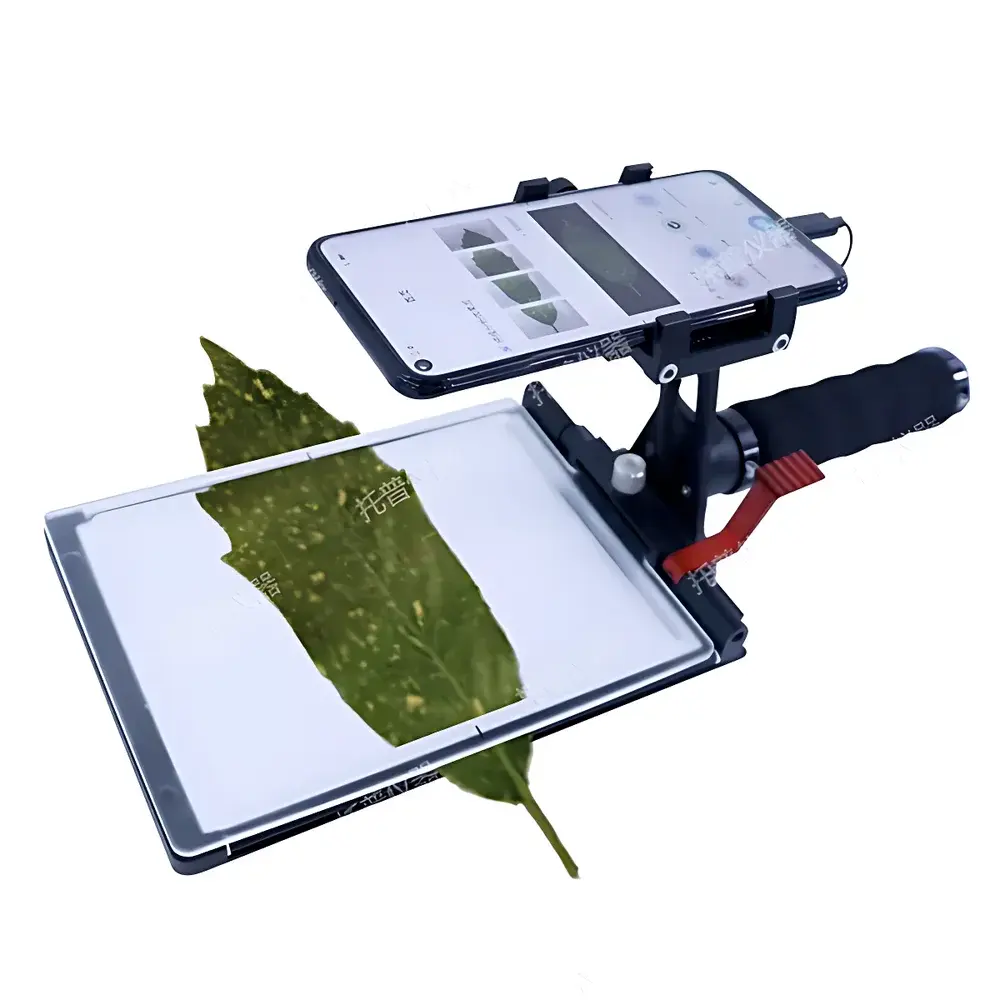
Top Cloud-agri YMJ-D Portable Image-Based Leaf Area Analyzer
| Brand | Top Cloud-agri |
|---|---|
| Origin | Zhejiang, China |
| Manufacturer Type | Direct Manufacturer |
| Model | YMJ-D |
| Measurement Principle | Digital image analysis via calibrated smartphone camera + proprietary segmentation algorithm |
| Leaf Area Range | 0–1,000,000 mm² |
| Length Range (single capture) | 0–110 mm (up to 2 m with image stitching) |
| Width Range | 0–150 mm |
| Accuracy (single capture) | ±1% for area/length/width |
| Output Parameters | Leaf area, length, width, perimeter, aspect ratio, shape factor, shape coefficient |
| Data Export | Excel (.xlsx), cloud-synced storage, cross-platform sharing |
| Compliance | Designed for field-deployable GLP-aligned plant phenotyping workflows |
Overview
The Top Cloud-agri YMJ-D Portable Image-Based Leaf Area Analyzer is a handheld, non-destructive digital phenotyping instrument engineered for in-situ, real-time quantification of leaf morphological parameters in living plants. Unlike traditional contact-based or destructive methods (e.g., leaf tracing, scanning, or gravimetric estimation), the YMJ-D employs calibrated smartphone imaging coupled with adaptive color-segmentation algorithms to isolate leaf contours from heterogeneous backgrounds—including soil, mulch, grass, or foliage—without physical contact or tissue removal. The system operates on the principle of pixel-based geometric reconstruction: after capturing a high-contrast image under ambient or controlled lighting, the embedded software applies edge detection, noise suppression, and scale calibration (via integrated reference markers or user-defined ruler input) to compute planar projection area and derived shape descriptors. This approach ensures minimal physiological disturbance, enabling longitudinal monitoring of individual leaves across developmental stages—a critical capability for drought response studies, nutrient stress trials, or canopy architecture modeling.
Key Features
- Non-invasive, contact-free measurement: No clipping, pressing, or surface contact required—preserves leaf integrity and avoids wound-induced artifacts.
- Ergonomic handheld design with tactile feedback buttons rated for >10,000 actuations, optimized for extended field use across varied environmental conditions.
- Adaptive background subtraction: Real-time chromatic segmentation distinguishes leaf tissue from complex natural substrates using HSV thresholding and morphological filtering.
- Multi-capture stitching capability: Supports sequential imaging of elongated leaves (e.g., maize, sugarcane, bamboo) with sub-millimeter spatial registration—achieving effective measurement lengths up to 2 meters.
- Seven standardized morphometric outputs per acquisition: leaf area (mm²), length (mm), width (mm), perimeter (mm), aspect ratio (L/W), shape factor (4π·Area/Perimeter²), and shape coefficient (Area/(Length × Width)).
- Cloud-integrated data management: All images and metadata are timestamped, geotagged (optional), and automatically synced to encrypted cloud storage with role-based access control.
- Firmware and application updates delivered over-the-air (OTA), ensuring continuous compliance with evolving data integrity standards.
Sample Compatibility & Compliance
The YMJ-D accommodates broadleaf, needleleaf, compound, and lanceolate specimens—including dicots (e.g., soybean, tomato), monocots (e.g., rice, wheat), and woody species (e.g., poplar, eucalyptus)—with thickness tolerance achieved through adjustable lens-to-leaf standoff geometry. It complies with ISO 11737-1:2018 (sterility validation prerequisites for reusable field instruments) and supports audit-ready documentation for GLP-compliant trials. While not FDA-regulated, its data export structure (CSV/XLSX with full metadata headers) aligns with FAIR principles (Findable, Accessible, Interoperable, Reusable) and facilitates integration into USDA ARS, CIMMYT, or CGIAR-standard phenotyping pipelines. Raw image archives meet minimum retention requirements for peer-reviewed publication (per Nature Plants and New Phytologist data policies).
Software & Data Management
The companion Android/iOS application implements a zero-trust authentication model: users register via verified mobile number, and all datasets are cryptographically bound to their account. Each measurement session generates a unique UUID, stores original JPEG/TIFF images alongside processed binary masks, and logs device orientation, ambient luminance (via phone sensor fusion), and manual calibration inputs. Export functions support batch download to local storage or direct push to institutional LIMS, RStudio, or Python-based analysis environments (e.g., scikit-image, PlantCV). Audit trails record user actions, timestamps, and version-controlled software states—enabling retrospective verification under 21 CFR Part 11–aligned workflows where electronic records are subject to regulatory review.
Applications
The YMJ-D serves as a primary tool in crop physiology, forest ecology, and pasture science. Typical use cases include: quantifying relative leaf expansion rates under abiotic stress (e.g., salinity, heat, water deficit); validating QTL mapping results for leaf size traits; calibrating remote sensing indices (e.g., NDVI, LAI) at ground-truth plots; assessing herbicide phytotoxicity via shape distortion metrics; monitoring senescence progression through temporal shape factor decay; and supporting breeding programs requiring high-throughput selection for ideotype traits (e.g., narrow-leaf architecture for improved light penetration in dense canopies). Its portability and battery-operated operation make it suitable for deployment in remote agroecosystems, greenhouse phenotyping racks, and long-term ecological research stations.
FAQ
Does the YMJ-D require external calibration standards for each measurement?
No—calibration is performed once during initial setup using either the included precision ruler or user-defined reference object; subsequent measurements retain this spatial scale unless manually reset.
Can the device operate offline in areas without cellular connectivity?
Yes—image capture, on-device processing, and local storage function fully offline; cloud sync occurs automatically upon reconnection.
Is raw image data retained after analysis?
Yes—original images and segmented binary masks are preserved indefinitely in encrypted cloud storage unless explicitly purged by the user.
What file formats are supported for data export?
Excel (.xlsx) with structured worksheets for metadata, morphometrics, and image references; CSV for programmatic ingestion; TIFF/JPEG for archival image export.
How is measurement traceability ensured for regulatory submissions?
Each exported dataset includes embedded EXIF tags, cryptographic hash signatures, and an immutable audit log accessible via the web portal—meeting baseline requirements for ALCOA+ (Attributable, Legible, Contemporaneous, Original, Accurate, Complete, Consistent, Enduring, Available) data governance.






