
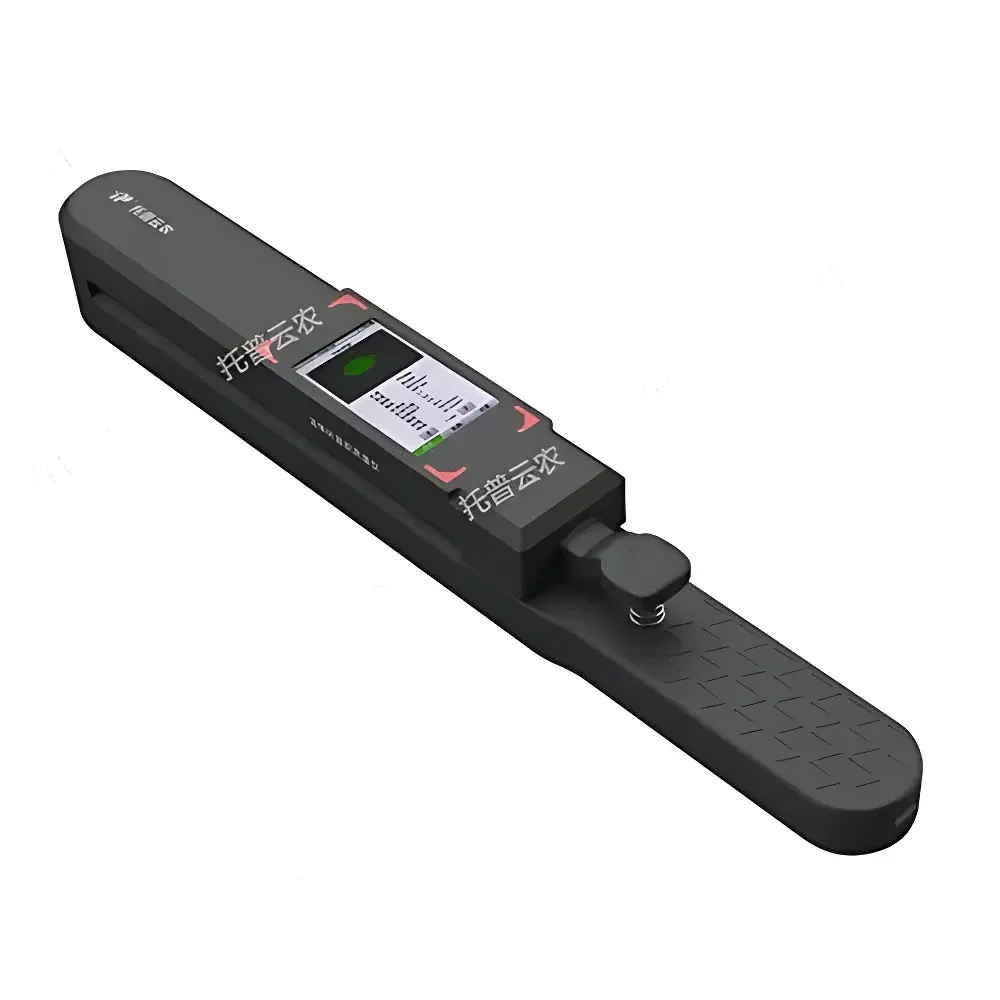
Top Cloud-agri YMJ-B (Upgraded Version) Portable Leaf Area Meter
| Brand | Top Cloud-agri |
|---|---|
| Origin | Zhejiang, China |
| Manufacturer Type | Direct Manufacturer |
| Country of Origin | China |
| Model | YMJ-B (Upgraded Version) |
| Detection Range | Scanning Area: 3000 × 210 mm² |
| Measurement Accuracy | ±2% for Leaf Area |
| Max. Scan Length | 3000 mm |
| Max. Width | 210 mm |
| Max. Thickness | 6.5 mm |
| Length Resolution | 0.1 mm |
| Width Resolution | 0.1 mm |
| Scan Speed | 150 mm/s |
| Display | 480 × 854 RGB Touchscreen |
| Power | 5 Ah Rechargeable Li-ion Battery |
| Operating Time | Up to 16 h |
| Dimensions | 420 × 50 × 54 mm |
| Weight | 0.53 kg |
| Operating Temperature | −20 °C to +60 °C |
| Operating Humidity | 0–100% RH (non-condensing) |
Overview
The Top Cloud-agri YMJ-B (Upgraded Version) Portable Leaf Area Meter is an optical scanning instrument engineered for in-field and laboratory quantification of leaf area and morphometric parameters without physical contact or tissue damage. It operates on the principle of high-resolution linear CCD imaging combined with real-time edge-detection algorithms to extract leaf silhouette boundaries from scanned reflectance data. Unlike destructive gravimetric or planimetric methods, this device enables rapid, non-invasive measurement of fresh, intact leaves—preserving physiological integrity for downstream assays. Its compact form factor, integrated GPS module, and extended battery life make it suitable for longitudinal field trials across agronomic, forestry, and ecological research programs where spatially referenced leaf area index (LAI), specific leaf area (SLA), and canopy architecture analysis are required.
Key Features
- RGB capacitive touchscreen (480 × 854 resolution) with dual-mode visualization: real-time leaf contour overlay and tabular parameter display (area, length, width, aspect ratio, perimeter).
- Three configurable geometric compensation modes—none, rectangular, and triangular—to correct for partial occlusion or irregular leaf margins, improving accuracy under heterogeneous sampling conditions.
- Dual acquisition modes: manual trigger for targeted single-leaf scans and auto-scan mode for continuous batch processing of detached samples on the scanning platen.
- Type-C universal interface supporting simultaneous charging and high-speed USB 2.0 data export; outputs native Excel (.xlsx) files containing raw coordinates, computed metrics, and timestamped geotags.
- Onboard storage architecture: 1,000 entries in volatile RAM cache + expandable microSD support for >1 million records; local validation flagging allows immediate rejection of low-contrast or motion-blurred scans.
- Integrated GNSS receiver compliant with GPS/GLONASS/BeiDou constellations; records WGS84 coordinates at sub-meter precision with each measurement for GIS-integrated experimental design and spatial metadata traceability.
- Intelligent power management: programmable auto-shutdown (1–30 min idle timeout), low-battery warning, and automatic checkpoint saving to prevent data loss during unexpected shutdowns.
Sample Compatibility & Compliance
The YMJ-B accommodates a broad range of botanical specimens: intact living leaves (up to 3000 mm long and 210 mm wide), excised foliage, herbaceous stems, petals, and other flat, opaque planar materials. Maximum sample thickness is 6.5 mm, permitting inclusion of compound leaves with minor petiole elevation. The system meets ISO 11277:2022 guidelines for non-destructive plant phenotyping instrumentation and supports GLP-aligned workflows through timestamped audit trails, user-defined ID tagging, and exportable metadata logs. While not FDA 21 CFR Part 11 certified out-of-the-box, its structured data output (CSV/Excel) facilitates integration into validated LIMS environments requiring electronic record retention.
Software & Data Management
Data handling is supported via two interoperable platforms: embedded firmware with local preview and filtering tools, and the companion Top Cloud-agri FieldScan mobile application (iOS/Android). The app enables real-time synchronization over Bluetooth 5.0, remote configuration of scan parameters, and cloud-backed backup. All exported datasets include standardized headers compatible with R (phytomorph, leafarea), Python (scikit-image, pandas), and commercial statistical packages (JMP, SAS, SPSS). Batch export options allow selective retrieval by date range, GPS zone, or operator ID—enabling stratified analysis per treatment block or phenological stage.
Applications
- Optimization of planting density and canopy management strategies through dynamic LAI monitoring across growth stages.
- Phenotypic screening of germplasm for drought tolerance, nitrogen use efficiency, or shade adaptation via SLA and leaf shape indices.
- Validation of remote sensing-derived vegetation indices (e.g., NDVI, EVI) using ground-truthed leaf area measurements.
- Ecophysiological studies linking leaf morphology to gas exchange, stomatal conductance, and photosynthetic capacity.
- Regulatory compliance testing for seed certification programs requiring standardized leaf dimension reporting per ISTA or OECD protocols.
FAQ
What is the minimum leaf size detectable by the YMJ-B?
The system reliably resolves features ≥1 mm²; however, optimal accuracy is achieved for samples >10 cm² due to edge-detection signal-to-noise constraints.
Can the device measure overlapping or folded leaves?
No—it requires fully flattened, non-overlapping placement on the scanning surface; stacked or curled specimens introduce segmentation errors.
Is calibration required before each use?
Factory calibration is stable across environmental conditions; users may perform optional verification using included NIST-traceable reference templates (100 × 100 mm² and 500 × 500 mm²).
Does the instrument support multi-language firmware?
Yes—English, Spanish, French, Portuguese, and Simplified Chinese UI languages are preloaded and selectable within system settings.
How is measurement repeatability ensured across operators?
Standardized scan protocols (e.g., consistent lighting angle, uniform pressure during placement) are documented in the user manual; inter-operator CV% remains <1.8% under controlled lab conditions.





