
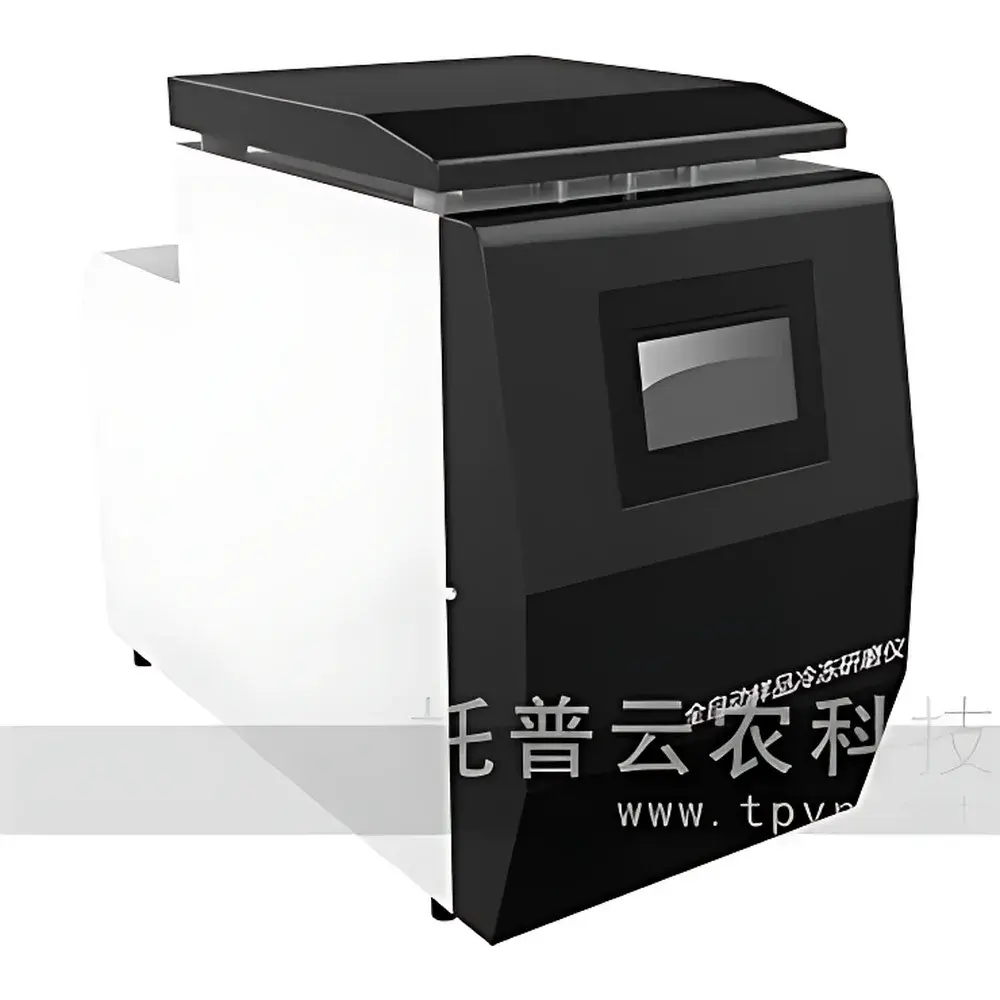
Top Cloud-agri YMY-240CL Cryogenic Ball Mill
| Brand | Top Cloud-agri |
|---|---|
| Origin | Zhejiang, China |
| Manufacturer Type | Direct Manufacturer |
| Country of Origin | China |
| Model | YMY-240CL |
| Price | Upon Request |
| Max Sample Capacity | 24 samples (simultaneous) |
| Final Particle Size | ~5 µm |
| Grinding Platform Count | >2 |
| Frequency Range | 0–70 Hz |
| Processing Time | 0–9999 min |
| Rotational Speed | 1000–7000 rpm |
| Grinding Ball Diameter | 0.1–30 mm |
| Grinding Ball Materials | Alloy Steel, Chrome Steel, Zirconia, Tungsten Carbide, Quartz Sand |
| Noise Level | <55 dB(A) |
| Temperature Control Range | −50 °C to +37 °C |
| Adapter Materials | PTFE or Alloy Steel |
| Sample Compatibility | Tissues (heart, spleen, lung, kidney, bone, skin, hair), Microorganisms (bacteria, yeast, fungi, spores), Soil, Plant Material, Fossil Specimens |
| Grinding Modes | Dry, Wet, Cryogenic |
| Data Storage | 10 Preset Protocols |
| Safety | Electromagnetic Lid Lock, Auto-Centering Clamp |
| Acceleration/Deceleration | ≤2 sec to max/min speed |
| Cross-Contamination Prevention | Individual Sealed Vials per Position |
| Adapter Customization | Available for 2 mL, 10 mL, and User-Specified Tube Formats |
Overview
The Top Cloud-agri YMY-240CL Cryogenic Ball Mill is an engineered solution for high-throughput, low-temperature mechanical homogenization and cell disruption in life science and analytical laboratories. Operating on the principle of high-frequency oscillatory impact grinding—where grinding balls are accelerated within sealed vials at controlled cryogenic temperatures—the instrument preserves thermolabile analytes (e.g., nucleic acids, proteins, metabolites, and labile enzymes) by minimizing thermal degradation during sample preparation. Unlike ambient-temperature mills, its integrated refrigeration system maintains sample integrity across diverse biological matrices, including fibrous plant tissues, mineral-rich bone, keratinized hair, and microbial cell walls with high structural resilience. Designed for reproducible, scalable sample processing, the YMY-240CL supports standardized workflows compliant with ISO 17025-accredited laboratory practices and GLP/GMP-aligned sample prep protocols.
Key Features
- Cryogenic temperature control: Precise regulation from −50 °C to +37 °C ensures consistent thermal management across all vial positions—critical for RNA integrity (RIN >8.5) and protease inhibition.
- Dual-platform oscillation architecture: Two independent grinding platforms enable asynchronous or synchronized operation, supporting parallel processing of heterogeneous sample types without cross-contamination.
- Intelligent touchscreen interface: 7-inch capacitive display with intuitive navigation, real-time parameter monitoring (frequency, time, temperature), and audit-trail-capable protocol logging.
- Preset biological tissue modes: Factory-configured protocols for heart, spleen, lung, kidney, bone, skin, and hair—each optimized for frequency ramping, dwell time, and cooling cycle duration.
- Auto-centering clamping system: Mechanically self-aligning vial holders ensure uniform energy transfer and eliminate positional bias during high-speed oscillation (up to 70 Hz).
- Rapid dynamic response: Achieves target frequency (0–70 Hz) or rotational equivalent (1000–7000 rpm) within ≤2 seconds, enabling precise pulse-mode grinding for fragile samples.
- Modular adapter ecosystem: Interchangeable PTFE and alloy steel adapters for 2 mL, 10 mL, and custom tube formats; compatible with standard microcentrifuge tubes, stainless-steel jars, and cryovials.
- Safety-integrated design: Electromagnetic lid interlock prevents operation when open; overtemperature and overpressure sensors trigger automatic shutdown.
Sample Compatibility & Compliance
The YMY-240CL accommodates a broad spectrum of challenging sample classes: soft mammalian tissues (e.g., liver, brain), calcified tissues (femur, tooth), chitinous structures (insect exoskeletons), lignocellulosic plant matter (wood, seed coats), environmental matrices (soil aggregates, sediment cores), and microbial cultures (Gram-positive bacteria, fungal hyphae, yeast pellets). All grinding vials are sealed under inert atmosphere (optional N₂ purge) to prevent oxidation. The system meets mechanical safety requirements per IEC 61000-6-2 (EMC immunity) and IEC 61000-6-4 (EMC emission), and its operational parameters support traceability under FDA 21 CFR Part 11 when paired with validated LIMS integration.
Software & Data Management
Embedded firmware stores up to 10 user-defined protocols with timestamped execution logs, including start/stop times, actual vs. setpoint temperature profiles, and frequency stability metrics. Exportable CSV reports include per-sample metadata (vial ID, ball type/diameter, cycle count), facilitating QC review and regulatory documentation. Optional Ethernet/Wi-Fi connectivity enables remote monitoring and centralized protocol deployment across multi-instrument labs—supporting ISO/IEC 17025 clause 7.7 (control of equipment records) and USP Analytical Instrument Qualification frameworks.
Applications
- High-yield genomic DNA/RNA extraction from fibrous or fatty tissues prior to NGS library prep
- Pre-analytical homogenization for LC-MS/MS-based metabolomics and lipidomics workflows
- Particle size reduction of pharmaceutical excipients and nanocrystal formulations
- Soil microbiome sampling where enzymatic activity must be arrested instantly upon collection
- Forensic tissue processing under chain-of-custody-compliant conditions
- Material science applications: dispersion of graphene oxide, metal-organic frameworks (MOFs), and ceramic precursors in solvent-free milling
FAQ
What refrigerants are used in the YMY-240CL cooling system?
The unit employs a closed-loop, compressor-based refrigeration circuit using R-404A refrigerant—no liquid nitrogen or external cryogens required.
Can the instrument be validated for GMP environments?
Yes—IQ/OQ documentation templates are available; performance qualification (PQ) can be executed using NIST-traceable temperature probes and certified reference standards for particle size distribution.
Is it possible to integrate the mill with robotic liquid handlers?
The device features RS-232 and Modbus TCP interfaces, enabling synchronization with third-party automation platforms for unattended batch processing.
How is cross-contamination prevented between samples?
Each vial operates in an isolated chamber; PTFE adapters provide chemical inertness, while stainless-steel components undergo optional passivation. No shared grinding media—balls are loaded per vial and tracked via barcoded inventory.
Does the system support regulatory audit trails?
All parameter changes, run executions, and error events are logged with UTC timestamps and operator IDs; logs are exportable and tamper-evident when stored on external encrypted drives.



