
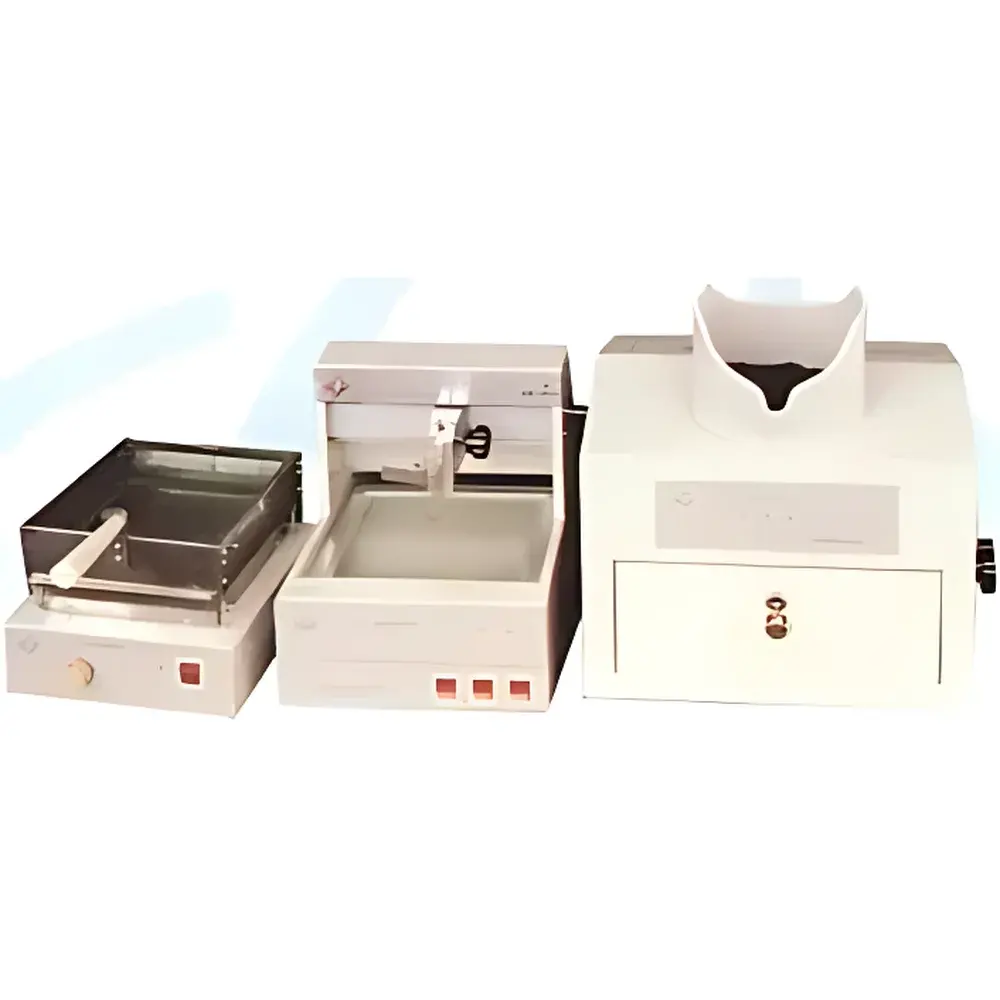
TOP-HJ-2 Mycotoxin Rapid Test Instrument
| Origin | Zhejiang, China |
|---|---|
| Manufacturer Type | Distributor |
| Origin Category | Domestic |
| Model | HJ-2 |
| Price | USD 850 (FOB) |
| Detection Principle | Thin-Layer Chromatography (TLC) with UV Fluorescence Quantification |
| Excitation Wavelength | 365 nm |
| Minimum Detectable Amount | 0.4 ng (AFB₁) |
| Sample Throughput | Up to 8 samples per run |
| Power Supply | AC 220 V, 50 Hz |
| Heater Plate | 200 mm × 200 mm, 600 W |
| UV Observation Chamber | 300 mm × 310 mm × 445 mm, 12 W lamp |
| Net Weight (Total System) | ~25 kg |
| Overall Footprint | < 0.1 m² |
Overview
The TOP-HJ-2 Mycotoxin Rapid Test Instrument is a dedicated thin-layer chromatography (TLC)-based analytical system engineered for the qualitative and semi-quantitative determination of aflatoxin B₁ (AFB₁) in complex food and feed matrices. Unlike immunoassay-based rapid test kits, the HJ-2 leverages classical TLC separation coupled with high-sensitivity 365 nm ultraviolet fluorescence detection—a method recognized in multiple national standard protocols (e.g., GB 5009.22–2016, China National Food Safety Standard for Aflatoxins in Foods). The instrument integrates three modular units—sample concentrator/spotter, horizontal development chamber, and UV visualization cabinet—into a compact, benchtop workflow optimized for routine screening in QC laboratories, grain inspection stations, and feed mills where regulatory compliance and method traceability are required.
Key Features
- Integrated TLC workflow architecture: Combines sample concentration, precise micro-spotting (spot diameter < 3 mm), solvent-based chromatographic development, and fluorescence-based detection in a single-purpose platform.
- Dedicated 365 nm UV excitation source: 12 W cold-cathode fluorescent lamp ensures stable output and minimal thermal degradation of aflatoxin standards during observation.
- Programmable heating plate: 200 mm × 200 mm ceramic surface with 600 W power enables controlled solvent evaporation and sample pre-concentration prior to spotting—critical for achieving the stated 0.4 ng minimum detectable amount of AFB₁.
- Benchtop modularity: Separable units (heater, development tank, UV cabinet) allow flexible configuration, easy cleaning, and independent calibration verification per ISO/IEC 17025 guidelines.
- No reagent consumption beyond standard TLC solvents (e.g., chloroform–acetone–water mixtures) and silica gel plates—eliminating recurring costs associated with antibody conjugates or enzymatic substrates.
Sample Compatibility & Compliance
The HJ-2 supports validated extraction protocols for cereals (corn, rice, wheat), oilseeds (peanuts, cottonseed), animal feed, dried fruits, fermented soy products, and aquatic feed. Sample preparation follows AOAC Official Method 994.02 principles: homogenization, solvent extraction (typically methanol–water or chloroform), liquid–liquid partitioning, and cleanup via solid-phase extraction (SPE) or immunoaffinity columns (optional). While the instrument itself does not perform extraction, its operational parameters—including spot volume control, development distance consistency, and UV intensity uniformity—are designed to meet repeatability requirements specified in GB/T 5009.22 and aligned with Codex Alimentarius Guideline CXG 193–1995. The system supports GLP documentation through manual logbook entries; digital audit trails require external LIMS integration.
Software & Data Management
The HJ-2 operates as a hardware-only platform with no embedded firmware or proprietary software. All data acquisition, image capture, and quantification are performed externally using calibrated UV photography systems or third-party densitometry tools (e.g., ImageJ with TLC plug-ins, or commercial systems such as CAMAG Reprostar 3). This design ensures full transparency in measurement traceability and avoids vendor lock-in. Users retain complete control over calibration curves (prepared from AFB₁ reference standards traceable to NIST SRM 2374), limit-of-detection validation, and reporting formats compatible with internal QA templates or regulatory submissions (e.g., FDA Form 3631, EU RASFF notifications).
Applications
- Routine screening of raw agricultural commodities at intake points in flour mills and feed blending facilities.
- Confirmatory testing following positive lateral-flow assay results, per EU Commission Regulation (EC) No 401/2006 Annex I requirements.
- Method validation studies comparing TLC performance against LC-MS/MS reference methods under ISO 5725-2 precision criteria.
- Educational use in food science laboratories to demonstrate fundamental mycotoxin chemistry, chromatographic resolution, and fluorescence photophysics.
- Field-deployable operation in mobile labs equipped with stable AC supply and ambient temperature control (15–25 °C recommended).
FAQ
Does the HJ-2 comply with international regulatory standards for aflatoxin testing?
Yes—the instrument supports methodologies referenced in Codex Alimentarius, GB 5009.22–2016, and AOAC 994.02. Final compliance depends on full implementation of validated SOPs, reference material traceability, and analyst training per ISO/IEC 17025.
Can the HJ-2 quantify aflatoxin B₂, G₁, or G₂?
No—it is optimized specifically for AFB₁ detection via its characteristic violet-blue fluorescence under 365 nm UV. Other aflatoxins require alternative excitation wavelengths or HPLC-based confirmation.
Is the UV observation cabinet safe for prolonged operator use?
The cabinet features interlocked door switches and UV-blocking acrylic shielding compliant with IEC 62471 (Photobiological Safety of Lamps). Operators must wear UV-protective eyewear during manual inspection.
What maintenance is required for long-term accuracy?
Annual verification of heater plate temperature uniformity (±2 °C), UV lamp irradiance (using NIST-traceable radiometer), and spotting precision (via calibrated micropipette and dye test) is recommended.
Is technical support available outside mainland China?
Distributor-level application support is provided globally; hardware service contracts and spare parts (e.g., replacement lamps, heating elements) are available through authorized regional partners.






