
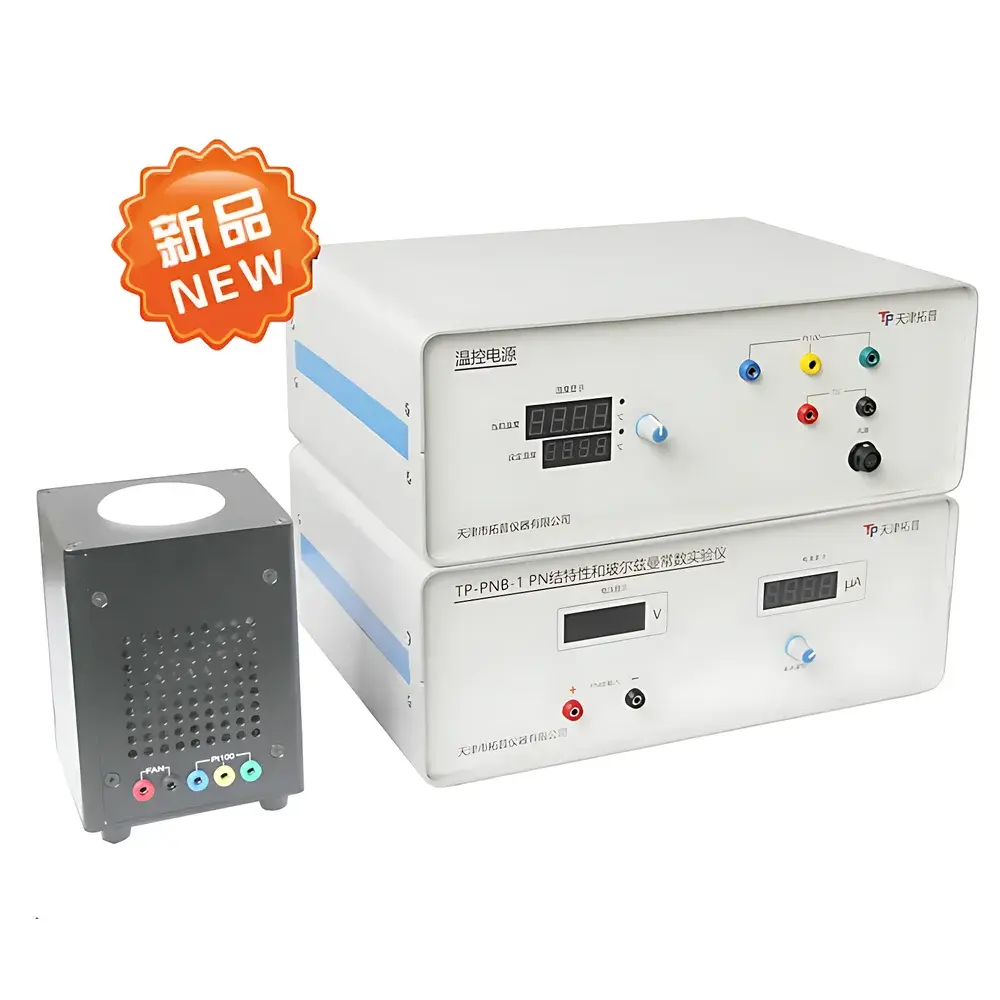
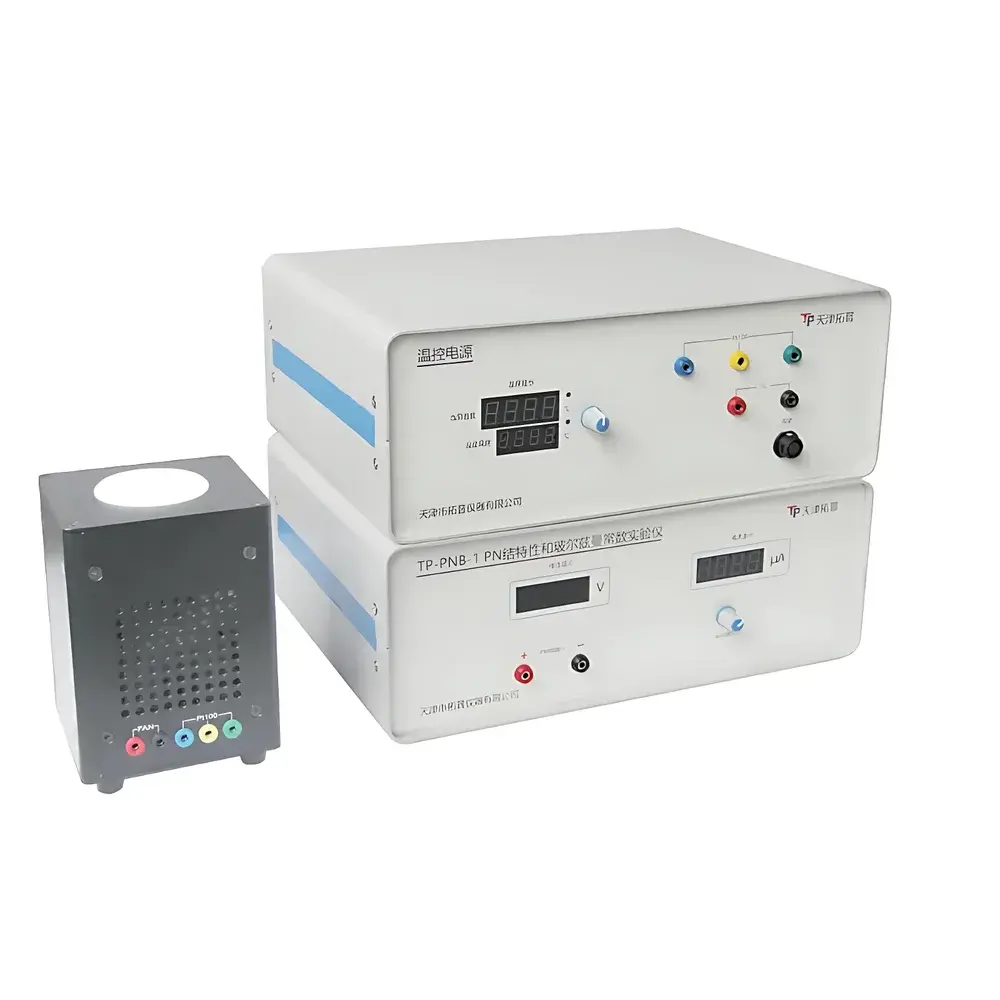
Top PNP TP-PNB-1 PN Junction Physical Characteristics Experiment System
| Brand | Top PNP |
|---|---|
| Origin | Tianjin, China |
| Manufacturer Type | Direct Manufacturer |
| Region Classification | Domestic (China) |
| Model | TP-PNB-1 |
| Pricing | Available Upon Request |
Overview
The Top PNP TP-PNB-1 PN Junction Physical Characteristics Experiment System is a precision educational and research-grade instrument engineered for quantitative characterization of semiconductor diode physics. It operates on the fundamental principle that the forward-biased voltage–current–temperature (V–I–T) relationship of an Si-based PN junction follows the Shockley diode equation, modified to account for thermal voltage variation. By applying a highly stable, digitally controlled microcurrent source (ranging from 1 µA to 10 mA) and measuring the corresponding forward voltage drop across the junction with millivolt-level resolution, the system enables experimental determination of key semiconductor parameters—including the Boltzmann constant (k), the temperature sensitivity coefficient (S = dVf/dT), and the bandgap energy (Eg) of silicon—via linear regression of ln(I) vs. 1/T or Vf vs. T plots. The integrated thermally regulated measurement chamber supports controlled thermal sweeps from 25 °C to 80 °C (±0.1 °C stability), facilitating reproducible acquisition of temperature-dependent I–V families under laboratory conditions.
Key Features
- Digital encoder-controlled microcurrent source ensures fine-grained, drift-free current adjustment with repeatable step resolution down to 1 µA—critical for low-current regime measurements where series resistance and recombination effects dominate.
- Four-range manual switching interface for forward voltage measurement (200 mV / 2 V / 20 V / 200 V full-scale), each optimized for signal-to-noise ratio and linearity; auto-zeroing circuitry minimizes offset errors prior to data capture.
- PID-based temperature controller with Pt100 sensor feedback delivers rapid thermal equilibration (< 3 min to ±0.2 °C at target) and long-term stability (< ±0.1 °C over 60 min), meeting pedagogical requirements for steady-state V–I curve tracing.
- Modular mechanical design includes interchangeable silicon diode test fixtures with spring-loaded gold-plated contacts, minimizing contact resistance variability and enabling consistent probe alignment across repeated experiments.
- Front-panel LED indicators provide real-time status feedback for current output mode, temperature setpoint attainment, and measurement range selection—reducing operator error in undergraduate teaching labs.
Sample Compatibility & Compliance
The TP-PNB-1 is validated for use with standard planar silicon PN junction diodes (e.g., 1N4148, IN4007, or custom lab-fabricated devices with known doping profiles). It accommodates axial-lead packages up to 5 mm diameter and PCB-mount SMD variants via optional adapter kits. All electrical isolation meets IEC 61010-1:2010 safety standards for laboratory measurement equipment. While not certified for industrial QA/QC compliance, its measurement methodology aligns with foundational semiconductor characterization practices referenced in ASTM F1740–21 (Standard Practice for Electrical Testing of Silicon Wafers) and ISO/IEC 17025–2017 principles for calibration traceability in academic instrumentation.
Software & Data Management
The system supports analog voltage and current outputs (0–5 V DC, scaled linearly) compatible with third-party DAQ systems (e.g., NI USB-6009, Keysight 34972A) and open-source platforms such as Arduino or Raspberry Pi for custom data logging. Optional LabVIEW-compatible drivers (provided upon request) enable automated temperature ramping, synchronized V–I sampling, and real-time parameter extraction—including automatic calculation of Eg via extrapolation of Vf(T) to 0 K. All raw datasets export in CSV format with timestamped metadata (setpoint T, measured T, I, Vf, ambient RH), supporting GLP-aligned documentation for student lab reports and faculty-led research projects.
Applications
- Undergraduate solid-state physics laboratories: Experimental verification of the diode equation, thermal voltage derivation (kT/q), and empirical bandgap estimation.
- Materials science courses: Comparative analysis of Eg temperature dependence across doped Si samples; correlation of ideality factor (n) with fabrication quality.
- Engineering curriculum modules: Hands-on training in precision low-current sourcing, four-wire sensing fundamentals, and closed-loop thermal control theory.
- Research preparatory work: Preliminary characterization of novel junction materials prior to full device testing in cleanroom environments.
- Calibration reference setup: Used in conjunction with digital multimeters traceable to national standards for validating low-voltage/low-current measurement chains.
FAQ
Is the TP-PNB-1 suitable for measuring Schottky or Zener diodes?
Yes—within its specified current and voltage ranges—but interpretation of extracted parameters requires modification of theoretical models (e.g., thermionic emission for Schottky, tunneling for Zener), and users must account for non-idealities such as series resistance and leakage.
Does the system include calibration certificates or NIST-traceable documentation?
Factory calibration data is provided for current source linearity and temperature sensor accuracy; however, formal NIST-traceable certification requires third-party metrology lab engagement per ISO/IEC 17025.
Can multiple temperature setpoints be programmed for unattended sequential measurements?
No—the unit features manual PID setpoint entry only. Automated multi-step thermal protocols require external DAQ integration using the analog control and monitoring outputs.
What is the typical warm-up time before measurement stability is achieved?
Allow 15 minutes after power-on for internal thermal equilibrium; subsequent temperature transitions stabilize within 2–3 minutes after setpoint change, verified by onboard Pt100 readout convergence.
Are replacement diodes or test fixtures available as consumables?
Standard 1N4148 diodes and spring-contact test holders are stocked as spare parts; custom fixture designs can be fabricated upon technical specification submission.



