
TOP-UNISTAR ultraLYZE VUV Vacuum Ultraviolet Spectrophotometer
| Brand | TOP-UNISTAR |
|---|---|
| Origin | Hong Kong, China |
| Manufacturer Type | Authorized Distributor |
| Product Origin | Domestic (PRC) |
| Model | ultraLYZE VUV |
| Pricing | Upon Request |
| Wavelength Range | 115–350 nm |
| Measurement Modes | Transmittance (T), Reflectance (R) |
| Accuracy (R/T) | < 0.3% |
| Wavelength Resolution | < 0.1 nm |
| Operating Environment | High Vacuum (<10⁻⁶ mbar) or N₂ Purge |
| Detector | Angle-Adjustable PMT with Reference Channel |
| Optional Modules | Polarizer, Micro-Focusing Optics, Automated Sample Transfer System |
Overview
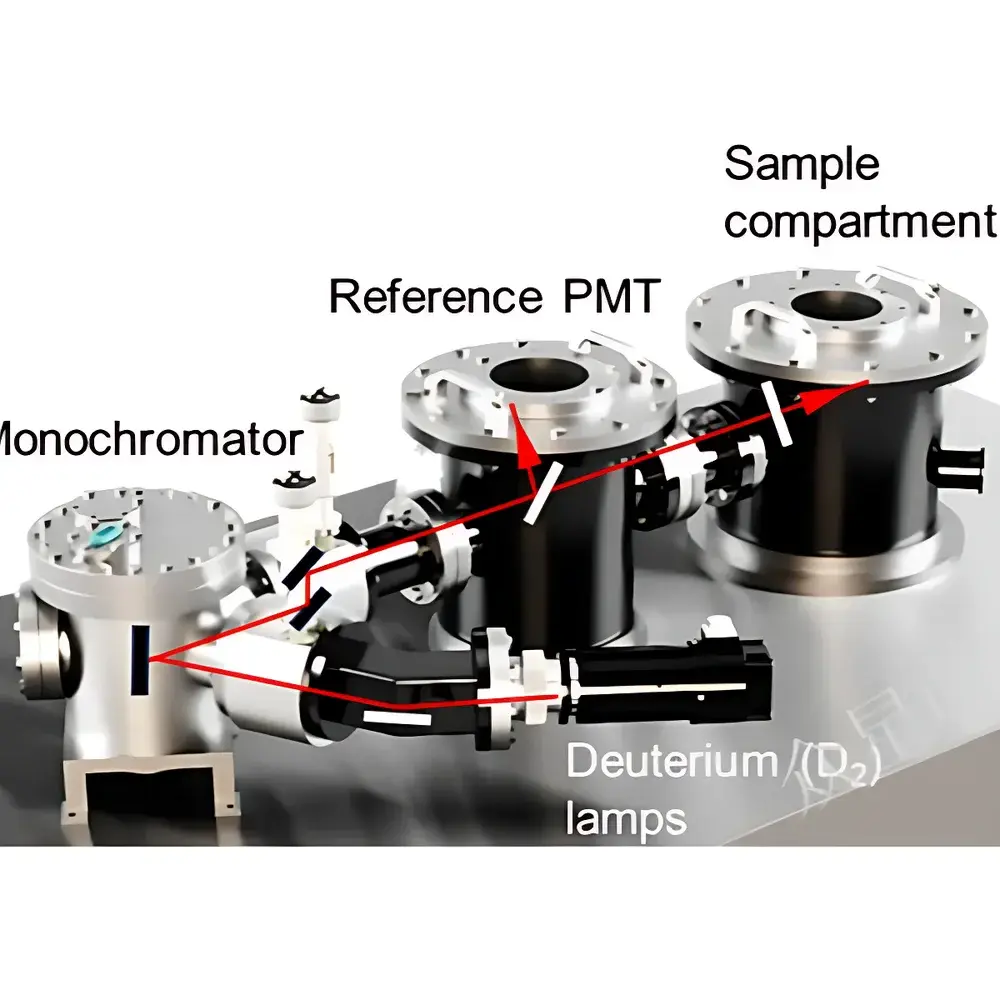
The TOP-UNISTAR ultraLYZE VUV is a research-grade vacuum ultraviolet (VUV) spectrophotometer engineered for high-fidelity optical characterization in the critical 115–350 nm spectral region. Unlike conventional UV-Vis instruments limited by atmospheric oxygen absorption below ~190 nm, the ultraLYZE VUV operates under controlled high-vacuum (<10⁻⁶ mbar) or nitrogen-purged conditions to eliminate O₂-induced attenuation and surface oxidation artifacts. Its core measurement principle relies on double-beam, real-time referenced photometry using a deuterium-based VUV continuum source and a high-efficiency Rowland-circle monochromator optimized for 100–300 nm diffraction. This architecture ensures traceable, stable spectral response across the entire deep-UV range—enabling quantitative transmittance and reflectance measurements essential for optical material development, lithographic process control, and space instrumentation validation.
Key Features
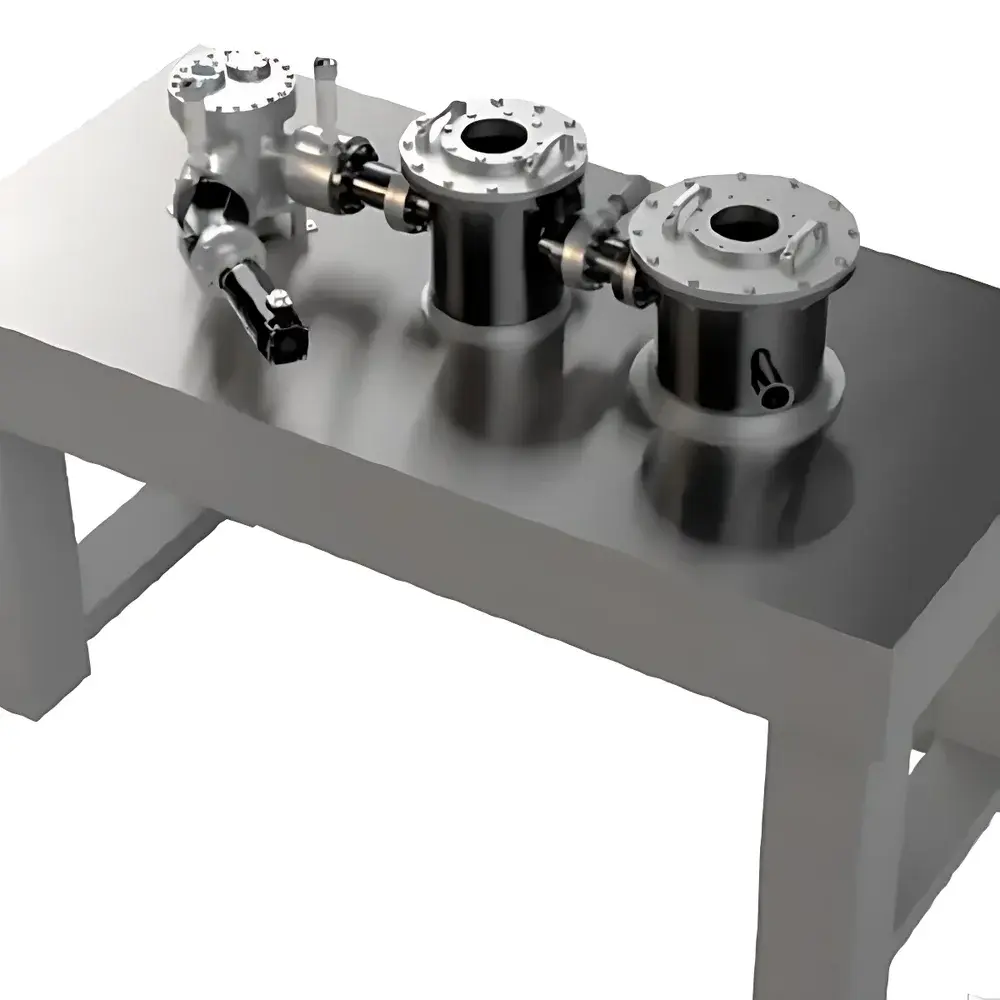
- Vacuum-compatible optical path with integrated turbomolecular pumping system achieving base pressure <10⁻⁶ mbar; alternatively configurable for continuous N₂ purge mode to reduce operational overhead
- Deuterium lamp source delivering stable, continuous emission from 115 nm through 350 nm—covering Lyman-α (121.6 nm), F₂ excimer (157 nm), ArF excimer (193 nm), and higher-order harmonics
- Rowland-circle monochromator with holographically ruled grating, delivering wavelength resolution 45% in the 115–200 nm band
- Dual-channel photomultiplier tube (PMT) detection system with mechanically adjustable incidence angle (±10°) and dedicated reference beam path for real-time signal normalization
- Turn-key automation including motorized slit control, wavelength scanning, and sample stage positioning—fully programmable via LabVIEW-based controller interface
- Modular mechanical design supporting field-upgradable components: rotating polarizer for S/P-state-resolved measurements, micro-focusing optics for ≤100 µm spot mapping, and multi-position sample carousel for unattended batch analysis
Sample Compatibility & Compliance
The ultraLYZE VUV accommodates flat, polished substrates up to Ø50 mm and thicknesses from 0.1 mm to 25 mm—including fused silica, CaF₂, MgF₂, sapphire, and multilayer dielectric coatings. Sample holders are compatible with cryogenic stages (80–300 K) and in-situ heating fixtures (up to 200 °C). All optical components use low-outgassing stainless steel and VITON-free vacuum seals compliant with ISO 27492 (Vacuum Technology — Materials Outgassing Requirements) and ASTM E2239 (Standard Practice for Vacuum Chamber Leak Testing). Data acquisition meets GLP audit requirements through timestamped metadata logging, user-access-level permissions, and electronic signature support aligned with FDA 21 CFR Part 11 Annex 11 principles.
Software & Data Management
Control and analysis are executed via ultraLYZE Control Suite—a Windows-native application built on modular C++ libraries with Python API extension capability. The software provides ISO/IEC 17025-aligned calibration workflows, including NIST-traceable spectral responsivity correction using certified VUV standard reference materials (SRMs). Raw spectra are stored in HDF5 format with embedded experimental parameters (pressure, detector HV, slit width, integration time). Batch processing supports ASTM E308-compliant colorimetric conversion, T/R ratio derivation, and thin-film optical constant inversion (n, k) via Levenberg-Marquardt fitting against transfer-matrix models. Audit trails record all parameter changes, user logins, and calibration events with SHA-256 hashing for data integrity verification.
Applications
- Optical Coating Development: Quantitative evaluation of VUV antireflection performance on MgF₂-coated mirrors and broadband transmission loss in CaF₂ lens assemblies used in synchrotron beamlines
- Semiconductor Lithography: Absorption coefficient profiling of 193 nm and 157 nm photoresists; uniformity mapping of film thickness variation across 300 mm wafers via spatially resolved reflectance
- Space Instrument Qualification: In-flight-relevant reflectance validation of Ir/Al-coated X-ray mirror coatings at 121.6 nm (Lyman-α) under simulated orbital thermal cycling
- Advanced Materials Research: Bandgap determination of wide-bandgap semiconductors (e.g., AlN, BN) and excitonic absorption features in 2D transition metal dichalcogenides
- Nuclear Fusion Diagnostics: Calibration of VUV spectrometer channels for ITER divertor plasma monitoring using certified reflectance standards
FAQ
What vacuum level is required for reliable 115 nm measurements?
A base pressure ≤5×10⁻⁷ mbar is recommended for optimal signal-to-noise at 115 nm; the system achieves this within 90 minutes using its dual-stage turbomolecular pump configuration.
Can the ultraLYZE VUV measure diffuse reflectance?
Yes—when equipped with the optional integrating sphere module (model IS-VUV-115), it supports ASTM E1331-compliant diffuse/near-specular separation for rough or textured surfaces.
Is NIST-traceable calibration available?
Calibration services include NIST SRM 2065 (VUV reflectance standard) and SRM 2066 (VUV transmittance standard), with full uncertainty budgets per ISO/IEC 17025.
How is ozone generation mitigated during operation?
The system incorporates catalytic ozone destruct units upstream of the exhaust line and uses oxygen-scavenging getter materials inside the optical chamber to suppress O₃ accumulation.
What file formats are supported for data export?
Spectra export natively to CSV, ASCII, JCAMP-DX, and HDF5; project archives include XML metadata conforming to the IUPAC Spectral Data Exchange Standard (SDES).





