
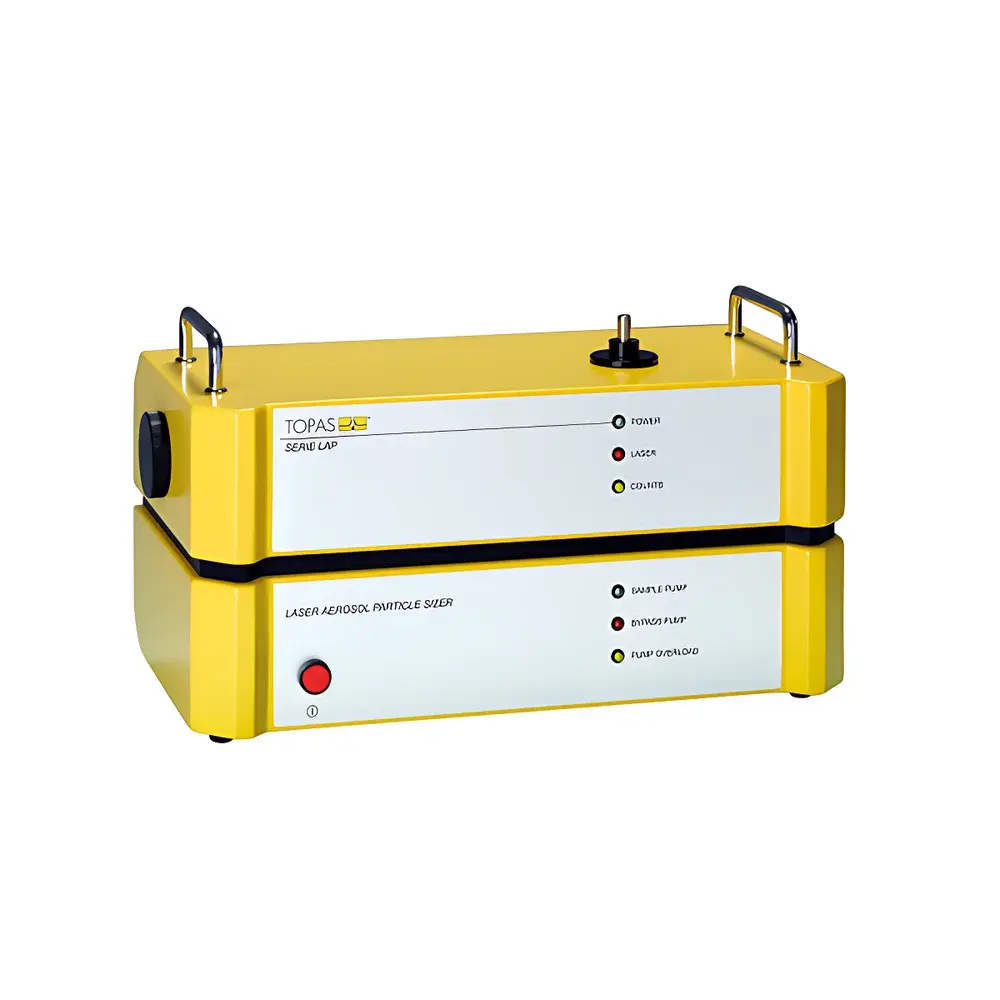
TOPAS LAP323 Dual-Wavelength Optical Aerosol Particle Size Spectrometer
| Brand | TOPAS |
|---|---|
| Origin | Germany |
| Model | LAP323 |
| Principle | Dual-wavelength optical light scattering (660 nm red & 450 nm blue laser diodes) |
| Sample Flow Rate | 3.0 L/min (total), 0.1 L/min (measurement) |
| Particle Size Range | 0.15–40 µm |
| Counting Range | up to 10⁷ particles/L |
| Size Channels | 128 (user-definable) |
| Mass Concentration Range | up to 10⁴ pg/cm³ |
| Compliance | ISO 21501-1:2009, VDI 3867-4:2020(E) |
| Dimensions | 220 × 380 × 200 mm |
| Weight | 9.4 kg |
| Power | 110–230 VAC, 50–60 Hz or 12 VDC, 4.2 A |
Overview
The TOPAS LAP323 is a high-resolution, dual-wavelength optical aerosol particle size spectrometer engineered for precise, real-time measurement of airborne particle number size distribution across a broad dynamic range—from ultrafine nuclei mode (0.15 µm) to coarse-mode particles (40 µm). It operates on the principle of Mie-scattered light detection using two independently calibrated laser sources: a 660 nm red laser diode (30 mW) and a 450 nm blue laser diode (60 mW). This dual-wavelength configuration mitigates inherent ambiguities in single-wavelength Mie inversion—particularly in the critical 0.3–1.0 µm range—where scattering intensity vs. particle diameter exhibits local minima and inflection points. By simultaneously acquiring orthogonal scattering signatures, the LAP323 achieves unambiguous particle sizing with enhanced classification fidelity, reduced ambiguity in bin assignment, and improved lower detection limit stability under variable refractive index conditions. The instrument integrates an internal volumetric pump, precision laminar flow control, and a thermally stabilized optical detection chamber, ensuring long-term repeatability and metrological traceability per ISO 21501-1:2009 and VDI 3867-4:2020(E).
Key Features
- Dual-wavelength optical detection (660 nm + 450 nm) enabling robust particle sizing across refractive index variations and eliminating Mie scattering ambiguities
- 128 fully user-definable size channels—configurable to match application-specific resolution requirements (e.g., narrow bins for filter efficiency testing or wide bins for ambient monitoring)
- Integrated bypass filtration system allowing gravimetric mass concentration validation (via optional pre-weighed filters) with >95% total flow routed through the removable bypass filter
- Optimized optical cavity design featuring uniform, high-intensity illumination and minimized edge-effects—reducing wall losses and improving counting efficiency for sub-0.3 µm particles
- Intelligent flow management: total sample flow of 3.0 L/min; precisely metered 0.1 L/min directed into the sensing zone via laminar flow restrictor and pressure-compensated flow control
- Compact benchtop form factor (220 × 380 × 200 mm), low power consumption (12 VDC option available), and EMI-hardened electronics suitable for laboratory, cleanroom, and mobile field deployment
Sample Compatibility & Compliance
The LAP323 is validated for use with polydisperse aerosols of diverse composition—including DEHS, NaCl, ammonium sulfate, carbon black, TiO₂, pharmaceutical dry powder inhalers (DPIs), oil mists, combustion soot, and ambient urban particulate matter (PM). Its optical calibration is traceable to NIST-traceable PSL and silica standards. The instrument meets the performance criteria specified in ISO 21501-1:2009 for light-scattering particle counters and complies with VDI 3867-4:2020(E) for aerosol measurement in technical environments. For regulated environments, raw data export supports audit-ready workflows compatible with GLP/GMP documentation requirements; timestamped channel histograms, pulse height distributions, and calibration logs are retained internally and exportable via RS232.
Software & Data Management
The LAP323 ships with PASWin software (v6.x or later), a Windows-based platform supporting real-time visualization, multi-instrument synchronization, automated calibration curve generation, and batch processing of time-resolved size distribution matrices. PASWin implements ISO-compliant Mie inversion algorithms with adjustable complex refractive index inputs (1.0–2.5 real part, 0–0.1 imaginary part). All measurements include embedded metadata: instrument ID, calibration date, flow rate, temperature, relative humidity (when connected to optional external sensors), and operator-defined sample IDs. Data exports are provided in ASCII CSV and HDF5 formats—both natively ingestible by Python (pandas/h5py), MATLAB, and commercial analytics platforms. Audit trail functionality records all parameter changes, calibration events, and file modifications in accordance with FDA 21 CFR Part 11 principles when used in validated environments.
Applications
- High-fidelity aerosol characterization in environmental chambers, exposure studies, and indoor air quality assessments
- Filter media evaluation per ISO 16890 and EN 1822—measuring penetration curves across 0.15–10 µm with statistical confidence at low-count conditions
- Pharmaceutical aerosol development: DPI and pMDI plume analysis, dose uniformity testing, and aerodynamic particle size distribution (APSD) verification
- Industrial hygiene monitoring: oil mist, welding fume, and metalworking fluid aerosol profiling for OEL compliance
- Calibration transfer and reference standard generation for OPCs, SMPS systems, and cascade impactors
- Research-grade nanoparticle synthesis process control and reactor effluent monitoring
FAQ
What particle refractive indices are supported in PASWin’s Mie inversion?
PASWin allows manual entry of complex refractive index (n + ik) values ranging from n = 1.00 to 2.50 and k = 0.00 to 0.10—covering common aerosols including water droplets, hydrocarbons, salts, and metal oxides.
Can the LAP323 operate continuously for unattended long-term monitoring?
Yes—the instrument supports 24/7 operation with thermal stabilization active, internal diagnostics logging, and configurable auto-zero cycles. External trigger inputs enable synchronization with environmental chamber protocols or emission event timers.
Is the 128-channel resolution hardware-limited or software-configurable?
The detector and signal processing architecture support up to 128 simultaneous pulse-height bins; users may define any subset (e.g., 32 or 64) with custom boundary values via PASWin—retaining full dynamic range and statistical integrity.
How is mass concentration derived from number distribution data?
Mass concentration is calculated using user-specified particle density and shape factor (spherical default), integrated over the measured size distribution. Gravimetric validation is performed separately using the integrated bypass filter path and analytical balance.
Does the LAP323 require annual factory recalibration?
While no mandatory annual recalibration is stipulated, TOPAS recommends biannual verification using NIST-traceable PSL standards; full optical alignment and flow calibration services are available through authorized service centers in Europe and North America.







