
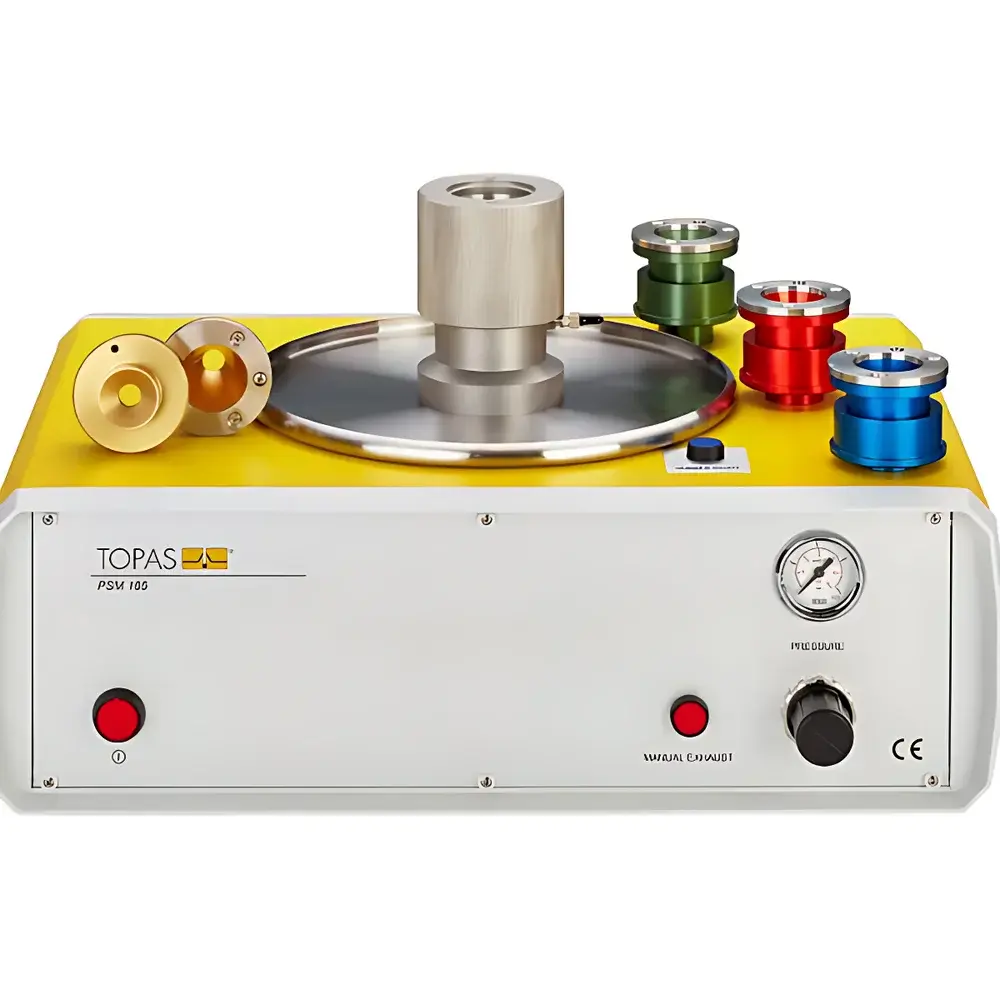
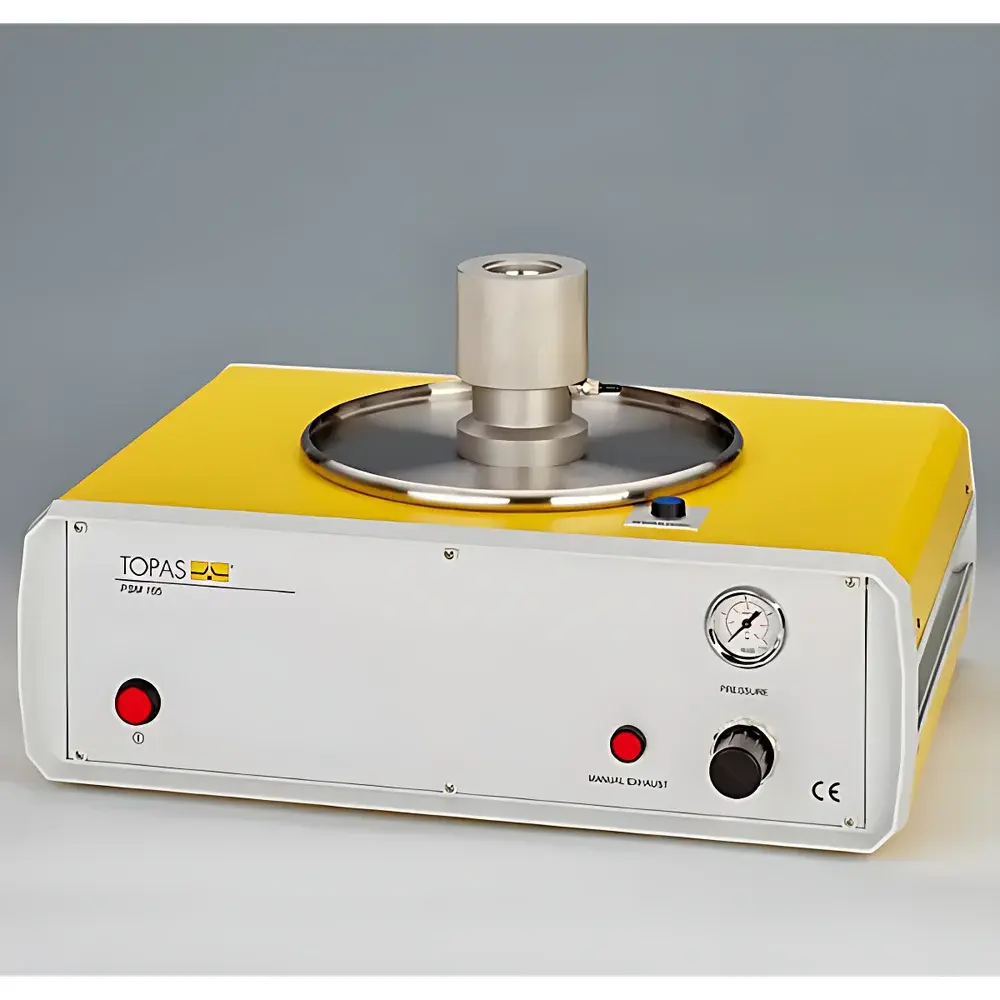
TOPAS PSM-165 Capillary Flow Porometer
| Brand | TOPAS |
|---|---|
| Origin | Germany |
| Model | PSM-165 |
| Measurement Principle | Capillary Flow Porometry (CFP) |
| Pore Size Range | 0.25–130 µm |
| Max Test Pressure | 6 bar |
| Operating Fluid | TOPOR® wetting liquid (custom-formulated fluorinated inert fluid) |
| Power Supply | 110–230 V AC |
| Dimensions (W×H×D) | 480 × 390 × 310 mm |
| Weight | 12 kg |
| Compliance | ASTM E1294-89, ASTM F316-03 |
Overview
The TOPAS PSM-165 Capillary Flow Porometer is a precision-engineered instrument for quantitative characterization of pore size distribution, bubble point pressure, and gas permeability in macro- to mesoporous materials. It operates on the fundamental principle of capillary flow porometry (CFP), a standardized gas-liquid displacement technique governed by the Young–Laplace equation. In this method, a non-volatile, low-surface-tension test liquid (TOPOR®) fully wets the sample’s pore network under vacuum; subsequent pressurized gas intrusion displaces the liquid from pores progressively—from largest to smallest—based on their hydraulic diameter. The resulting pressure-volume flow curve enables calculation of pore size distribution, mean flow pore size, minimum (bubble point) and maximum pore sizes, and dry/wet flow curves. Designed specifically for open-cell, high-porosity substrates—including nonwovens, sintered metals/polymers, filter papers, micromeshes, and tissue engineering scaffolds—the PSM-165 delivers high reproducibility for pores >0.25 µm, with optimal resolution in the 10–100 µm range critical for filtration, hygiene product development, and barrier material qualification.
Key Features
- Engineered for robust, repeatable capillary flow measurements across a broad pore size range (0.25–130 µm), with enhanced sensitivity for porous media >10 µm—ideal for nonwovens, meltblown fabrics, and sintered metal filters.
- User-configurable sample holders accommodate diverse geometries and thicknesses, including rigid, compressible, and layered structures; optional manual bubble point mode supports direct measurement of dense or low-permeability samples without automated pressure ramping.
- Integrated pressure control system with digital regulation up to 6 bar ensures precise, stepwise gas intrusion and minimizes overshoot during critical bubble point detection.
- PSMWin software provides full instrument control, real-time flow monitoring, automatic curve fitting, and ISO/ASTM-compliant reporting—including bubble point, mean flow pore size (MFPS), and cumulative/differential pore size distributions.
- TOPOR®—a proprietary, chemically inert, low-volatility fluorinated liquid—is pre-optimized for complete wetting of hydrophobic and hydrophilic surfaces, eliminating user-dependent wetting validation steps and ensuring compliance with ASTM F316-03 requirements for test fluid selection.
Sample Compatibility & Compliance
The PSM-165 is validated for flat, sheet-like porous materials with thicknesses from 0.1 mm to 15 mm and diameters up to 70 mm. Compatible substrates include polypropylene and polyester nonwovens, cellulose-based filter papers, stainless steel and bronze sintered membranes, expanded PTFE, ceramic monoliths, and electrospun polymer mats. Its measurement protocol adheres strictly to ASTM E1294-89 (for pore size distribution of membrane filters) and ASTM F316-03 (for determining pore size characteristics of membrane filters via liquid expulsion). Data traceability meets GLP-aligned documentation standards, with audit-ready export of raw pressure/flow datasets, operator logs, and calibration metadata. While not inherently 21 CFR Part 11 compliant, the PSMWin software architecture supports integration into validated laboratory environments through external electronic signature and access control systems.
Software & Data Management
PSMWin is a Windows-based application offering intuitive workflow navigation, multi-language support (English, German, Chinese), and modular data handling. It enables automated test sequence definition—including pre-wetting time, pressure ramp rate, dwell intervals, and endpoint criteria—ensuring inter-laboratory consistency. All measurements are timestamped and stored in a structured SQLite database, supporting batch export to CSV, PDF, and XML formats. Statistical analysis tools facilitate comparative evaluation across sample lots, including Cp/Cpk calculations for QC release testing. Raw data files retain full pressure-flow resolution (≥100 points per decade), enabling post-acquisition reprocessing using alternative pore size models (e.g., Hagen–Poiseuille vs. Washburn corrections) without retesting.
Applications
- Filtration & Separation: Quantifying pore size distribution and air permeability of depth filters, pleated cartridges, and HEPA pre-filters to correlate structural parameters with particle retention efficiency and pressure drop profiles.
- Hygiene & Absorbent Products: Characterizing capillary rise dynamics and effective pore structure of diaper core layers, feminine care acquisition/distribution layers, and surgical gowns to optimize fluid intake rate, rewet resistance, and breathability.
- Tissue Engineering Scaffolds: Mapping interconnected pore geometry and surface area-to-volume ratios in 3D-printed or electrospun matrices to inform cell seeding density, nutrient diffusion modeling, and scaffold degradation kinetics.
- Quality Assurance & Supplier Qualification: Enforcing incoming material specifications for nonwoven backing layers, battery separator films, and catalyst support substrates against defined pore size limits and batch-to-batch variability thresholds.
- Barrier Performance Assessment: Evaluating bacterial and particulate retention efficacy of medical face masks, surgical drapes, and cleanroom wipes by correlating bubble point pressure with log reduction values (LRV) under standardized challenge conditions.
FAQ
What test liquids can be used besides TOPOR®?
While TOPOR® is the factory-qualified fluid for optimal wetting and repeatability, other low-surface-tension liquids—including perfluoroalkyl ethers (e.g., Galwick®), alcohols, or silicone oils—may be employed provided their surface tension and contact angle on the sample are known and validated per ASTM F316-03 Annex A1.
Can the PSM-165 measure through-thickness anisotropy in layered materials?
Yes—by performing sequential measurements on each side of asymmetric membranes or laminated composites, users can detect directional pore structure differences and identify preferential flow paths relevant to cross-flow filtration design.
Is calibration traceable to national standards?
The pressure transducer is calibrated annually against NIST-traceable deadweight testers; flow sensors are verified using certified volumetric flow standards. Calibration certificates and uncertainty budgets are supplied with each instrument.
How is sample preparation handled for irregular or curved surfaces?
Custom-machined O-ring fixtures and compression plates ensure uniform sealing without edge leakage; for highly irregular geometries, users may mount samples on porous support discs or use vacuum-assisted edge clamping to maintain integrity during wetting and pressurization.
Does the system support automated pass/fail decision logic for QC workflows?
PSMWin allows definition of upper/lower specification limits for bubble point, MFPS, and % porosity; tests automatically flag out-of-spec results and generate printable compliance reports aligned with ISO 9001 and IATF 16949 documentation requirements.



