
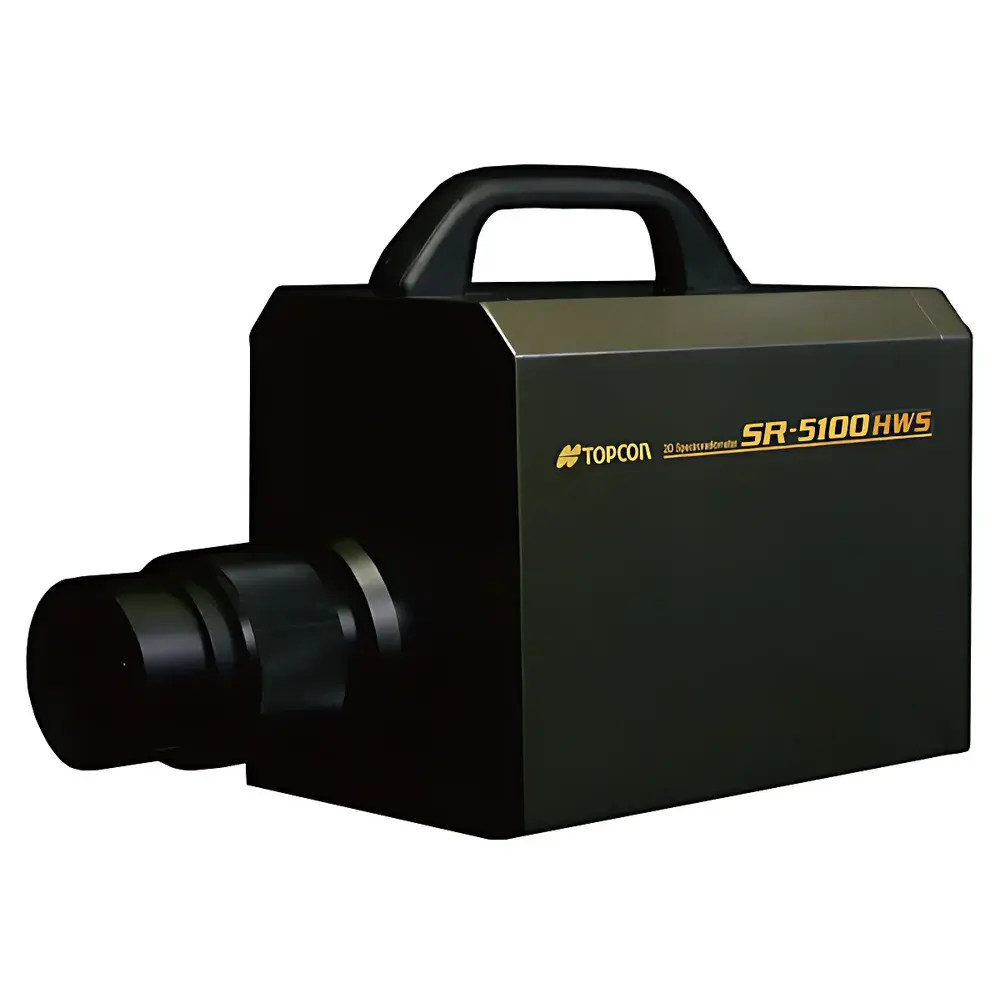
Topcon SR-5100 2D Spectroradiometer
| Origin | Japan |
|---|---|
| Manufacturer Type | Authorized Distributor |
| Origin Category | Imported |
| Model | SR-5100 |
| Price Range | USD 13,500 – 27,000 |
Overview
The Topcon SR-5100 is a high-resolution, two-dimensional spectroradiometer engineered for quantitative spectral radiometric imaging across industrial R&D and quality assurance environments. Unlike conventional point-measurement spectroradiometers, the SR-5100 integrates a scientific-grade CMOS sensor (2448 × 2048 pixels, 5 MP) with a calibrated imaging spectrograph to deliver spatially resolved spectral data at 1 nm wavelength resolution across the visible and near-visible range (typically 380–780 nm). It operates on the principle of slit-based dispersive spectroscopy combined with pixel-wise radiometric calibration, enabling simultaneous acquisition of spectral radiance (cd/m²/nm), chromaticity (CIE x,y or u′,v′), luminance (cd/m²), and correlated color temperature (CCT) for every pixel in the field of view. With a dynamic radiance range extending up to 1.7 × 10¹⁰ cd/m², the instrument supports characterization of ultra-bright emitters—including Micro-LEDs, laser diodes, and high-luminance OLED microdisplays—without neutral density attenuation or exposure bracketing.
Key Features
- 5-megapixel spatial resolution (2448 × 2048) with full-frame spectral acquisition at 1 nm spectral sampling interval
- Radiance measurement range: 1 × 10⁻³ to 1.7 × 10¹⁰ cd/m² — validated per CIE S 023/E:2016 and JIS Z 8722
- Traceable calibration via NIST-traceable standard lamp (SR-5100 includes factory certificate with uncertainty budget per ISO/IEC 17025)
- Dual operational modes: Spectral mode (full 380–780 nm spectrum per pixel) and XYZ tristimulus mode (high-speed CIE 1931 colorimetric evaluation)
- Non-contact, non-destructive optical measurement — no sample preparation or physical interaction required
- Integrated thermal stabilization and dark-current compensation for measurement repeatability ≤ ±0.5% (k = 2) over 8-hour sessions
- Modular lens system supporting macro, telecentric, and microscope-coupled configurations (e.g., SR-5100HM variant with upright metallurgical microscope)
Sample Compatibility & Compliance
The SR-5100 accommodates planar and curved emissive surfaces (displays, automotive lighting, architectural luminaires), transmissive materials (optical films, filters, biological tissues), and reflective targets (fabrics, painted surfaces, skin phantoms). Its measurement geometry conforms to CIE Publication 127:2007 (conditions A, B, and C for LED testing) and supports compliance workflows aligned with IEC 62341-6-3 (OLED displays), JEITA ED-2531A (LCD luminance uniformity), and ASTM E308-22 (computing color from spectral data). For regulated industries, raw spectral data files include embedded metadata compliant with ASTM E2919-20 for audit-ready traceability; optional software modules support 21 CFR Part 11-compliant electronic signatures and audit trails.
Software & Data Management
Controlled via Topcon’s proprietary SR-5000 Series Software (v4.2+), the SR-5100 delivers real-time spectral imaging, region-of-interest (ROI) analysis, false-color mapping, and automated uniformity metrics (e.g., Δu′v′, luminance deviation %, spectral similarity index). Data export formats include CSV (per-pixel spectra), TIFF (radiance maps), and industry-standard JDX (JCAMP-DX) for spectral interchange. The software architecture supports batch processing, script automation (Python API), and integration into LabVIEW and MATLAB environments. All calibration coefficients, exposure parameters, and environmental logs are embedded in each dataset to satisfy GLP/GMP documentation requirements.
Applications
- Micro/Mini-LED display development: pixel-level spectral uniformity, binning analysis, and angular emission profiling
- Automotive HMI validation: instrument cluster luminance gradients, ambient light sensor response mapping, and glare assessment per UNECE R118
- Textile and pigment R&D: spectral reflectance quantification of dyed fabrics under multiple illuminants (D50, D65, F11)
- Dermatological research: objective quantification of melanin distribution and erythema indices via spectral absorption ratio analysis (e.g., 540 nm / 580 nm)
- Optical thin-film inspection: interference fringe detection, thickness variation mapping, and coating homogeneity assessment
- Ecological and architectural lighting studies: spectral sky luminance modeling, vegetation reflectance monitoring, and circadian stimulus (CS) calculation
- Histopathology support (with SR-5100HM): quantification of hematoxylin-eosin staining intensity gradients and chromogen separation in digital pathology workflows
FAQ
Does the SR-5100 require periodic recalibration?
Yes — Topcon recommends annual recalibration using a NIST-traceable reference source; certificates include measurement uncertainty budgets per ISO/IEC 17025.
Can the SR-5100 measure pulsed or modulated light sources?
Yes — with external trigger synchronization (TTL input), it supports gated integration for PWM-driven LEDs and flicker-sensitive applications.
Is spectral data compatible with third-party color science tools?
Yes — exported JDX and CSV files are natively readable by ColorSync Utility, ChromaLab, and the open-source Colour Science Python library.
What is the minimum measurable spot size?
Depends on working distance and lens configuration; with the standard 50 mm lens at 300 mm WD, the smallest resolvable feature is ~60 µm.
Does the system support automated pass/fail judgment against user-defined tolerances?
Yes — the software allows definition of multi-parameter acceptance criteria (e.g., luminance ±5%, u′v′ ΔE₀₀ ≤ 0.003, peak wavelength ±1.5 nm) with CSV report generation.




