
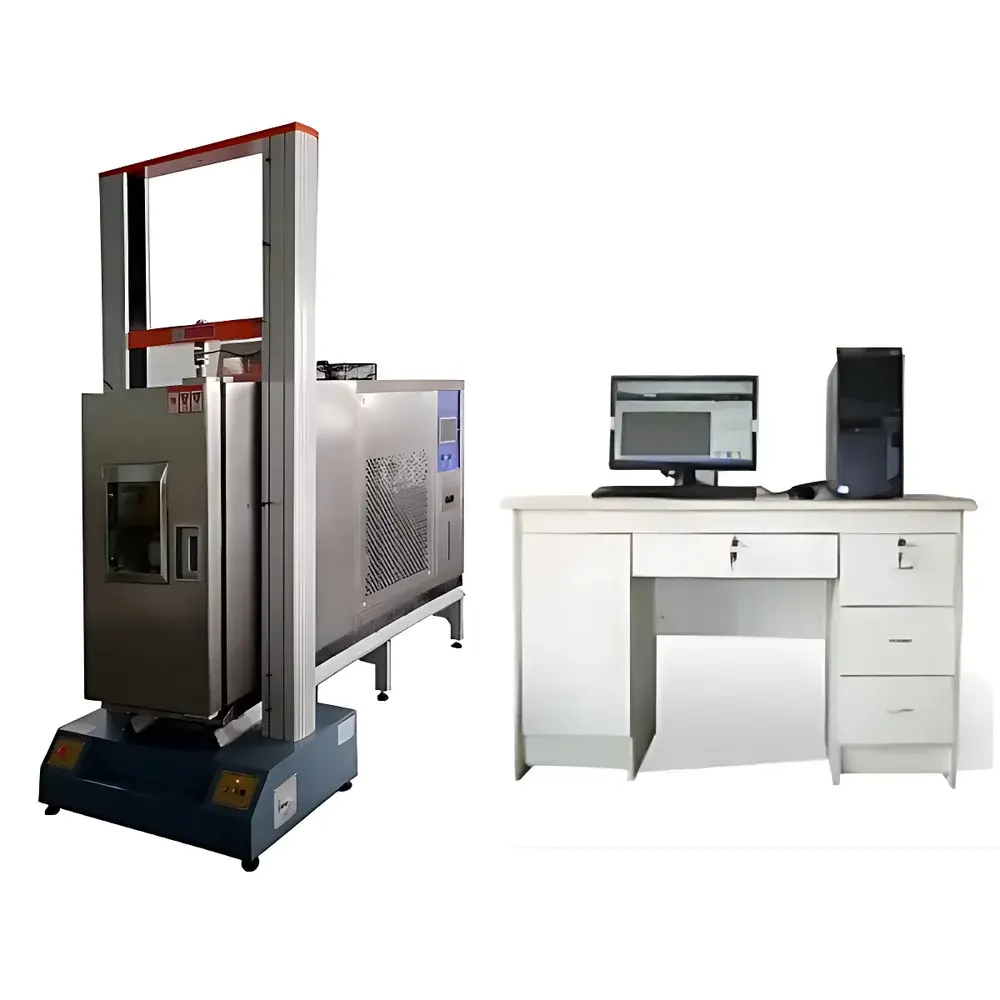
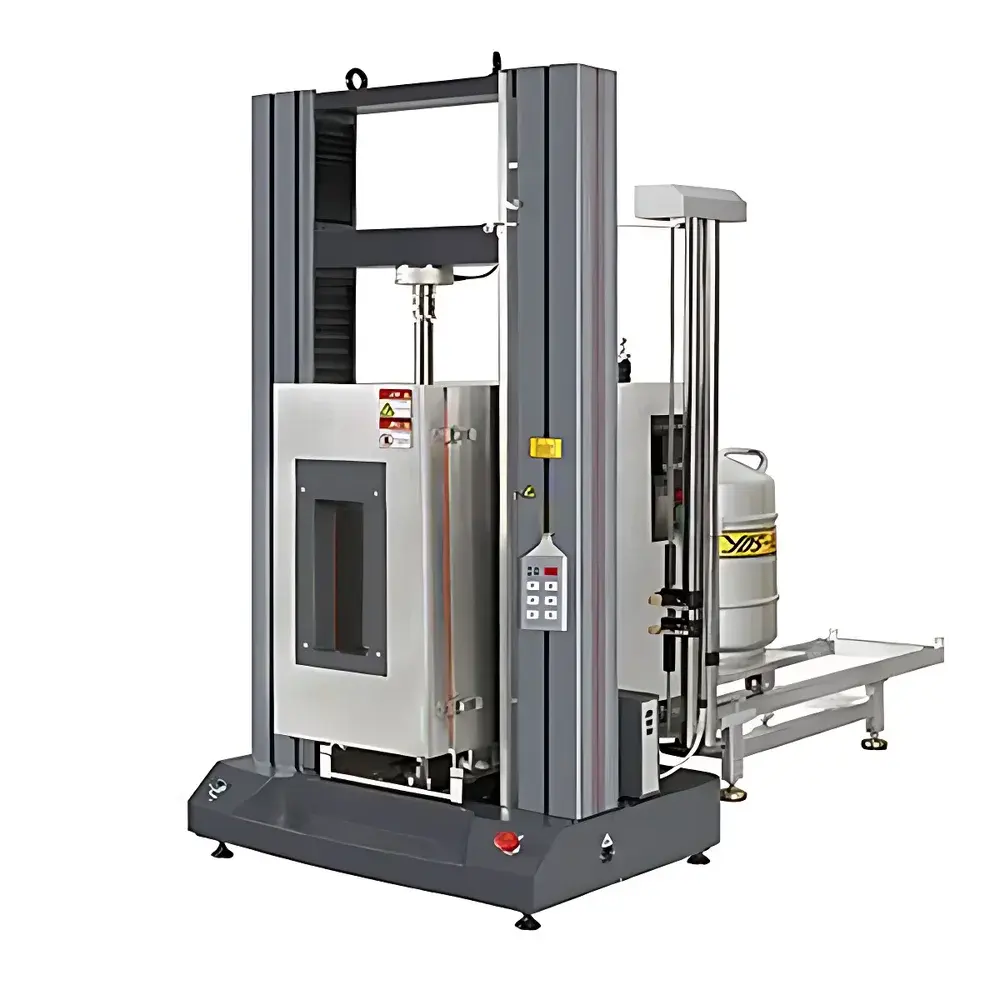
Topfeng TFW-317 Intelligent Universal Testing Machine with Integrated Environmental Chamber
| Brand | Topfeng |
|---|---|
| Origin | Shanghai, China |
| Manufacturer Type | Direct Manufacturer |
| Instrument Type | Electromechanical Universal Testing Machine |
| Model | TFW-317 |
| Load Capacity Range | 0.02 N to 300 kN |
| Load Accuracy | ±0.5% |
| Temperature Chamber Range | −40 °C to +100 °C |
| Temperature Control Accuracy | ±2 °C (longitudinal 100 mm) |
| Vertical Test Space (standard) | 1000 mm |
| Column Internal Width | 840 mm |
| Host Dimensions | 1250 × 560 × 2400 mm |
| Weight | ~380 kg |
| Power Supply | AC 220 V / 50 Hz ±10%, 750 W (host) |
Overview
The Topfeng TFW-317 Intelligent Universal Testing Machine is an electromechanical materials testing system engineered for precision mechanical characterization across variable thermal environments. It integrates a high-stability servo-controlled loading frame with a programmable environmental chamber capable of sustained operation from −40 °C to +100 °C. The system operates on the principle of controlled displacement or load application under closed-loop feedback, enabling static and quasi-static mechanical testing—including tension, compression, flexure, peel, tear, and shear—on metallic, polymeric, ceramic, composite, and elastomeric specimens. Its dual-mode architecture supports both ambient-condition testing and thermally conditioned evaluation in compliance with internationally recognized test standards including ISO 6892-1, ASTM E8/E9/E21, GB/T 228.1, JIS Z 2241, and DIN 50125. The machine’s structural rigidity, low thermal drift frame design, and high-resolution transduction ensure reproducible force and displacement measurements essential for R&D validation, quality control, and regulatory documentation.
Key Features
- Full-range load capacity from 0.02 N to 300 kN, selectable via modular load cell configuration (5 kN to 300 kN standard options)
- Force measurement accuracy of ±0.5% of reading over 0.4–100% full scale (FS), certified to ISO 7500-1 Class 0.5
- High-resolution force resolution up to 1 part in 500,000 FS, maintained continuously without range switching
- Displacement and strain measurement with ±0.5% indication error and resolution up to 1/300,000 FS
- Integrated environmental chamber with programmable ramp-and-soak profiles, ±2 °C uniformity over 100 mm longitudinal zone
- Chamber constructed from 304 stainless steel exterior and 316 mirror-finish interior, insulated with high-density alumina-silica fiber
- Double-port access (50 mm diameter) with retractable thermal shielding blocks to minimize heat leakage during specimen insertion
- Automatic data acquisition synchronized between mechanical actuation and thermal conditioning parameters
- Robust dual-column frame (840 mm internal width, 1000 mm vertical travel) optimized for lateral stability during high-load flexural and compression tests
Sample Compatibility & Compliance
The TFW-317 accommodates standardized and custom geometries—from miniature dog-bone tensile coupons (ASTM D638 Type I–V) to large-section compression cylinders (ASTM C39) and multi-layer peel specimens (ASTM D903). Its open-test-zone design permits integration of extensometers, video extensometry systems, and acoustic emission sensors. All mechanical and thermal subsystems are designed to meet ISO/IEC 17025 requirements for accredited testing laboratories. Force calibration traceability follows national metrology standards (e.g., CNAS-accredited reference standards). Thermal chamber performance complies with ASTM E145 Class II specifications for forced-convection environmental chambers. The system supports audit-ready operation under GLP and GMP frameworks, with optional 21 CFR Part 11-compliant software modules available for electronic signatures, audit trails, and data integrity assurance.
Software & Data Management
The Windows-based control and analysis suite provides real-time visualization of load–displacement, stress–strain, and temperature–time curves. It enables automated calculation of key mechanical properties—including ultimate tensile strength, yield point (0.2% offset), modulus of elasticity, fracture toughness indices, and creep compliance—according to user-selected standard templates. Raw data are stored in ASCII-compatible .csv and proprietary binary formats with embedded metadata (test ID, operator, timestamp, environmental setpoints, calibration IDs). Export functions support direct integration into LIMS platforms and statistical process control (SPC) tools. Software architecture supports multi-user role management, password-protected method libraries, and version-controlled test protocols. Optional add-ons include advanced curve-fitting algorithms (e.g., Ramberg–Osgood, Hollomon), batch report generation, and PDF/A-1b archival output compliant with ISO 19005-1.
Applications
This system serves as a primary characterization tool in polymer processing labs evaluating low-temperature brittleness of automotive plastics (SAE J2231), aerospace composites undergoing thermal cycling per MIL-STD-810H, and biomedical device materials tested per ISO 1798 and ASTM F2129. It supports metallurgical QA workflows for heat-treated alloys per ASTM A370, ceramic strength certification per ISO 14704, and adhesive bond durability assessment under thermal-humidity stress (IPC-TM-650 2.4.24). Universities utilize it for graduate-level mechanics of materials instruction and failure analysis research. Independent testing laboratories deploy it for third-party certification against EN 10002-1, GB/T 228.1, and ASME BPVC Section II Part D requirements.
FAQ
What temperature ranges can the integrated chamber achieve, and how quickly does it stabilize?
The chamber operates from −40 °C to +100 °C. Temperature stabilization time is ≤5 minutes across the entire working zone when operating above 0 °C; below 0 °C, stabilization is also ≤5 minutes under nominal load conditions.
Is the system compatible with external extensometers or digital image correlation (DIC) systems?
Yes—the machine features standardized mounting interfaces and optical access ports (including side-view windows and top-mounted lens flanges) for seamless integration with contact and non-contact strain measurement devices.
Does the software support automated pass/fail evaluation against predefined specification limits?
Yes—custom acceptance criteria can be defined per test method, triggering real-time alerts and generating summary verdicts in exported reports.
Can the TFW-317 be configured for high-speed dynamic testing?
No—it is optimized for quasi-static mechanical testing (strain rates from 0.0001 to 500 mm/min). For cyclic or fatigue applications, Topfeng offers complementary electrodynamic systems (e.g., TFV series) with frequency capabilities up to 100 Hz.
What maintenance intervals and calibration procedures are recommended?
Annual force calibration using traceable deadweight or hydraulic standards is advised. Chamber temperature uniformity verification should occur quarterly using NIST-traceable PT100 probes placed at prescribed locations per ASTM E145 Annex A3.



