
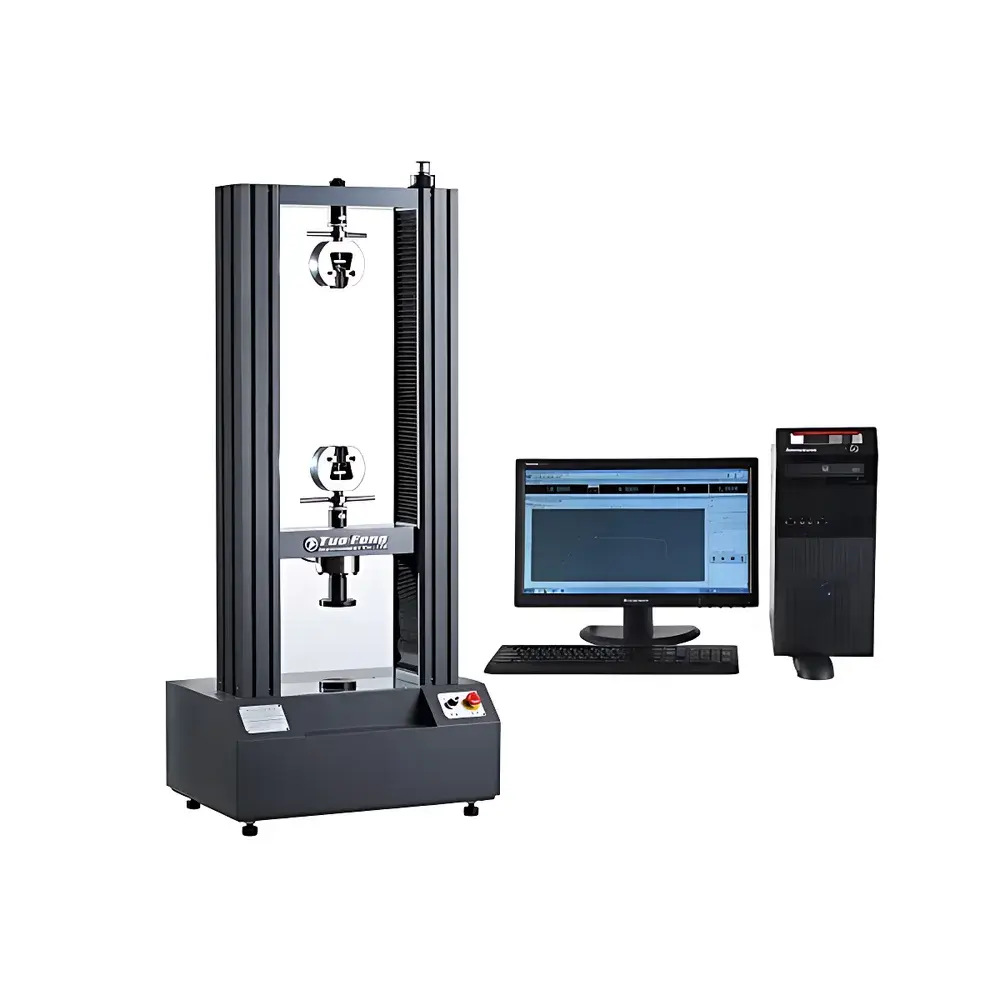
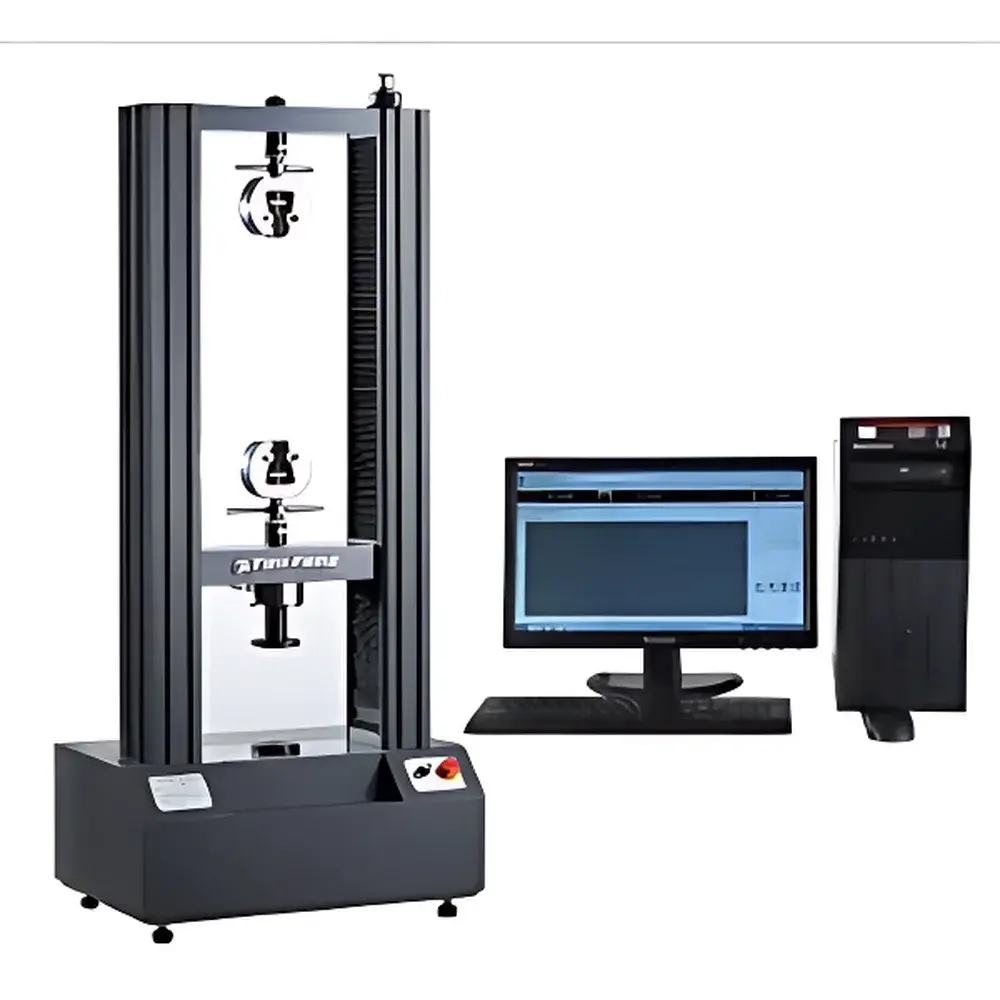
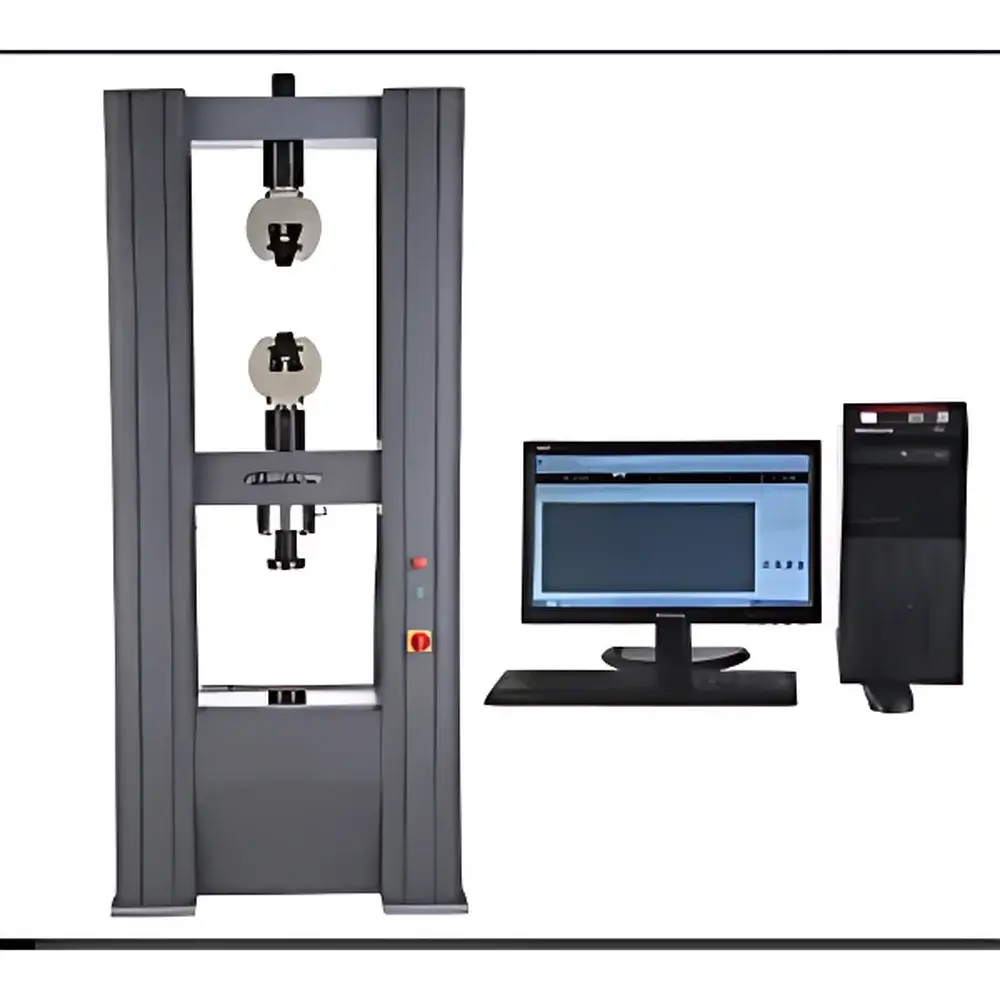
Topfeng TFW-5S Microcomputer-Controlled Electronic Universal Testing Machine
| Brand | Topfeng |
|---|---|
| Origin | Shanghai, China |
| Manufacturer Type | Direct Manufacturer |
| Country of Origin | China |
| Model | TFW-5S |
| Instrument Type | Electronic Universal Testing Machine |
| Maximum Test Load | 5 kN (500 kgf) |
| Accuracy Class | 0.5 |
| Effective Force Measurement Range | 0.2%–100% of Full Scale |
| Force Measurement Accuracy | ±0.005% of Reading |
| Force Resolution | 1/±500,000 codes (full-scale, no range switching, constant resolution) |
| Drive System | Servo Motor with Worm Gear Reducer |
| Lead Screw | High-Precision Ball Screw |
| Effective Test Width | 370 mm (customizable) |
| Tensile Stroke | 800 mm (customizable) |
| Test Speed Range | 0.01–500 mm/min (optional extended range) |
| Displacement Measurement | Optical Encoder |
| Displacement Accuracy | ±0.005% of Reading |
| Strain Measurement | Optional Extensometer or Large-Deformation Sensor |
| Strain Accuracy | ±0.005% of Reading |
| Safety Protection | Electronic Limit Switches, Emergency Stop Button |
| Crosshead Adjustment | Dual-Speed (Fast/Slow) Motorized Control with Jog Function |
| Return Function | Automatic or Manual High-Speed Return to Initial Position |
| Overload Protection | Auto-shutdown at >110% of Rated Load |
| Fixture Customization | Application-Specific Fixtures Available |
| Dimensions (W×D×H) | 650 × 400 × 1680 mm |
| Power Supply | 220 V AC, 750 W |
| Net Weight | ~280 kg |
Overview
The Topfeng TFW-5S Microcomputer-Controlled Electronic Universal Testing Machine is a precision-engineered electromechanical system designed for static mechanical property evaluation of metallic, non-metallic, and composite materials under controlled uniaxial loading conditions. Based on the fundamental principles of load-cell transduction, high-resolution optical displacement feedback, and closed-loop servo control, the TFW-5S delivers traceable, repeatable, and standards-compliant force-displacement data across tension, compression, bending, shear, peel, tear, and adhesion test modes. Its architecture adheres strictly to GB/T 16491–2008 — the Chinese national standard for electronic universal testing machines — while maintaining full functional compatibility with international testing protocols including ISO 6892-1 (tensile testing of metals), ASTM E8/E8M, ASTM D638 (plastics), ASTM D790 (flexural properties), ISO 178 (flexure), and ISO 1133 (melt flow index support). The machine operates within a calibrated force range of 0.2% to 100% of its 5 kN capacity, achieving Class 0.5 accuracy per ISO 7500-1 and GB/T 228.1, making it suitable for R&D laboratories, quality control departments, and third-party certification facilities requiring regulatory-grade mechanical characterization.
Key Features
- High-fidelity dual-closed-loop control: independent real-time regulation of load and displacement using a 500,000-count A/D converter and optical encoder feedback (±0.005% reading accuracy for both force and displacement).
- Constant-resolution force measurement: 1/±500,000 full-scale resolution maintained across the entire dynamic range—no auto-ranging or signal attenuation required.
- Robust mechanical drive train: integrated servo motor coupled with a self-locking worm gear reducer and preloaded high-precision ball screw (C5 grade), ensuring minimal backlash (<0.02 mm) and long-term positional repeatability.
- Intelligent crosshead motion: programmable dual-speed (fast/slow) motorized adjustment with jog capability and automatic return-to-start function post-test.
- Comprehensive safety architecture: redundant hardware protection layers including electronic limit switches, emergency stop circuitry, and software-enforced overload cutoff (>110% of rated load).
- Modular extensometry support: native interface for clip-on extensometers (e.g., ASTM E83 Class B-1) and large-deformation sensors (video or contact-type), enabling strain-controlled testing per ISO 527-2 and ASTM D3039.
Sample Compatibility & Compliance
The TFW-5S accommodates specimens ranging from thin polymer films (≥0.05 mm thick) to structural metal coupons (up to 25 mm thickness, depending on fixture geometry), with customizable grips—including wedge-action, pneumatic, vise, and hydraulic options—for flat, round, threaded, or irregular geometries. All test sequences are fully compliant with GLP documentation requirements: audit trails, user authentication, electronic signatures, and data integrity safeguards align with FDA 21 CFR Part 11 expectations when configured with optional validation packages. Calibration certificates conform to ISO/IEC 17025:2017 requirements and reference NIST-traceable standards. Routine verification follows ISO 7500-1 procedures for static calibration and ISO 4865 for dynamic performance assessment.
Software & Data Management
Running natively on Windows OS, the embedded testing software provides multi-mode control (constant rate of extension, constant load, constant strain, dwell, cyclic ramp-hold), real-time plotting of up to six synchronized axes (e.g., stress–strain, load–time, displacement–time), and automated parameter derivation—including tensile strength, yield point (0.2% offset), Young’s modulus, elongation at break, compressive yield stress, flexural modulus, peel strength, and adhesive bond strength. Data export supports CSV, XLSX, PDF, and XML formats; raw time-series files include timestamped metadata (operator ID, environmental conditions, calibration status). Software supports language switching (English, Simplified/Traditional Chinese), unit conversion (N/kN/lbf, mm/in, MPa/psi), and comparative overlay of up to 16 test curves. All results are automatically timestamped and stored in an encrypted local database with configurable backup intervals. Remote diagnostics and firmware updates are supported via secure HTTPS channel, with lifetime free version upgrades included.
Applications
- Mechanical qualification of aerospace composites (carbon fiber laminates, honeycomb cores) per ASTM D3410 and MIL-STD-17.
- Quality assurance of medical device polymers (PEEK, PTFE, silicone elastomers) per ISO 5832-12 and USP /.
- Validation of battery electrode coatings and separator membranes under tensile and puncture loads.
- Characterization of construction materials (rebar, FRP tendons, geotextiles) per ASTM A615 and ISO 10319.
- R&D of soft biomaterials (hydrogels, decellularized tissues) using low-force, high-strain protocols with video extensometry integration.
- Automotive component testing (seals, gaskets, bushings) under compression set and creep conditions.
FAQ
What standards does the TFW-5S officially comply with?
It meets GB/T 16491–2008 and is operationally compatible with ISO 6892-1, ASTM E8/E8M, ASTM D638, ASTM D790, ISO 178, and JIS Z2241.
Can the system be validated for GMP/GLP environments?
Yes—when equipped with optional IQ/OQ documentation, electronic signature modules, and audit trail logging, it satisfies FDA 21 CFR Part 11 and EU Annex 11 requirements.
Is strain measurement included as standard?
No—the base configuration includes only load and crosshead displacement. An extensometer or large-deformation sensor must be selected as an optional add-on for direct strain measurement.
What is the maximum specimen height accommodated without modification?
The standard vertical test space is 800 mm between platens; this can be extended to 1200 mm upon request.
Does the software support automated report generation for regulatory submissions?
Yes—customizable templates generate PDF reports containing test parameters, raw data plots, statistical summaries, and digital signatures, all traceable to instrument calibration records.



