
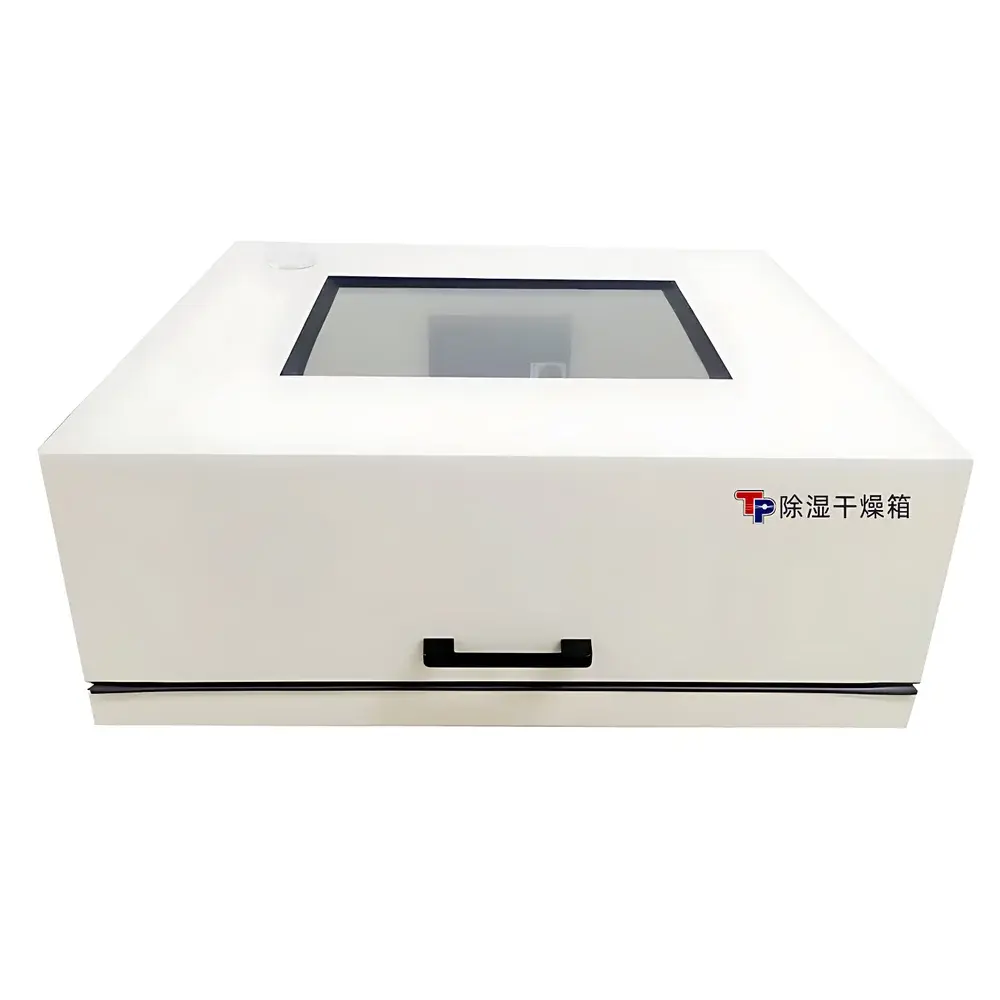
Topo DB-1 Desiccant Dry Box
| Brand | Topo/TP |
|---|---|
| Origin | Tianjin, China |
| Manufacturer Type | Direct Manufacturer |
| Origin Category | Domestic (China) |
| Model | DB-1 |
| Price | USD 420 (approx.) |
Overview
The Topo DB-1 Desiccant Dry Box is an engineered environmental containment system designed specifically to safeguard precision analytical instrumentation—particularly Fourier Transform Infrared (FTIR) spectrometers used in asphalt and polymer characterization—from ambient humidity-induced degradation. Unlike conventional drying cabinets relying on heated air circulation, the DB-1 employs solid-state electronic desiccation technology based on thermoelectric (Peltier) dehumidification. This principle enables continuous moisture removal without introducing thermal gradients, airflow turbulence, or condensation risks—critical for maintaining optical path integrity, detector stability, and long-term calibration fidelity of sensitive IR optics and hygroscopic beam splitters. The unit operates as a sealed, passively isolated chamber, decoupling internal relative humidity (RH) from fluctuating laboratory conditions—ensuring RH remains consistently below 40% under typical ambient loads (≤75% RH, 25 °C), thereby meeting ASTM E1421 and ISO 17025 environmental control recommendations for spectroscopic measurement validity.
Key Features
- Hermetically sealed enclosure with silicone-gasketed door and reinforced acrylic viewing panel for real-time instrument monitoring without compromising humidity integrity
- Dual-mode thermoelectric dehumidifier core: M-mode (Medium) optimized for stable operation at ambient RH ≤60%; H-mode (High) delivers enhanced condensation capacity for environments up to 85% RH
- Internal dimensions of 660 × 500 × 240 mm (W × D × H) accommodate standard benchtop FTIR systems—including PerkinElmer Spectrum Two, Thermo Nicolet iS5, and Bruker Tensor series—with clearance for peripheral accessories
- External footprint of 700 × 600 × 300 mm ensures compatibility with standard lab benches and fume hood cutouts
- Dual power interface: IEC 60320 C14 three-pin AC inlet (220 V AC, 50 Hz) + USB-B port for optional external sensor integration or firmware diagnostics
- Robust steel chassis with powder-coated finish and non-slip rubber feet for vibration-dampened placement adjacent to sensitive optical tables
Sample Compatibility & Compliance
The DB-1 is not intended for sample storage or processing; rather, it functions exclusively as an instrument protection housing. It is validated for continuous deployment with FTIR spectrometers requiring stable RH <45% during acquisition—especially critical for KBr pellet analysis, ATR sampling of bituminous binders, and thin-film measurements where water vapor absorption distorts C=O, O–H, and S=O spectral bands. The design complies with general laboratory safety requirements per IEC 61010-1 and meets mechanical robustness criteria outlined in ISO 14644-1 Class 8 cleanroom handling protocols for non-sterile instrumentation enclosures. While not certified to GLP or GMP Annex 1 standards, its traceable humidity control supports audit-ready documentation when paired with external calibrated RH loggers (e.g., Vaisala HMP110).
Software & Data Management
The DB-1 operates as a standalone hardware platform with no embedded microcontroller or proprietary software. Its operational status is indicated solely via front-panel LED indicators (power, M/H mode, fault). For laboratories requiring environmental data logging, the unit supports integration with third-party monitoring systems via its USB-B port—enabling connection to host PCs running compliant platforms such as LabVIEW, MATLAB Data Acquisition Toolbox, or enterprise-grade LIMS solutions (e.g., Thermo Fisher SampleManager). All operational parameters remain fully transparent and unencrypted, facilitating FDA 21 CFR Part 11-compliant audit trails when deployed alongside validated timestamped logging hardware.
Applications
- Protecting FTIR spectrometers during asphalt binder oxidation studies (ASTM D7175, AASHTO TP70)
- Maintaining spectral baseline stability in polymer additive identification workflows
- Enabling reproducible carbonyl index quantification in aged bitumen samples
- Supporting QC/QA labs performing routine infrared verification per ISO 9001 clause 7.1.5.2
- Extending service intervals for hygroscopic optical components (e.g., DTGS detectors, KBr beamsplitters)
FAQ
Does the DB-1 require consumable desiccants or replacement filters?
No. The thermoelectric dehumidification system is maintenance-free and contains no silica gel, molecular sieves, or replaceable cartridges.
Can the DB-1 be used for storing reference standards or calibration samples?
It is not designed or validated for sample storage; its internal environment lacks temperature regulation and active RH feedback control required for certified reference material preservation.
Is the unit compatible with 110 V AC power supplies?
No. The DB-1 is configured exclusively for 220 V AC, 50 Hz input and requires a step-up transformer for use in North American or Japanese electrical infrastructures.
What is the maximum allowable ambient temperature for safe operation?
Continuous operation is rated for ambient temperatures between 15 °C and 35 °C. Operation above 35 °C may reduce dehumidification efficiency and trigger thermal shutdown protection.
Does the DB-1 meet IP rating standards for dust or moisture ingress?
While not formally IP-rated, the gasketed door seal and recessed interface layout provide effective resistance against particulate ingress and incidental splashes—sufficient for standard ISO 14644-1 Class 8 laboratory environments.






