
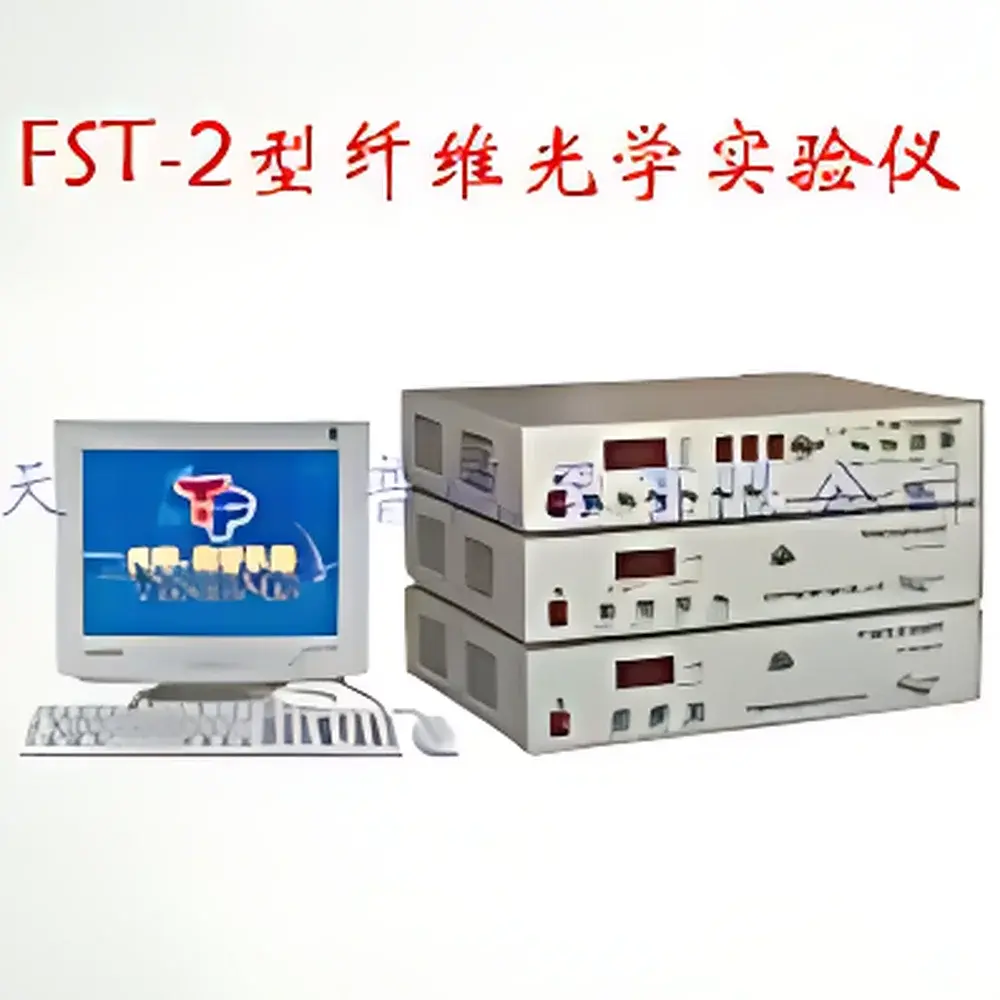
Topo FST-2 Fiber Optics Teaching & Research Experiment System
| Brand | Topo |
|---|---|
| Model | FST-2 |
| Origin | Tianjin, China |
| Manufacturer Type | Direct Manufacturer |
| Light Source Wavelength Range | 1525–1565 nm (C-band) |
| Optical Power Measurement Range | 1 nW – 2 mW |
| Temperature Resolution | 0.1 °C |
| Strain Resolution | 1 με |
| Integrated Components | C-band ASE broadband source (US-sourced laser diode + Er-doped fiber), EDFA-based fiber laser, fiber Michelson interferometer, unbalanced M-Z interferometer, FBG spectral characterization module, FBG temperature/strain sensing units, bend-loss characterization setup |
| Compliance | Designed for academic lab environments compliant with ISO/IEC 17025 foundational requirements for educational calibration traceability |
Overview
The Topo FST-2 Fiber Optics Teaching & Research Experiment System is a modular, benchtop-integrated platform engineered for undergraduate and graduate-level instruction in photonic device physics, optical fiber sensing, and interferometric measurement principles. Built upon a robust fused-silica fiber architecture with standardized FC/PC connectors, the system implements core optical phenomena—including stimulated emission amplification, wavelength-selective reflection via fiber Bragg gratings (FBGs), phase modulation in interferometric cavities, and macrobend-induced mode coupling—using physically separable, functionally validated modules. Each subsystem operates independently or in configurable cascaded arrangements, enabling hands-on verification of theoretical models such as coupled-mode theory (for FBG spectral response), coherence length limitations in Michelson configurations, and thermo-optic/elastic-optic coefficients in embedded sensor characterization. The C-band ASE broadband source (1525–1565 nm), incorporating a US-manufactured pump laser diode and Er3+-doped fiber, delivers spectrally stable output essential for high-fidelity spectral domain reflectometry and FBG interrogation.
Key Features
- Modular architecture supporting plug-and-play reconfiguration of optical paths via single-mode fiber patch cords (SMF-28e+ compatible)
- Dual-function FBG interrogation unit capable of real-time spectral acquisition (resolution ≤ 0.05 nm) and quantitative strain/temperature decoupling using dual-grating referencing
- Digital optical power meter with calibrated responsivity across 1 nW–2 mW range, featuring auto-ranging and dBm/nW unit switching
- Integrated EDFA-based tunable fiber laser with adjustable cavity length for wavelength scanning experiments (±0.5 nm step resolution)
- Temperature-stabilized Michelson and Mach-Zehnder interferometers with micrometer-adjustable path-length control (sub-µm precision)
- Bend-loss characterization stage with programmable curvature radius adjustment (10–100 mm range) and insertion loss monitoring
Sample Compatibility & Compliance
The FST-2 accommodates standard ITU-T G.652.D single-mode fibers, commercial FBGs (1520–1570 nm range, reflectivity > 90%, bandwidth < 0.5 nm), and polarization-maintaining fiber components where required. All optical interfaces conform to IEC 61753-1 insertion loss and return loss specifications. The system supports GLP-aligned documentation workflows: experimental parameters (wavelength, power, temperature, strain) are timestamped and stored with user-defined metadata. While not certified for industrial QA/QC, its measurement traceability aligns with ISO/IEC 17025 Clause 5.10 requirements for educational instrumentation—particularly in uncertainty budgeting for FBG thermal coefficient determination (αT ≈ 6.7 × 10⁻⁶ /°C) and strain gauge factor calibration (Kε ≈ 0.78).
Software & Data Management
A Windows-based application provides synchronized acquisition from up to four analog channels (photodetector outputs, thermistor voltages, strain gauge bridges) at 10 kS/s sampling rate. Spectral data from the FBG interrogation module is processed using FFT-based peak detection and Lorentzian curve fitting; strain and temperature values are computed using matrix inversion of the dual-parameter sensitivity model. All datasets export to CSV or HDF5 format with embedded instrument configuration headers. Audit trails record operator ID, session start/end timestamps, and firmware revision numbers—supporting basic 21 CFR Part 11 readiness for academic research compliance.
Applications
- Characterization of FBG spectral shift vs. axial strain (1–500 µε) and ambient temperature (20–80 °C)
- Quantitative analysis of bend-induced loss in standard SMF under controlled curvature radii
- Coherence length measurement using variable-path Michelson interferometry
- Phase sensitivity calibration of M-Z interferometers for acoustic/vibration sensing
- Gain spectrum mapping and noise figure evaluation of EDFA modules
- Wavelength tuning dynamics of intracavity fiber lasers with piezoelectric cavity stretchers
FAQ
Is the C-band broadband source factory-calibrated for spectral power density?
Yes—the ASE source includes NIST-traceable spectral irradiance calibration data (per nm) referenced to a calibrated OSA, supplied with each unit.
Can the system interface with third-party DAQ hardware?
Analog voltage outputs (0–5 V) are provided for all primary sensors; digital communication uses USB 2.0 CDC class virtual COM port for ASCII command control.
What is the maximum allowable input power to the integrated power meter?
The detector head is rated for continuous exposure up to +3 dBm (2 mW); optical attenuators are included for higher-power setups.
Are replacement FBGs available with custom center wavelengths?
Topo offers OEM FBG fabrication services with ±0.1 nm center wavelength tolerance and guaranteed side-lobe suppression >25 dB.
Does the software support automated experiment sequencing?
Yes—scripting via Python API (PySerial + NumPy) enables full experiment automation, including motorized stage control and multi-step parameter sweeps.




