
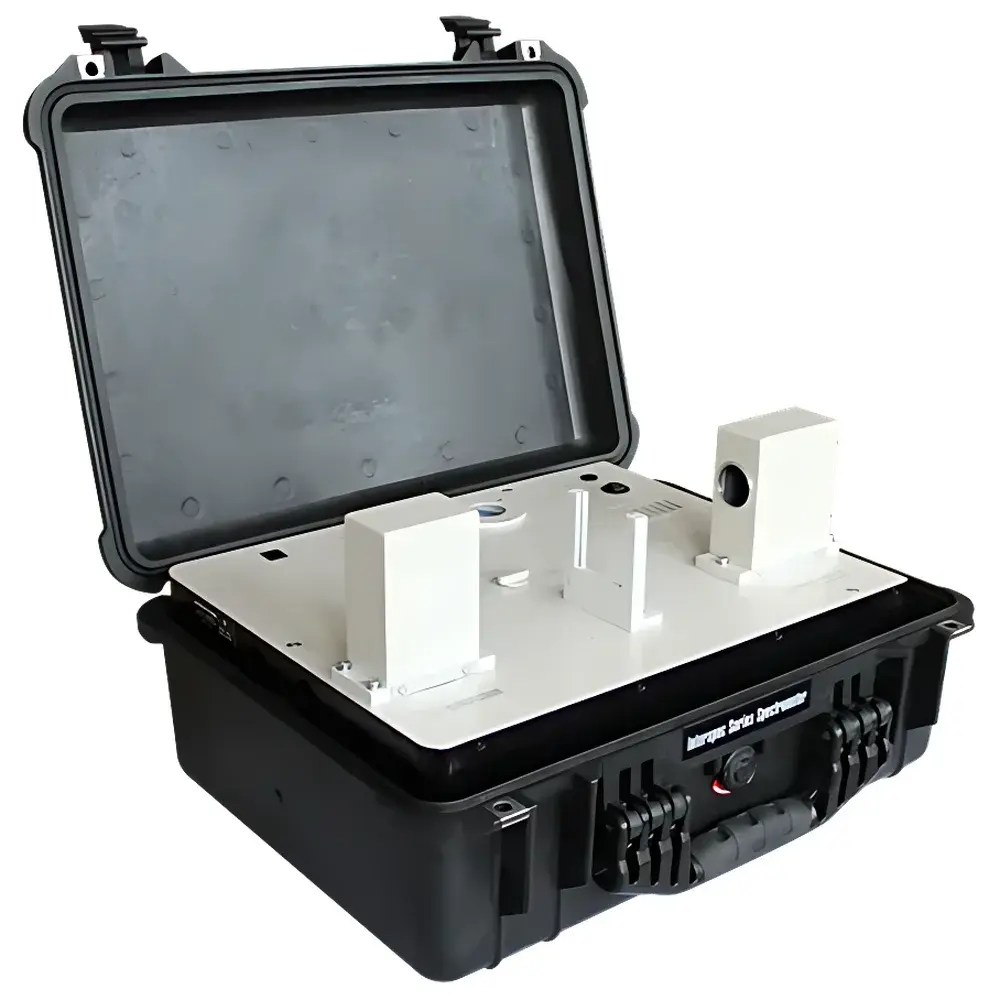
Topo FTIR931 Portable Fourier Transform Infrared Spectrometer
| Brand | Topo |
|---|---|
| Model | FTIR 931 |
| Type | Portable FTIR Spectrometer |
| Wavenumber Range | 7800–375 cm⁻¹ |
| Resolution | ≤1 cm⁻¹ (down to 0.5 cm⁻¹) |
| Signal-to-Noise Ratio (S/N) | ≥15,000:1 (at 4 cm⁻¹, 1 min scan) |
| Scan Speed | Microprocessor-controlled, 6 selectable speeds |
| Beam Diameter | 30 mm |
| Sample Beam Spot | 5 mm Ø |
| Beamsplitter | Multi-layer coated KBr |
| Detector | Imported low-noise DLATGS |
| Source | Imported long-life, high-intensity air-cooled ceramic IR source |
| Interferometer | Laser-controlled automatic alignment and frequency calibration (He–Ne reference laser) |
| Wavenumber Accuracy | ±0.01 cm⁻¹ |
| Linearity | ≤0.1% T |
| Aperture Ratio | f/3.2 |
| Data Interface | USB 2.0 |
| Dimensions (W×D×H) | 490 × 390 × 200 mm |
| Weight | 18 kg |
| Power Supply | 90–230 V AC / 12 V DC, 40 W |
| Operating Temperature | 15–28 °C |
| Relative Humidity | <65% RH (non-condensing) |
| Compliance | CE, RoHS, ISO/IEC 17025 compatible operation environment |
| Software | Windows 32-bit compatible (Win 98/2000/XP/Vista), FDA 21 CFR Part 11–ready audit trail & user access control modules included |
Overview
The Topo FTIR931 is a field-deployable, research-grade portable Fourier Transform Infrared (FTIR) spectrometer engineered for high-fidelity molecular identification and quantitative analysis in non-laboratory environments. Based on Michelson interferometry with He–Ne laser-referenced path-length stabilization, the instrument acquires full mid-infrared spectra (7800–375 cm⁻¹) via rapid-scan acquisition and digital signal processing. Its robust optomechanical architecture—featuring an auto-aligning interferometer, multi-layer coated KBr beamsplitter, and thermoelectrically stabilized DLATGS detector—ensures spectral reproducibility across variable ambient conditions. Designed for compliance with ISO 17025–aligned measurement practices, the FTIR931 delivers traceable wavenumber accuracy (±0.01 cm⁻¹) and linearity ≤0.1% T, enabling reliable use in method validation, raw material verification, and on-site quality screening.
Key Features
- True portability: Integrated 18 kg chassis with shock-absorbing housing, 12 V DC operation capability, and battery-ready power architecture for mobile deployment.
- High-resolution spectral acquisition: Adjustable resolution down to 0.5 cm⁻¹ with <1 cm⁻¹ standard performance, optimized for functional group discrimination and polymer fingerprinting.
- Laser-referenced interferometer: Real-time He–Ne laser feedback ensures dynamic compensation of thermal drift and mechanical displacement during scanning.
- Optimized optical throughput: f/3.2 aperture ratio and 30 mm collimated beam diameter maximize radiant flux while maintaining compatibility with standard ATR, transmission, and gas cell accessories.
- Low-noise detection system: Imported DLATGS detector with integrated preamplifier achieves S/N ≥15,000:1 (4 cm⁻¹, 1 min scan), supporting trace-level detection in solid, liquid, and gaseous matrices.
- Comprehensive environmental resilience: Operational within 15–28 °C and <65% RH (non-condensing); includes desiccant chamber and sealed optical bench to mitigate moisture-induced KBr degradation.
Sample Compatibility & Compliance
The FTIR931 supports universal sampling configurations through standardized optical interfaces—including dedicated mounts for diamond ATR, KBr pellet press kits, liquid transmission cells (0.1–100 µm pathlength), and sealed gas cells (up to 10 cm path). All accessory couplings maintain beam alignment integrity without realignment tools. The system meets CE and RoHS directives for electromagnetic compatibility and hazardous substance restriction. Its operational parameters and software architecture support GLP/GMP-aligned workflows: spectral metadata (operator ID, timestamp, instrument ID, calibration status) are embedded in each .spa file; audit trails, electronic signatures, and role-based access controls comply with FDA 21 CFR Part 11 requirements when configured with validated software packages.
Software & Data Management
Bundled TopoSpectra™ v4.x software provides full spectral acquisition, preprocessing (zero-filling, apodization, phase correction), quantitative modeling (classical least-squares, PLS regression), and library search (built-in 12,000+ compound NIST/EPA/Polymers libraries). Raw interferogram and spectrum files conform to ASTM E1421 and JCAMP-DX v5.0 standards. Data export supports CSV, ASCII, and .spc formats for third-party chemometric platforms (e.g., Unscrambler®, MATLAB®). Network-enabled remote diagnostics and firmware updates are supported via encrypted USB or Ethernet connection. All spectral acquisitions include automated background subtraction, atmospheric CO₂/H₂O compensation, and real-time S/N monitoring.
Applications
- Pharmaceutical: Excipient verification, counterfeit drug screening, and blend uniformity assessment per USP and EP 2.2.24 guidelines.
- Polymer science: Identification of copolymer composition, oxidation state (carbonyl index), and crystallinity via band deconvolution.
- Environmental field analysis: On-site detection of hydrocarbon contaminants in soil extracts or VOCs in ambient air using gas cell modules.
- Forensics: Non-destructive fiber, paint chip, and adhesive analysis under chain-of-custody protocols.
- Materials QA/QC: Incoming raw material authentication (e.g., silicone oils, resins, lubricants) against reference spectra in controlled repositories.
FAQ
Is the FTIR931 suitable for regulatory submissions under FDA or EMA guidelines?
Yes—when operated with validated TopoSpectra™ software and documented calibration procedures, the system supports data integrity requirements of 21 CFR Part 11 and Annex 11, including electronic records, audit trails, and user authentication.
Can the instrument perform quantitative analysis without external calibration standards?
Quantitative models require initial calibration using certified reference materials; however, the system includes built-in PLS and CLS algorithms with cross-validation reporting to meet ISO 11095 linearity verification criteria.
What maintenance is required to sustain wavenumber accuracy over time?
Annual verification using NIST-traceable polystyrene film is recommended; the He–Ne laser stabilization minimizes daily recalibration needs, and automated alignment routines execute at startup.
Does the FTIR931 support hyphenated techniques such as GC-FTIR?
No—the FTIR931 is a standalone benchtop-portable unit; it does not feature gas chromatograph coupling ports or microflow interfaces.
How is moisture managed in the optical path during extended field use?
The instrument integrates a dual-stage desiccant chamber (with visible indicator silica gel) and sealed, dry-air purged interferometer compartment—no external purge gas supply is required for standard operation.
Related Products





