
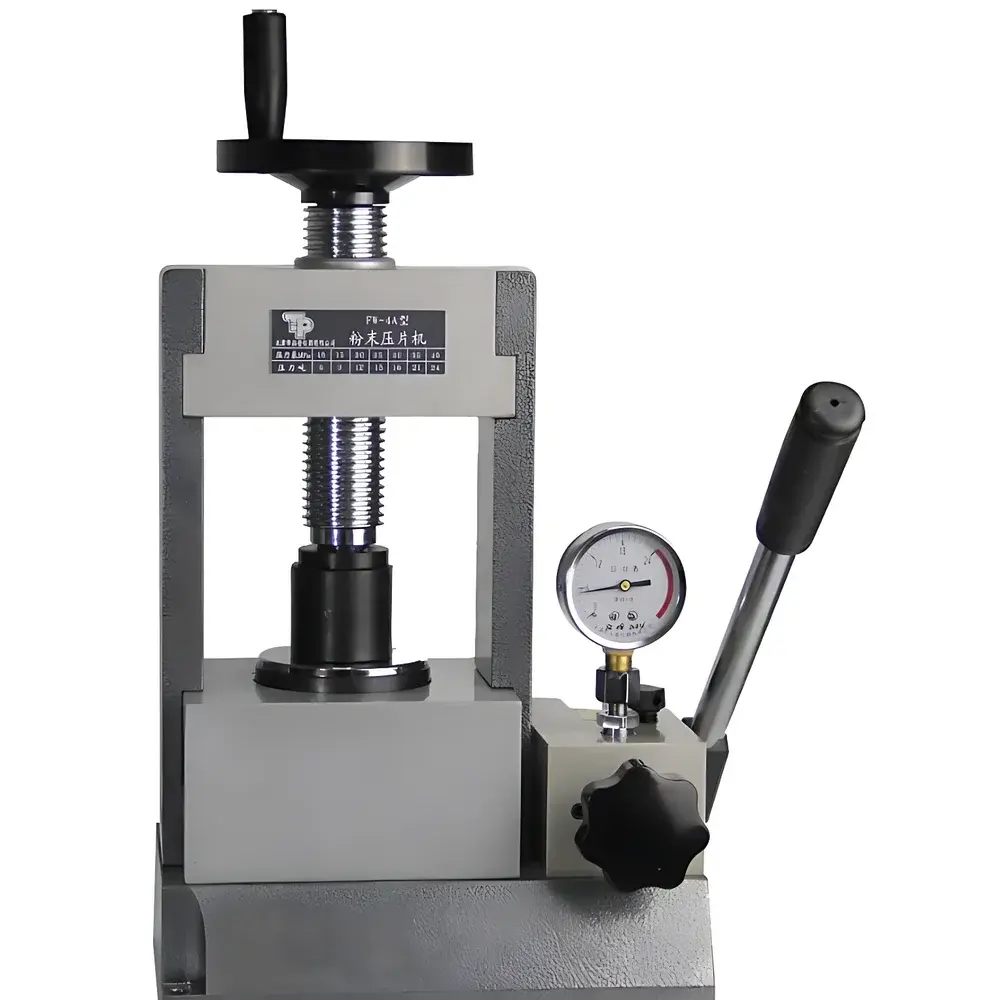
Topo FW-4A Manual Hydraulic Powder Pellet Press
| Brand | Topo |
|---|---|
| Model | FW-4A |
| Type | Manual Hydraulic Pellet Press |
| Max. Pressure | 24 Ton (235 kN) |
| Piston Diameter | 86 mm |
| Piston Stroke | 20 mm |
| Column Configuration | Dual Side-mounted Columns |
| Column Spacing (W × D) | 110 × 140 mm |
| Dimensions (W × D × H) | 470 × 380 × 200 mm |
| Net Weight | 49 kg |
Overview
The Topo FW-4A Manual Hydraulic Powder Pellet Press is a compact, benchtop laboratory press engineered for reproducible sample preparation in spectroscopic, X-ray diffraction (XRD), and elemental analysis workflows. It operates on a manually actuated hydraulic principle—leveraging Pascal’s law to convert hand-applied force into uniform, controllable pressure across the die cavity. With a maximum rated capacity of 24 tons (235 kN), the FW-4A delivers sufficient compaction force for routine pelletization of inorganic powders, catalysts, pharmaceutical excipients, geological samples, and ceramic precursors. Its rigid dual-column frame ensures minimal lateral deflection during compression, preserving die alignment and enhancing pellet density homogeneity—critical for quantitative FTIR, KBr disc preparation, and pressed-powder XRD analysis.
Key Features
- Robust dual side-mounted column architecture with 110 × 140 mm internal spacing, accommodating standard 13 mm, 16 mm, and 25 mm die sets without interference.
- 86 mm piston diameter combined with 20 mm stroke depth enables precise control over compaction height and green density—essential for achieving consistent pellet thickness and mechanical integrity.
- Manually operated hydraulic system eliminates dependency on external power sources or compressed air; ideal for glovebox integration, cleanroom environments, or field-deployable analytical labs.
- Stainless-steel-plated pressure plate and hardened steel die cavity minimize contamination and wear during repeated use with abrasive or corrosive materials.
- Benchtop footprint (470 × 380 × 200 mm) and 49 kg net weight ensure stable placement on standard lab benches while permitting repositioning via integrated lifting handles.
Sample Compatibility & Compliance
The FW-4A supports a wide range of dry, free-flowing, and moderately cohesive powders—including metal oxides, silicates, polymers, salts, and pharmaceutical APIs—provided they are pre-sieved (<150 µm) and optionally blended with spectroscopic-grade KBr or polyethylene binders. It complies with standard sample preparation protocols referenced in ASTM E1318 (XRF pellet preparation), ISO 13907 (powder metallurgy green strength testing), and USP (FTIR reference standard preparation). While the instrument itself carries no CE or UL certification as a standalone mechanical device, its design conforms to ISO 12100 (risk assessment for machinery) and incorporates guarded manual operation—eliminating pinch-point hazards common in lever-actuated presses.
Software & Data Management
As a purely mechanical, non-electronic press, the FW-4A does not incorporate embedded controllers, digital readouts, or data logging interfaces. Pressure application is monitored externally using calibrated analog or digital pressure gauges (e.g., Bourdon-tube or piezoresistive transducers) mounted on auxiliary hydraulic manifolds—an industry-standard practice for traceable, GLP-compliant pellet fabrication. Users maintain full auditability through manual logbook entries or LIMS-integrated documentation of applied load (ton), dwell time, die ID, and operator signature—fully aligned with FDA 21 CFR Part 11 requirements when paired with validated electronic record systems.
Applications
- Preparation of transparent KBr pellets for mid-IR transmission spectroscopy (4000–400 cm⁻¹).
- Formation of homogeneous, binder-free pellets for quantitative XRD phase analysis and Rietveld refinement.
- Compaction of calibration standards for wavelength-dispersive XRF and energy-dispersive XRF instrumentation.
- Green body formation in ceramic processing R&D, including sintering behavior studies under controlled atmospheres.
- Controlled densification of battery electrode materials (e.g., LiCoO₂, NMC cathodes) prior to electrochemical cell assembly.
FAQ
What is the maximum recommended operating pressure for routine use?
For optimal longevity and repeatability, we recommend limiting continuous operation to ≤20 tons (196 kN); 24-ton capacity is reserved for short-duration, high-density applications.
Can the FW-4A be used with heated or cooled dies?
Yes—the open-frame geometry and unobstructed column spacing allow integration of temperature-controlled die holders (−40 °C to +200 °C), provided hydraulic hoses and seals are rated for the intended thermal range.
Is die set compatibility standardized across manufacturers?
The FW-4A accepts ANSI/ISO-standard cylindrical die sets (e.g., Specac, Pike Technologies, Harrick) with outer diameters up to 25.4 mm and heights ≤30 mm; custom adapters may be required for non-circular or segmented dies.
Does Topo provide calibration certificates for the hydraulic system?
Calibration is performed at the factory using traceable dead-weight testing; optional NIST-traceable calibration reports (per ISO/IEC 17025) are available upon request at time of order.
How often should hydraulic oil be replaced?
Under normal laboratory use (≤50 cycles/week), mineral-based hydraulic oil should be replaced every 12 months or after 500 operational cycles—whichever occurs first—to maintain viscosity stability and seal integrity.




