
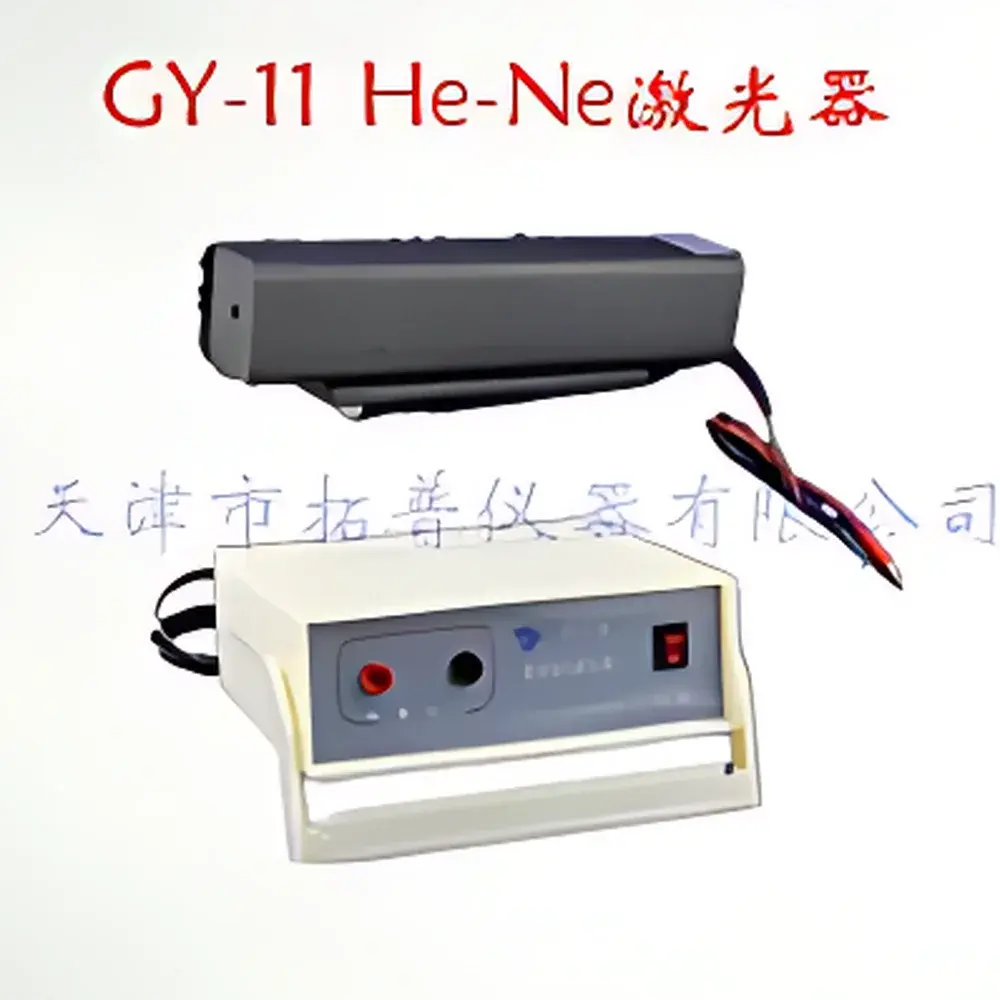
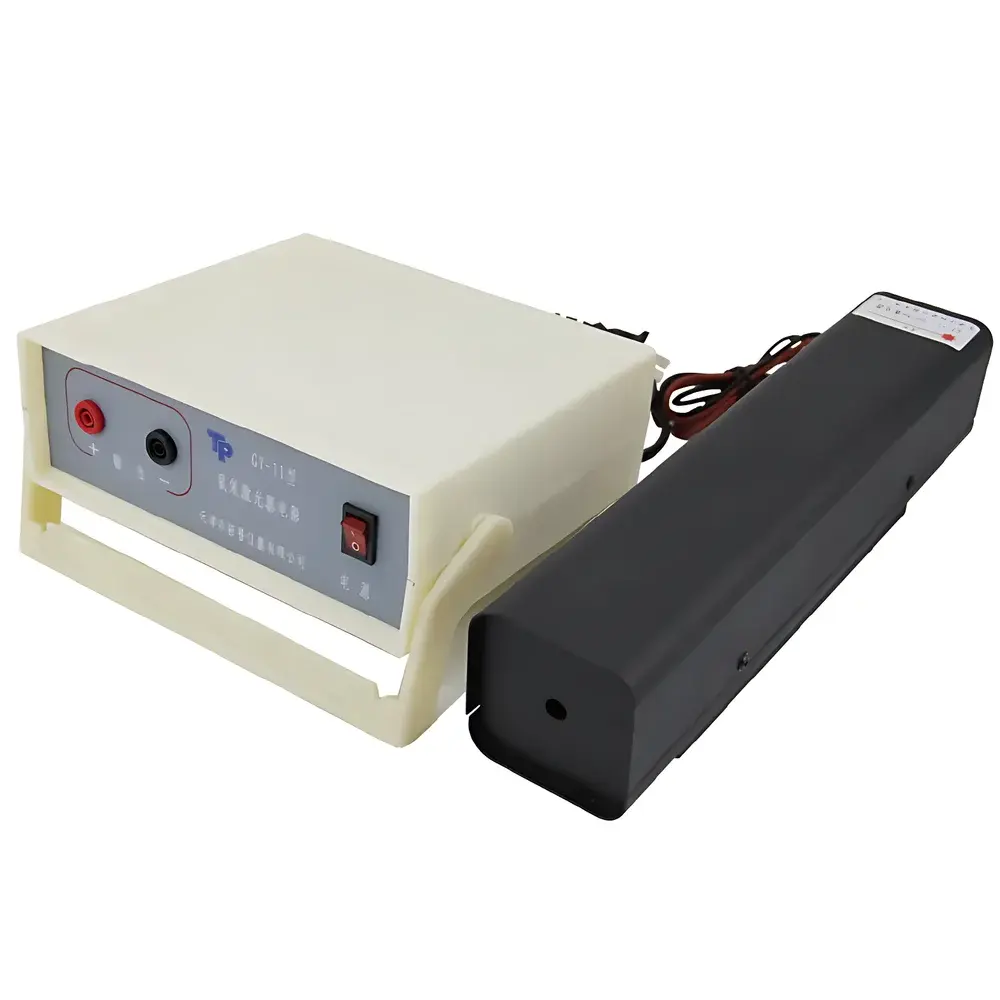
Topo GY-11 Helium-Neon (He-Ne) Laser
| Brand | Topo |
|---|---|
| Origin | Tianjin, China |
| Manufacturer Type | Direct Manufacturer |
| Model | GY-11 |
| Wavelength | 632.8 nm |
| Output Power | 1.5 mW |
| Total Length (incl. Power Supply) | 250 mm |
| Compliance | CE-marked for Class II laser safety per IEC 60825-1 |
Overview
The Topo GY-11 Helium-Neon (He-Ne) Laser is a continuous-wave (CW), gas-discharge laser engineered for stable, coherent visible-light emission at the internationally standardized wavelength of 632.8 nm. Operating on the 3s²→2p⁴ transition in neon atoms—pumped by electron collision excitation within a helium–neon gas mixture—the GY-11 delivers high spatial coherence and low beam divergence (<1.5 mrad), making it ideal for fundamental optical metrology, alignment, and pedagogical laboratory applications. Its sealed-bore plasma tube design ensures long-term operational stability with minimal mode-hopping or power drift over extended duty cycles. The integrated linear power supply enables plug-and-play operation without external high-voltage drivers, reducing setup complexity while maintaining strict adherence to Class II laser safety requirements per IEC 60825-1.
Key Features
- Stable TEM₀₀ transverse mode output with M² < 1.1, optimized for interference contrast and diffraction pattern fidelity
- Hermetically sealed plasma tube with borosilicate glass envelope and internal mirror coatings (R > 99.9% HR, R ≈ 98% OC), ensuring >10,000-hour service life under nominal operating conditions
- Integrated regulated DC power supply with current-limiting protection and soft-start circuitry to suppress inrush transients
- Compact mechanical footprint (250 mm total length including integrated PSU) designed for benchtop integration in teaching labs and compact optical tables
- Front-panel power indicator LED and rear-panel cooling vents compliant with EN 61000-6-3 for electromagnetic compatibility in shared lab environments
Sample Compatibility & Compliance
The GY-11 is not a sample-interaction instrument but functions as a calibrated reference light source. It is routinely employed with standard optical components—including beam splitters, Michelson and Mach–Zehnder interferometer kits, diffraction gratings (600–1200 lines/mm), and spatial filters—without requiring optical coupling modifications. All units undergo factory calibration against NIST-traceable photodiode standards for output power verification. The device conforms to IEC 60825-1:2014 Edition 3 for Class II laser product classification, with maximum accessible emission limit (AEL) compliance verified via angular subtense measurement and exposure duration assessment. Full documentation includes Declaration of Conformity, laser safety labeling (EN ISO 15004-2), and RoHS 2015/863/EU compliance certification.
Software & Data Management
As a passive CW light source, the GY-11 does not incorporate onboard microcontrollers, digital interfaces, or firmware. It operates independently of software control and requires no driver installation or configuration utilities. Power-on behavior is deterministic and repeatable: full lasing threshold is reached within ≤90 seconds after cold start, with output power stabilizing to ±3% of nominal value (1.5 mW) after 5 minutes of thermal equilibrium. For integration into automated optical test benches, users may interface the GY-11’s 24 VDC input via programmable power supplies (e.g., Keysight N6705C) or TTL-gated relays to enable remote on/off sequencing. No audit trail, data logging, or FDA 21 CFR Part 11 compliance features are applicable—consistent with its role as a standalone analog optical source.
Applications
- Undergraduate and graduate optics laboratories: ray tracing validation, thin-film interference, Newton’s rings, and Fabry–Pérot cavity characterization
- Metrological alignment: straightness verification of machine tool guideways, collimation of large-aperture telescopes, and precision leveling in civil engineering surveying
- Calibration reference for photodetector responsivity, spectrometer wavelength axis, and CCD pixel pitch measurements
- Teaching demonstrations of wavefront coherence, polarization superposition, and Gaussian beam propagation using standard lens sets (f = 25 mm to f = 200 mm)
- Baseline source in holographic interferometry setups where temporal coherence length (>20 cm) and spectral purity (Δλ < 0.002 nm) are critical
FAQ
What is the typical warm-up time required to achieve stable output power?
The GY-11 reaches thermal equilibrium and delivers output power within ±3% of rated 1.5 mW after approximately 5 minutes of continuous operation from ambient start.
Is the laser beam polarized, and if so, what is the extinction ratio?
Yes—the GY-11 emits linearly polarized light with an extinction ratio ≥500:1, oriented parallel to the base mounting plane; polarization direction is marked on the housing.
Can the GY-11 be operated continuously for extended periods (e.g., 8+ hours)?
Yes—designed for uninterrupted operation up to 12 hours per session, provided ambient temperature remains between 15–30 °C and airflow around the rear vent is unobstructed.
Does the unit include mounting hardware for optical breadboards or posts?
Standard M4 threaded holes (two locations) are provided on the base plate for direct attachment to 25 mm or 50 mm optical posts and kinematic mounts.
Is there a recommended method to verify beam pointing stability over time?
Users may monitor centroid displacement on a fixed-position target screen at 1 m distance using a calibrated reticle eyepiece; typical drift is <5 µrad over 1 hour under stable thermal conditions.





