
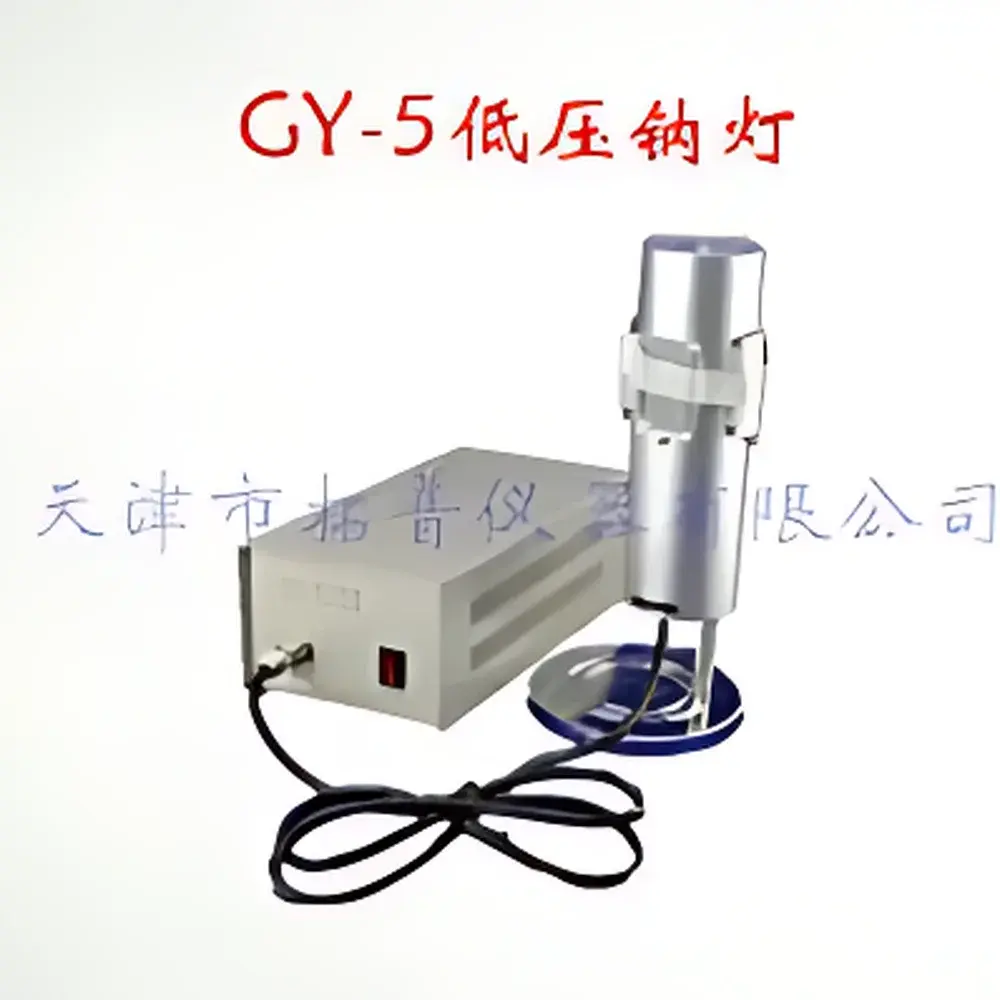
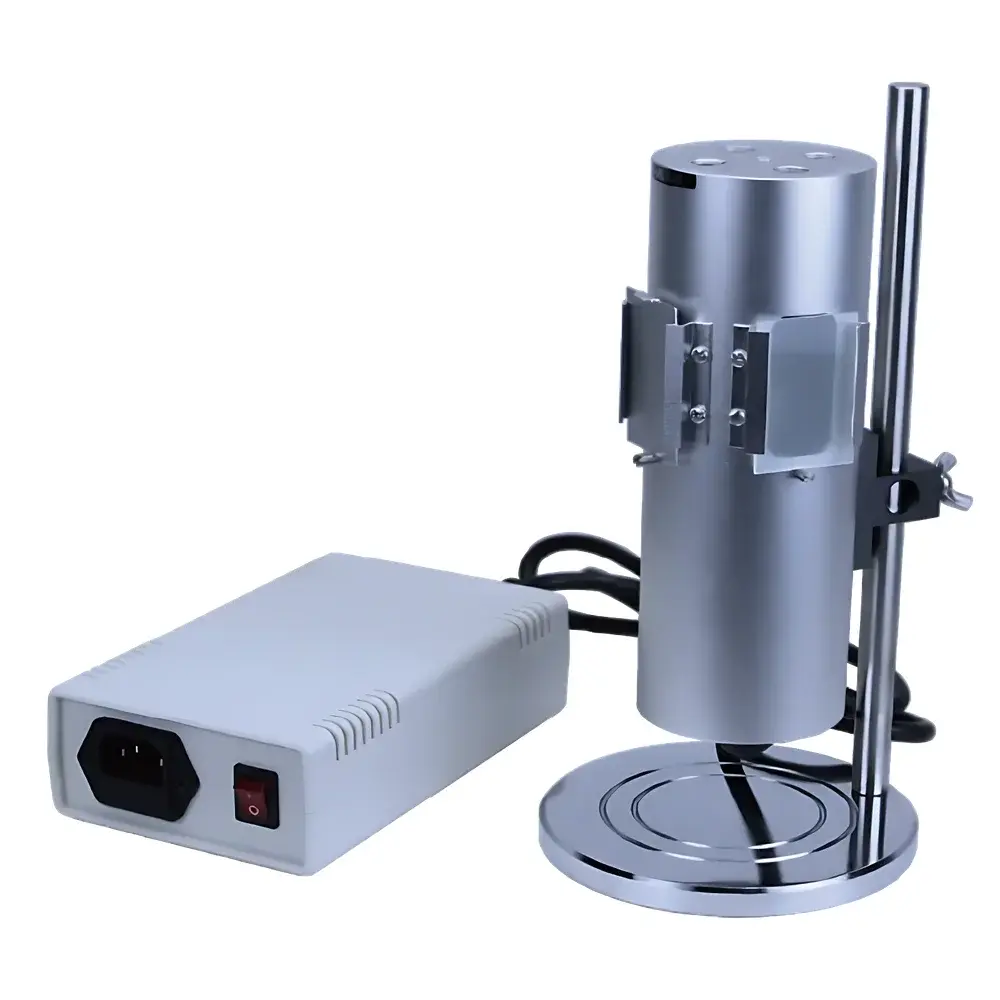
Topo GY-5 Low-Pressure Sodium (LPS) Calibration Lamp
| Brand | Topo (TP) |
|---|---|
| Origin | Tianjin, China |
| Manufacturer Type | Direct Manufacturer |
| Country of Origin | China |
| Model | GY-5 |
| Pricing | Available Upon Request |
Overview
The Topo GY-5 Low-Pressure Sodium (LPS) Calibration Lamp is a precision optical reference source engineered for wavelength calibration and spectral resolution verification in laboratory-grade spectrometers, monochromators, interferometers, and other dispersive optical instruments. Operating on the principle of low-pressure sodium vapor discharge, the lamp emits intense, narrow-line radiation dominated by the well-characterized sodium D-line doublet at 589.0 nm and 589.6 nm (vacuum wavelengths). These two closely spaced emission lines—separated by approximately 0.6 nm—serve as an internationally recognized standard for evaluating instrumental line shape, resolving power, and wavelength accuracy. The integrated constant-current ballast ensures stable discharge conditions, minimizing intensity drift and spectral broadening over extended operation periods. Unlike broadband sources, the GY-5 delivers high spectral purity with minimal background continuum, enabling traceable calibration in accordance with ISO/IEC 17025–accredited metrology workflows.
Key Features
- Stable, low-pressure sodium discharge yielding dominant D-line emission at 589.0 nm and 589.6 nm with full width at half maximum (FWHM) < 0.01 nm under optimal thermal stabilization
- Integrated precision current-regulated ballast for consistent arc ignition, luminous flux stability (< ±1.5% over 30 min), and minimized spectral shift due to thermal drift
- Rugged borosilicate glass envelope with optimized sodium reservoir geometry to maintain vapor pressure equilibrium across ambient temperature ranges (15–30 °C)
- Designed for direct coupling into fiber-optic input ports, collimated beam paths, or monochromator slits via standard SMA905 or M25×0.75 threaded interfaces
- Compliant with IEC 61000-4-11 for immunity to voltage fluctuations and IEC 62471 for photobiological safety (Risk Group 1)
Sample Compatibility & Compliance
The GY-5 lamp is compatible with all optical systems requiring primary or secondary wavelength reference standards in the visible range (570–600 nm). It is routinely deployed in UV-Vis-NIR spectrophotometers, Raman spectrometers, atomic absorption instrumentation, and grating-based optical encoders. Its emission profile satisfies the requirements of ASTM E275 for spectral bandpass verification and ISO 10110-6 for optical component testing. When used in conjunction with NIST-traceable reference filters or calibrated photodiodes, the GY-5 supports GLP-compliant calibration records per ISO/IEC 17025 clause 6.4.4. No sample preparation is required; the lamp operates as a self-contained, non-consumable reference source with typical service life exceeding 3,000 hours under recommended duty cycles (≤8 h/day, ambient cooling).
Software & Data Management
While the GY-5 is a hardware-only calibration source, it integrates seamlessly into automated calibration routines within third-party spectroscopic platforms including Ocean Insight OceanView, Thermo Fisher OMNIC, and Horiba LabSpec. Instrument control software may trigger lamp activation via TTL or RS-232 handshake protocols when paired with optional relay modules. All calibration events—including lamp runtime, ambient temperature, and spectral acquisition timestamps—can be logged in audit-trail-enabled systems compliant with FDA 21 CFR Part 11 requirements. Raw spectral data acquired using the GY-5 are suitable for quantitative assessment of resolution (e.g., Rayleigh criterion validation) and wavelength deviation (±0.05 nm tolerance verification) in instrument qualification protocols (IQ/OQ/PQ).
Applications
- Wavelength scale verification and linearization of scanning monochromators and array-based spectrometers
- Resolution testing of diffraction gratings, etalons, and Fabry–Pérot interferometers
- Validation of spectral bandwidth specifications per manufacturer datasheets and ISO 14644-1 Annex B
- Reference standard in inter-laboratory comparison studies for optical metrology accreditation
- Supporting traceability chains for national metrology institutes (NMIs) and accredited calibration laboratories
FAQ
What is the expected warm-up time to achieve spectral stability?
Typical thermal and discharge stabilization requires 15–20 minutes after cold start; spectral centroid drift remains below ±0.005 nm after this period.
Can the GY-5 be used interchangeably with high-pressure sodium lamps?
No—high-pressure sodium sources exhibit broadened, multi-line spectra unsuitable for high-resolution calibration; the GY-5’s low-pressure design is essential for D-line isolation.
Is the lamp compatible with vacuum or purged optical enclosures?
Yes—the sealed quartz envelope is rated for operation under dry nitrogen purge (≤100 kPa); vacuum use is not recommended due to thermal stress risk.
Does the GY-5 require annual recalibration?
No—the emission wavelengths are defined by atomic transition physics and do not drift; however, output intensity should be monitored annually using a NIST-traceable photometer.
How does the GY-5 compare to mercury-argon or holmium oxide reference standards?
The GY-5 provides superior line intensity and signal-to-noise ratio for D-line–centered applications, whereas Hg/Ar offers broader coverage; Ho oxide is absorption-based and requires transmission path alignment.





