
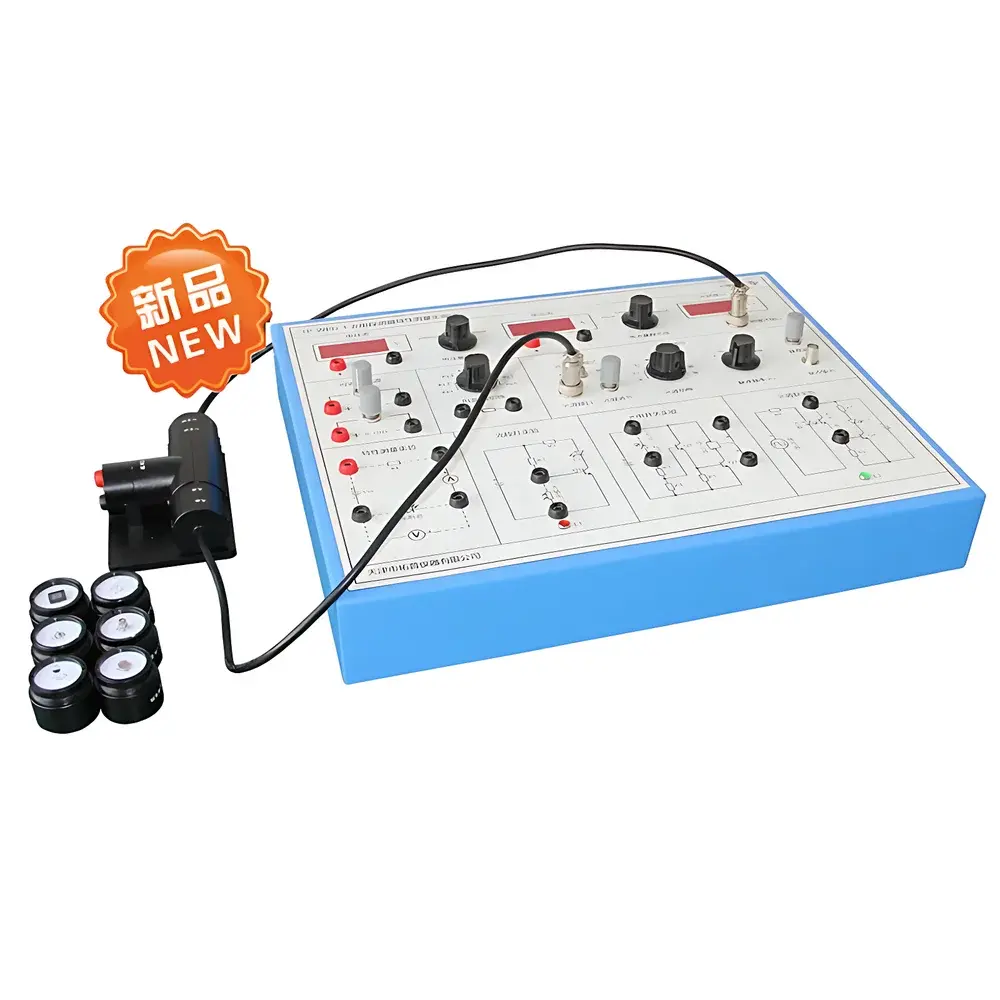
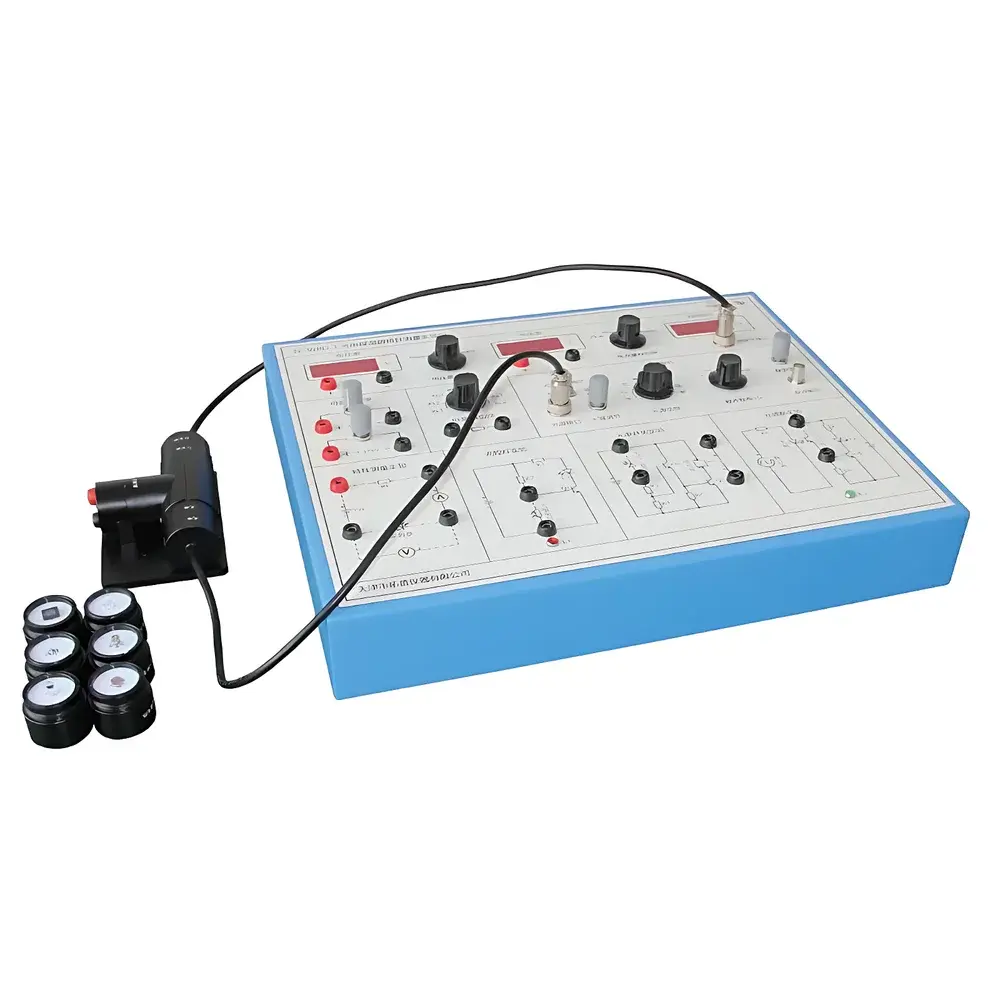
Topo Optoelectronics Photodetector Characterization Experimental System TP-WPD-1
| Brand | Topo/TP |
|---|---|
| Origin | Tianjin, China |
| Manufacturer Type | Direct Manufacturer |
| Region of Origin | Domestic (China) |
| Model | TP-WPD-1 |
| Pricing | Available Upon Request |
Overview
The Topo Optoelectronics Photodetector Characterization Experimental System TP-WPD-1 is an education-focused benchtop instrumentation platform engineered for undergraduate and graduate laboratories in optoelectronics, photonics, and electrical engineering curricula. It implements a modular, hands-on methodology to characterize fundamental electro-optical response parameters of discrete photodetectors using standardized optical excitation and electrical measurement techniques. The system operates on the principle of controlled illumination—employing stable, spectrally defined LED sources—and simultaneous acquisition of detector current/voltage output under variable bias and irradiance conditions. Its architecture supports both static (DC) and dynamic (time-resolved) characterization modes, enabling pedagogical exploration of responsivity, dark current, spectral response, linearity, and transient response—core metrics referenced in ISO 11146, IEC 60747-5-2, and IEEE Std 1892–2021 for photodetector evaluation.
Key Features
- Modular experimental framework supporting two-tiered pedagogy: foundational characterization (6 detector types) and applied system integration scenarios.
- Integrated multi-wavelength LED light source: white LED plus six discrete monochromatic LEDs (450 nm, 525 nm, 590 nm, 630 nm, 660 nm, 850 nm), selectable via front-panel rotary switch—eliminating mechanical filter exchange and minimizing alignment drift.
- T-shaped light-tight optical enclosure with beam splitting functionality: enables concurrent monitoring of incident irradiance (via built-in calibrated photodiode reference channel) and detector under test (DUT) response—ensuring traceable, ratio-metric measurement without sequential instrument reconfiguration.
- Front-panel interface with dedicated knobs and digital indicators for real-time adjustment of bias voltage (0–12 V DC, ±1% accuracy), illumination intensity (0–100% LED drive), and measurement range selection (nA to mA full scale).
- Compact planar chassis design (320 × 240 × 120 mm) constructed from anodized aluminum housing; weight < 3.2 kg—optimized for classroom portability, shared lab bench deployment, and student workstation integration.
Sample Compatibility & Compliance
The TP-WPD-1 accommodates standard through-hole and surface-mount photodetectors with 2–3 pin configurations, including photoresistors (LDRs), silicon PIN photodiodes, phototransistors, silicon solar cells (photovoltaic mode), avalanche photodiodes (APDs, operated below breakdown), and dual-junction color-sensitive diodes. All experiments comply with university-level laboratory safety standards (IEC 61010-1 Class II). Electrical interfaces conform to TTL-compatible signal levels and low-voltage (< 15 V) operation, ensuring compatibility with standard oscilloscopes, digital multimeters, and data acquisition systems. The system supports documentation practices aligned with GLP principles for academic lab reporting, including manual parameter logging and structured experimental record templates provided in the instructor’s guide.
Software & Data Management
While the TP-WPD-1 operates as a standalone analog/digital hybrid instrument, it includes analog voltage and current output terminals compatible with third-party DAQ hardware (e.g., National Instruments USB-6000 series or Arduino-based ADC modules). Optional MATLAB® and Python (PyVISA) script templates are supplied for automated sweep acquisition—enabling students to generate I-V curves, spectral responsivity plots (A/W vs. λ), and rise/fall time histograms. All measurement protocols adhere to reproducible experimental conditions: fixed LED thermal stabilization time (≥30 s), ambient light rejection via T-shaped baffle, and zero-offset calibration routine prior to each session. Data export supports CSV format for post-processing in Excel, OriginLab, or Python SciPy environments.
Applications
- Teaching core semiconductor optoelectronic behavior: carrier generation, recombination kinetics, junction capacitance effects, and bias-dependent quantum efficiency.
- Comparative analysis of detector figures of merit: detectivity (D*), noise-equivalent power (NEP), linearity range, and spectral mismatch error in photometric applications.
- Design validation of simple optoelectronic subsystems—e.g., light barrier sensors, ambient light control loops, pulse oximetry signal chains, and basic optical communication receivers.
- Preparation for advanced research labs involving lock-in amplification, optical modulation transfer function (MTF) testing, or calibration against NIST-traceable reference detectors.
FAQ
Does the TP-WPD-1 support AC-coupled or modulated light measurements?
No—it is designed for DC and quasi-static characterization only. Time-domain response is evaluated via step-function illumination (manual LED ON/OFF) and oscilloscope capture at the DUT output.
Can the system be used with fiber-coupled detectors?
Yes, provided the detector has free-space input or is mounted in a standard TO-can package with accessible leads; optional fiber adapter kits (FC/PC or SMA) are available separately.
Is calibration traceable to national standards?
The internal reference photodiode is factory-calibrated against a NIST-traceable irradiance standard at 550 nm; full calibration certificate is included with each unit.
What power supply requirements does the instrument have?
Single-input 100–240 V AC, 50/60 Hz; internal switching PSU delivers isolated ±12 V and +5 V rails—no external bench supplies required.
Are experiment manuals and lab worksheets provided in English?
Yes—comprehensive English-language instructor’s manual (120 pp), student lab guides, and editable LaTeX-based report templates are delivered digitally with the system.




