
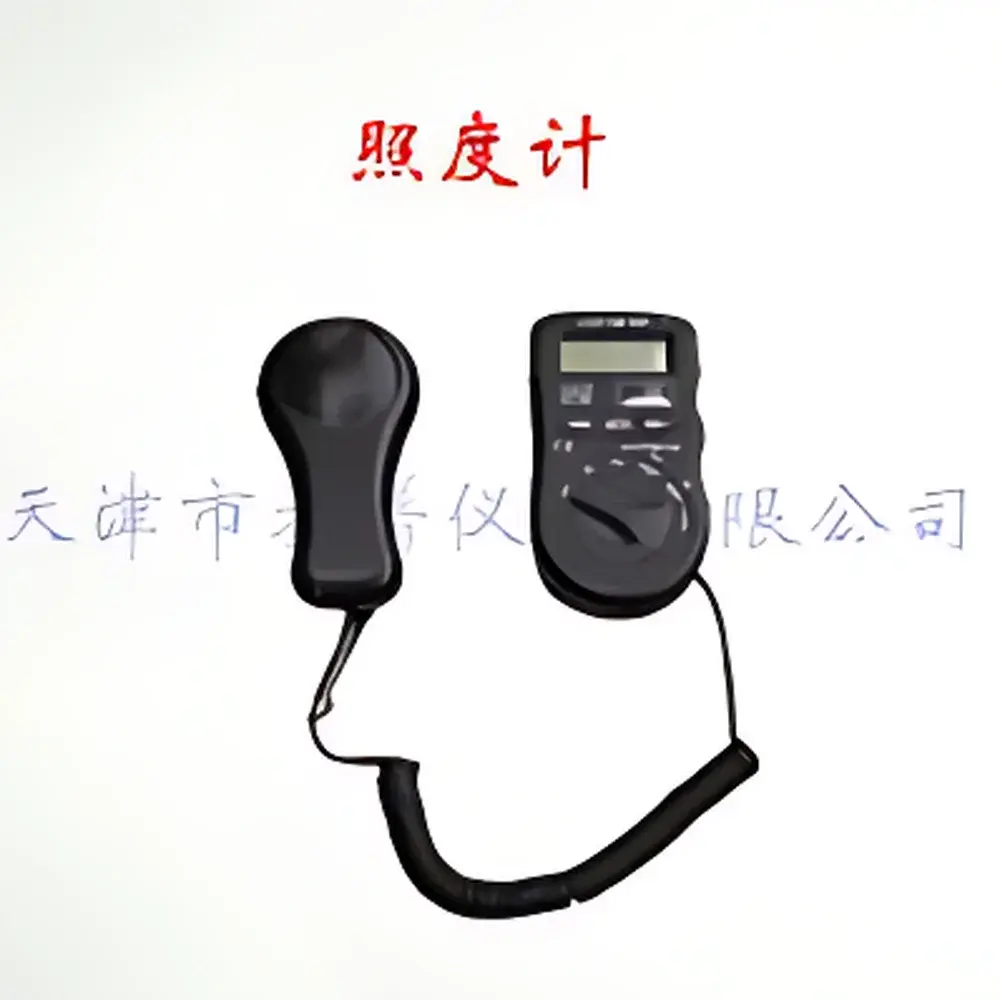
Topo TP-100 Pocket Digital Lux Meter
| Brand | Topo |
|---|---|
| Model | TP-100 |
| Type | Handheld Photometer |
| Measurement Units | lux and foot-candles (fc) |
| Display | 3½-digit LCD |
| Resolution | 0.1 lux / 0.1 fc |
| Range | 0.1–50,000 lux |
| Accuracy | ±5% rdg ±10 digits (<10,000 lux) |
| Probe Dimensions | 115 × 60 × 27 mm |
| Weight | 160 g |
| Power | Battery-operated with low-battery indicator and auto-power-off |
| Functions | Data hold, max-value hold |
Overview
The Topo TP-100 Pocket Digital Lux Meter is a compact, handheld photometric instrument engineered for rapid, field-deployable measurement of ambient illuminance in accordance with CIE standard photopic luminosity function (V(λ)). It operates on the principle of silicon photodiode detection coupled with precision optical filtering to ensure spectral response closely aligned with the human eye’s photopic sensitivity curve (CIE 1931). Designed for routine light-level verification in architectural lighting audits, workplace safety compliance checks, museum conservation environments, and educational laboratory settings, the TP-100 delivers traceable, repeatable readings without requiring external calibration sources under normal operating conditions. Its dual-unit capability (lux and foot-candles) supports both SI and imperial reporting requirements, facilitating seamless integration into international facility management workflows.
Key Features
- Compact ergonomic form factor (115 × 60 × 27 mm probe; total unit weight: 160 g) optimized for one-handed operation and extended field use.
- High-contrast 3½-digit LCD display with automatic decimal point positioning and backlight-free readability under varied ambient lighting.
- Dual-range measurement architecture supporting simultaneous lux and foot-candle readouts, eliminating manual unit conversion errors.
- Resolution of 0.1 lux / 0.1 fc across the full 0.1–50,000 lux dynamic range, enabling detection of subtle illumination gradients in low-light applications such as darkroom validation or emergency egress path assessment.
- Real-time data hold and peak-hold functions allow stable capture of transient or fluctuating light levels—critical during flicker analysis or pulsed LED source evaluation.
- Auto-power-off circuitry extends battery life while preserving measurement integrity; low-battery indicator provides unambiguous visual warning prior to operational interruption.
- Rugged ABS housing with integrated probe geometry ensures mechanical stability during repeated placement on work surfaces, fixtures, or mounting brackets.
Sample Compatibility & Compliance
The TP-100 is calibrated for use with steady-state and quasi-stationary broadband light sources including incandescent, fluorescent, HID, and white LED lamps. It is not intended for pulsed laser radiation, UV-C germicidal irradiation, or narrowband monochromatic sources outside the 400–700 nm photopic band. The instrument conforms to the essential performance criteria defined in IEC 60825-1 (laser safety—exclusion clause) and meets the basic metrological requirements referenced in ISO/CIE 19476:2014 (photometry—characteristics of illuminance meters). While not certified to GLP or GMP standards, its documented accuracy specifications support routine verification per internal QA protocols aligned with OSHA 1910.141 (sanitation), EN 12464-1 (lighting of work places), and ASHRAE 90.1 Annex G (lighting power allowance validation).
Software & Data Management
The TP-100 operates as a standalone analog-digital hybrid meter with no embedded firmware update capability or USB/Bluetooth connectivity. All measurements are displayed and retained locally via the LCD interface only. For documentation purposes, users may manually record readings—including hold and max-value outputs—into lab notebooks, Excel spreadsheets, or CMMS platforms. Though it lacks digital export functionality, its consistent resolution and stated accuracy permit inclusion in audit trails where manual entry is permitted under organizational SOPs. No software license, driver installation, or cloud service subscription is required or supported.
Applications
- Workplace lighting compliance verification against occupational health thresholds (e.g., OSHA-recommended 500 lux for general office tasks).
- Architectural daylight harvesting system commissioning and seasonal performance monitoring.
- Museum and archival storage environment control—ensuring illuminance remains below 50 lux for light-sensitive artifacts per ICOM-CC guidelines.
- Educational physics laboratories conducting inverse-square law experiments or spectral response characterization.
- Facility maintenance teams performing routine lamp output decay tracking and relamping scheduling.
- Photography and film set lighting pre-checks to confirm uniformity and avoid overexposure in critical zones.
FAQ
What is the spectral response range of the TP-100 sensor?
The photodiode incorporates a V(λ)-matched optical filter compliant with CIE 1931 standard observer characteristics, covering 400–700 nm with f1′ error < 6% — suitable for general-purpose visible-light illuminance measurement.
Can the TP-100 measure pulsed or flashing light sources?
It captures instantaneous values but does not compute time-weighted averages or frequency-domain metrics; therefore, it is not recommended for stroboscopic or high-frequency PWM-driven LEDs without supplemental instrumentation.
Is calibration certificate included with purchase?
A factory calibration report (traceable to NIM China) is provided upon request at time of order; NIST-traceable recalibration services are available through authorized Topo service centers.
Does the device meet FDA 21 CFR Part 11 requirements?
No — the TP-100 lacks electronic audit trail, user authentication, or data export controls required for regulated pharmaceutical or clinical trial environments.
How often should the instrument be recalibrated?
Annual recalibration is recommended for continuous industrial use; biennial verification suffices for intermittent academic or facility management applications, contingent upon documented handling and storage conditions.



