
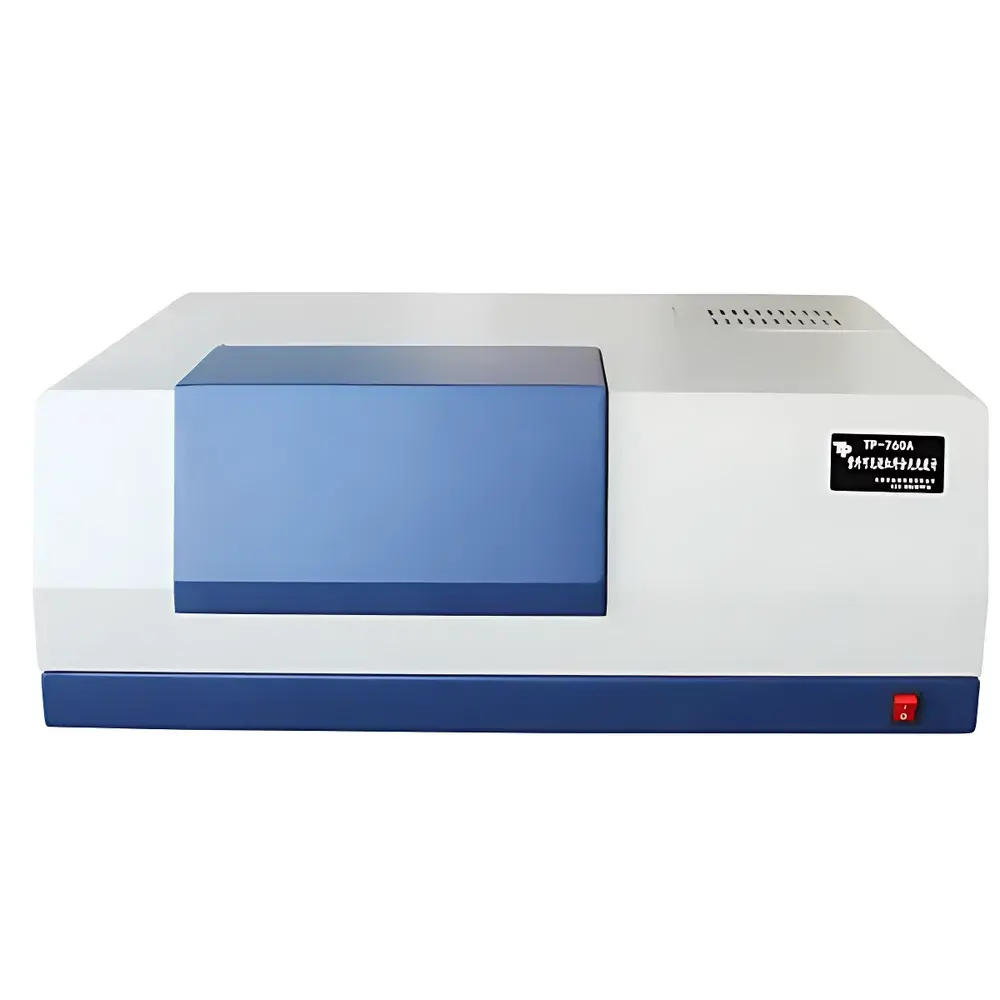
Topo TP-760A UV-Vis-NIR Spectrophotometer
| Brand | Topo |
|---|---|
| Origin | Tianjin, China |
| Manufacturer Type | Direct Manufacturer |
| Product Category | Domestic |
| Model | TP-760A |
| Price Range | USD 21,000–28,000 (FOB) |
| Spectral Range | 280–2500 nm |
| Spectral Bandwidth | UV/VIS: 0.1, 0.2, 0.5, 1.0, 2.0, 3.0, 5.0 nm (selectable) |
| NIR | 0.4–16.0 nm (auto/manual) |
| Wavelength Accuracy | ±0.5 nm (UV/VIS) |
| Wavelength Repeatability | ≤0.3 nm (UV/VIS) |
| Photometric Accuracy | ±0.3% T |
| Baseline Flatness | ±0.008 A (280–2500 nm, after 30-min warm-up) |
Overview
The Topo TP-760A UV-Vis-NIR Spectrophotometer is a high-performance dual-beam, double-grating spectrophotometric system engineered for quantitative and qualitative optical characterization across the ultraviolet, visible, and near-infrared spectral domains (280–2500 nm). It employs a physically integrated host unit and 60-mm diameter integrating sphere to enable simultaneous measurement of transmittance, specular reflectance, and diffuse reflectance—without mechanical reconfiguration. The instrument operates on a dual-detector architecture: a high-sensitivity silicon photodiode for UV/VIS detection and an extended-range InGaAs detector for NIR, ensuring low-noise signal acquisition and enhanced dynamic range. Its optical design minimizes stray light and baseline drift through active beam balancing and thermally stabilized grating mounts, delivering high reproducibility in demanding industrial and regulatory environments.
Key Features
- Dual-beam, double-grating optical path with independent UV/VIS and NIR dispersion channels, reducing spectral crosstalk and enabling optimized resolution across the full range.
- Integrated 60-mm PTFE-coated integrating sphere with baffle-controlled port geometry for ISO/IEC 17025-compliant diffuse reflectance and total transmittance measurements.
- Automated wavelength calibration using internal holmium oxide and neutral density reference standards; self-diagnostic startup routine verifies optical alignment and detector response stability.
- Computer-controlled operation via dedicated Windows 11 (64-bit) software with real-time spectral preview, multi-curve overlay, and GLP-compliant audit trail logging (user ID, timestamp, parameter settings, raw data checksum).
- Preconfigured application modules for architectural glazing analysis—including solar heat gain coefficient (SHGC), visible light transmittance (VLT), and UV rejection—aligned with GB/T 2680-2021, ISO 9050:2003, and JGJ/T 151-2008 test protocols.
Sample Compatibility & Compliance
The TP-760A accommodates flat, rigid, and semi-rigid samples up to 100 mm × 100 mm × 25 mm (L×W×H), including monolithic and laminated architectural glasses (e.g., low-emissivity coated, magnetron sputtered, ion-plated, and float glass), polymer films, textile substrates, and liquid cuvettes (10-mm pathlength standard). All optical measurements comply with ASTM E424, ISO 9050, and GB/T 36261-2018 for solar optical property determination. For pharmaceutical and food-grade liquid analysis (e.g., glucose, fructose, sucrose solutions), the system supports cuvette-based absorbance quantification per USP and EP 2.2.25 guidelines. Instrument validation documentation includes factory-certified wavelength and photometric accuracy reports traceable to NIM (National Institute of Metrology, China) standards.
Software & Data Management
The proprietary TopoSpec v3.2 software provides full instrument control, spectral acquisition, and post-processing functionality. Data files are stored in native binary format (.tps) with embedded metadata (instrument ID, operator, date/time, calibration status, environmental conditions). Export options include CSV, TXT, and Excel-compatible XLSX formats; spectral overlays support up to 16 curves with customizable axis scaling and annotation. Reporting templates adhere to ISO/IEC 17025 clause 7.8 requirements: each printed report contains instrument identification, uncertainty statements (k=2), method references, and digital signature fields. Audit trails are encrypted and non-editable; software enforces password-protected user roles (Operator, Supervisor, Administrator) aligned with FDA 21 CFR Part 11 electronic record controls.
Applications
- Architectural glazing certification: direct calculation of solar transmittance (Tsol), solar reflectance (Rsol), and shading coefficient (SC) per JG/T 235-2014 and GJB 2502.2-2006.
- Coating and thin-film R&D: thickness estimation via interference fringe analysis in transmission mode (280–1100 nm), supported by built-in thin-film modeling tools.
- Textile and polymer optical evaluation: UV protection factor (UPF) assessment per GB/T 22476-2008 and AATCC TM183.
- Food and beverage quality control: quantitative analysis of sugar concentration, color index (CIE L*a*b*), and turbidity in aqueous solutions using preloaded calibration curves.
- Military-spec material testing: infrared camouflage fabric reflectance profiling (1000–2500 nm) compliant with GJB 798-90 spectral reflectance requirements.
FAQ
What standards does the TP-760A support for architectural glass testing?
It fully implements GB/T 2680-2021, JGJ/T 151-2008, ISO 9050:2003, and GB/T 36261-2018 for solar-optical property measurement, including automated SHGC derivation.
Can the instrument measure both transmittance and reflectance without hardware reconfiguration?
Yes—the integrated 60-mm integrating sphere enables seamless switching between transmittance, specular reflectance, and diffuse reflectance modes via software command.
Is the software compliant with FDA 21 CFR Part 11 for regulated laboratories?
TopoSpec v3.2 includes electronic signatures, audit trail encryption, role-based access control, and immutable data archiving—fully satisfying Part 11 requirements for electronic records and signatures.
What is the recommended warm-up time before baseline stabilization?
A minimum 30-minute thermal equilibration period is required to achieve ±0.008 A baseline flatness across 280–2500 nm, as verified per GB/T 25261-2010 Annex B.
Does the system support custom method development for non-standard applications?
Yes—users may define custom wavelength ranges, bandwidths, scan speeds, and mathematical operations (e.g., first derivative, Kubelka-Munk transformation) via the Method Editor module.





