
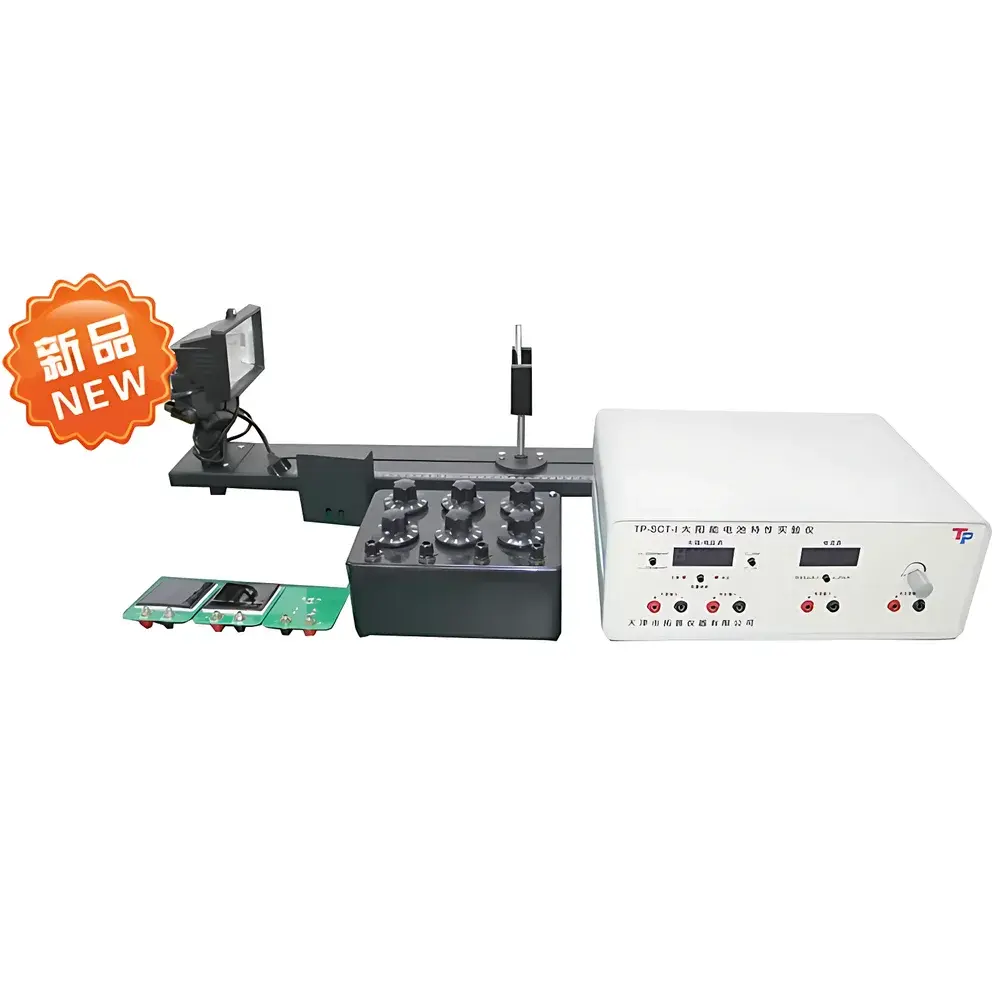
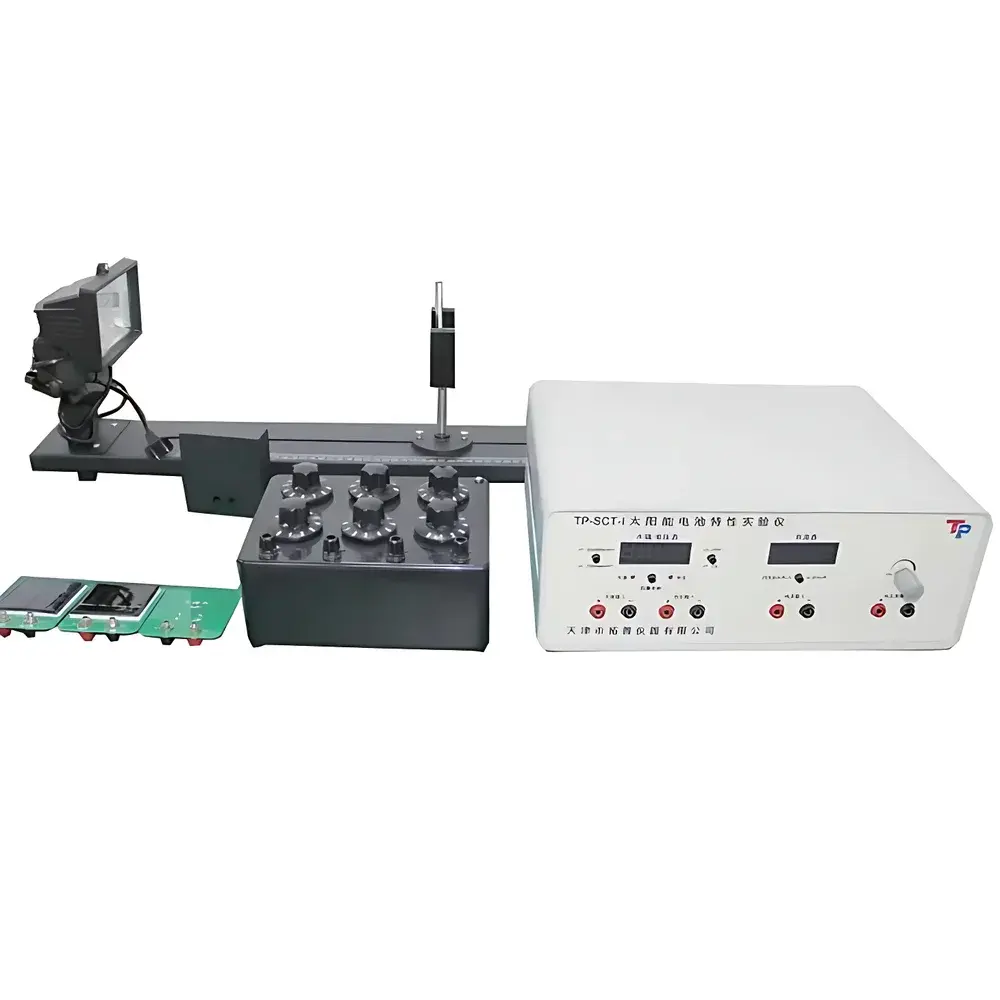
Topo TP-SCT-1 Solar Cell Characterization Trainer
| Brand | Topo |
|---|---|
| Origin | Tianjin, China |
| Manufacturer Type | Direct Manufacturer |
| Region Classification | Domestic (China) |
| Model | TP-SCT-1 |
| Pricing | Available Upon Request |
Overview
The Topo TP-SCT-1 Solar Cell Characterization Trainer is an educational and research-grade instrumentation platform engineered for the empirical analysis of photovoltaic (PV) device performance under controlled illumination. It employs a calibrated tungsten-halogen lamp as a stable, spectrally continuous light source to simulate terrestrial solar irradiance (AM1.5G spectral approximation). The system enables direct measurement of fundamental current–voltage (I–V) characteristics of crystalline silicon (mono- and polycrystalline), amorphous silicon, and other thin-film solar cell specimens. Core output parameters—including short-circuit current (ISC), open-circuit voltage (VOC), maximum power point (PMAX), fill factor (FF), and conversion efficiency (η)—are derived via synchronized electrical load sweeping and irradiance quantification. Designed for laboratory-scale reproducibility, the TP-SCT-1 supports both qualitative pedagogical demonstrations and quantitative validation of PV material behavior under variable illumination conditions.
Key Features
- Integrated tungsten-halogen lamp with adjustable optical alignment and thermal shielding to ensure stable spectral output and minimize sample heating artifacts during extended measurements.
- Dual-range digital lux meter (0–2000 lx and 0–20,000 lx ranges) with NIST-traceable calibration for irradiance assessment—enabling high-resolution characterization across low- to mid-intensity illumination regimes relevant to indoor testing and partial-shading studies.
- Manual linear translation stage for precise control of source-to-sample distance (range: 10–100 cm), facilitating systematic investigation of irradiance dependence (E ∝ 1/d²) on I–V curve morphology and PCE trends.
- Modular sample holder accommodating standardized PV test coupons (up to 100 mm × 100 mm), compatible with industry-standard electrode configurations (e.g., silver paste contacts, busbar layouts) and supporting rapid specimen exchange without recalibration.
- Embedded analog front-end with four-quadrant operation, capable of sourcing and sinking current up to ±2 A at ±30 V, ensuring accurate capture of forward- and reverse-bias regions including diode leakage and breakdown thresholds.
Sample Compatibility & Compliance
The TP-SCT-1 is validated for use with silicon-based photovoltaic materials, including monocrystalline, multicrystalline, and hydrogenated amorphous silicon (a-Si:H) devices. Its illumination uniformity (>90% over 80 mm diameter) and spectral stability (<±2% drift over 30 min) meet ASTM E927-22 requirements for reference solar simulators used in educational and pre-certification testing environments. While not certified to IEC 60904-9 Class AAA standards for commercial PV testing, the system adheres to ISO/IEC 17025 principles for measurement uncertainty estimation and traceability. All electrical interfaces comply with IEC 61000-4-5 surge immunity and EN 61326-1 EMC directives for laboratory equipment.
Software & Data Management
The trainer includes PC-based acquisition software (Windows 10/11 compatible) supporting real-time I–V curve plotting, automatic PMAX extraction, and batch export of raw data in CSV and MATLAB (.mat) formats. Software implements configurable sweep parameters (voltage step size: 10 mV–100 mV; dwell time: 10–500 ms), hysteresis-aware dual-sweep protocols, and built-in calculation modules for FF, η, series resistance (RS), and shunt resistance (RSH) using standard single-diode model fitting. Audit trails, user authentication, and timestamped metadata logging are implemented in accordance with GLP-compliant documentation practices—though full 21 CFR Part 11 electronic signature functionality is not included, as the system is intended for teaching and exploratory research rather than regulated quality assurance workflows.
Applications
- Undergraduate and graduate laboratory instruction in semiconductor physics, renewable energy engineering, and materials science curricula.
- Comparative evaluation of PV material responses to spectral mismatch, temperature gradients, and non-uniform illumination—supporting student-designed experiments on degradation mechanisms and anti-reflection coating efficacy.
- Pre-screening of prototype solar cells prior to deployment in outdoor test beds or accredited certification labs.
- Calibration reference for low-cost pyranometers and photodiode-based irradiance sensors within university microgrid research facilities.
- Development of empirical models linking geometric configuration (e.g., tilt angle, shadow occlusion) to electrical output metrics under controlled lab conditions.
FAQ
Does the TP-SCT-1 include a certified solar simulator?
No—the tungsten-halogen source provides broad-spectrum visible-NIR irradiance but does not meet IEC 60904-9 spectral match (Class A), spatial uniformity (Class A), or temporal stability (Class A) requirements for formal PV device certification.
Can the system measure temperature-dependent I–V characteristics?
Not natively—the base unit lacks integrated temperature control or monitoring. However, external thermoelectric coolers or environmental chambers may be coupled with the sample stage for custom thermal studies.
Is remote operation supported via LAN or USB?
Yes—data acquisition and instrument control are fully supported over USB 2.0; TCP/IP communication is not implemented.
What safety certifications does the unit carry?
It conforms to IEC 61010-1:2010 for electrical safety in laboratory equipment and carries CE marking per EU Low Voltage Directive 2014/35/EU and EMC Directive 2014/30/EU.
Are calibration certificates provided with the lux meter?
A factory calibration report with uncertainty budget (k=2) is supplied; end-user recalibration is recommended annually or after mechanical shock.




