
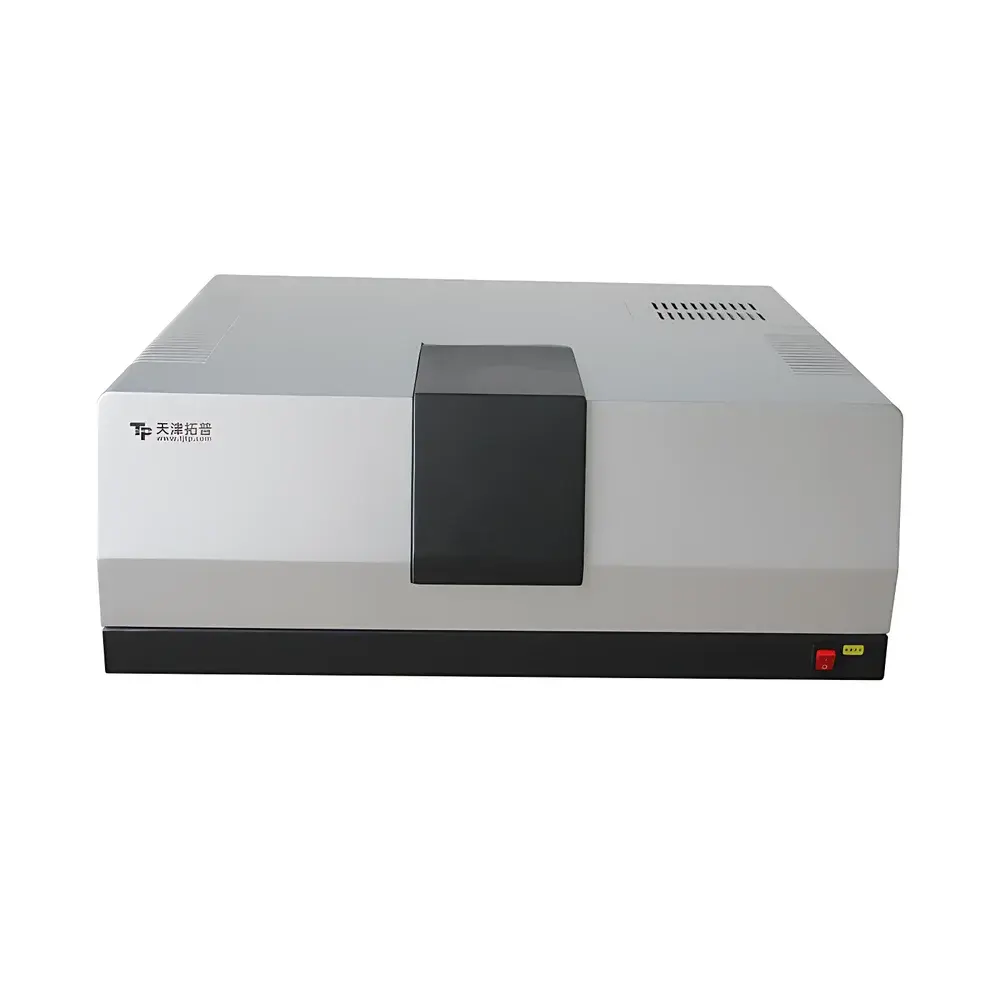
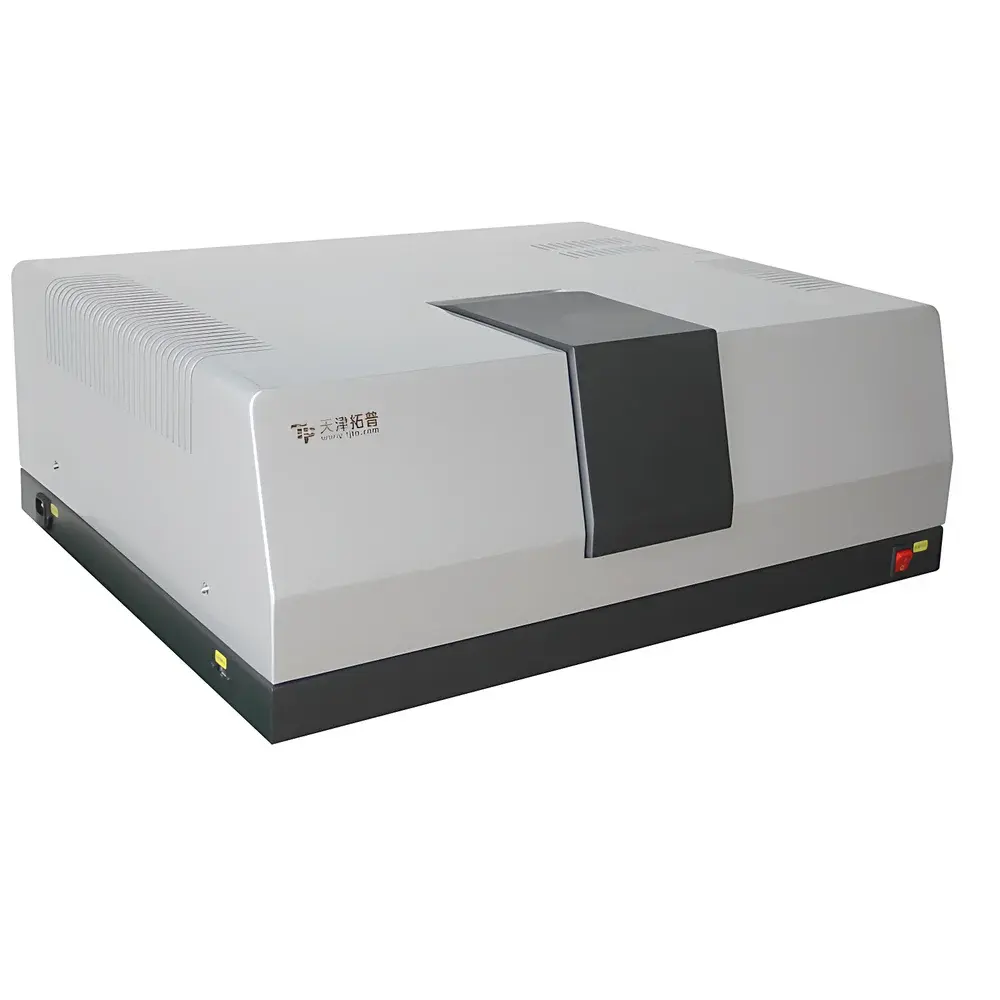
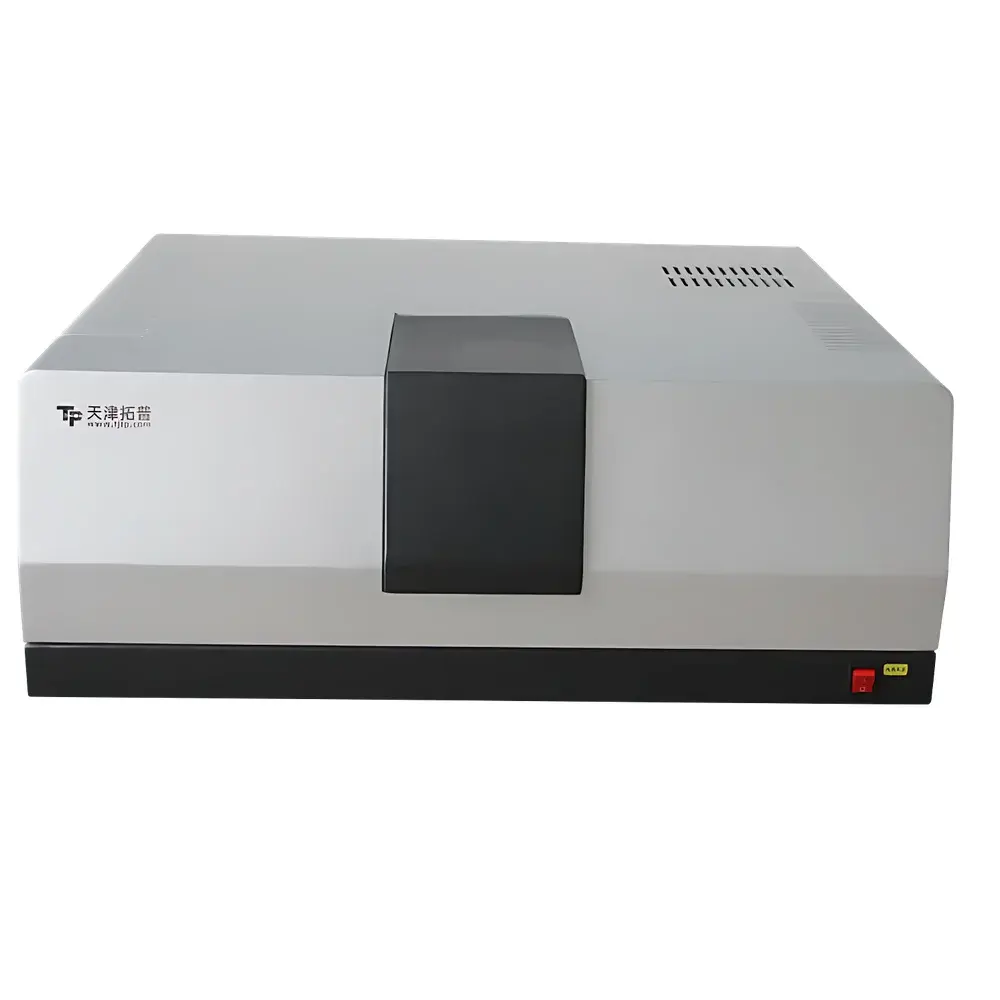
Topo TP720 UV-Visible-Near Infrared Spectrophotometer
| Brand | Topo |
|---|---|
| Origin | Tianjin, China |
| Manufacturer Type | Direct Manufacturer |
| Region Classification | Domestic (China) |
| Model | TP720 |
| Price Range | USD 21,000 – 35,000 (FOB Tianjin) |
| Spectral Range | 190–3200 nm |
| Spectral Bandwidth (UV/VIS) | 0.1, 0.2, 0.5, 1.0, 2.0, 3.0, 5.0 nm (selectable) |
| Spectral Bandwidth (NIR) | 0.4–16.0 nm (auto/manual) |
| Wavelength Accuracy | ±0.5 nm (UV/VIS) |
| Wavelength Repeatability | ≤0.3 nm (UV/VIS) |
| Photometric Accuracy | ±0.3% T |
| Baseline Flatness | ±0.005 A (200–2500 nm, after 30-min warm-up) |
Overview
The Topo TP720 UV-Visible-Near Infrared Spectrophotometer is a dual-beam, double-grating, dual-detector scanning spectrophotometer engineered for high-fidelity spectral characterization across an exceptionally broad wavelength range—from deep ultraviolet (190 nm) through the visible spectrum and into the near-infrared (up to 3200 nm). Its optical architecture leverages separate optimized detectors for UV/VIS (silicon photodiode) and NIR (InGaAs), ensuring consistent signal-to-noise performance and minimal detector-induced artifacts across the full operational band. The instrument employs a precision stepper-motor-driven monochromator with thermally stabilized gratings and real-time wavelength calibration via internal reference lines, enabling traceable, repeatable measurements compliant with international photometric standards. Designed for rigorous laboratory environments—including QC labs, R&D centers, and materials testing facilities—the TP720 delivers quantitative absorbance, transmittance, reflectance, and radiant energy data with metrological integrity suitable for method validation under GLP and ISO/IEC 17025 frameworks.
Key Features
- Dual-beam optical path with real-time background compensation, minimizing drift from source instability or environmental fluctuations
- Double-grating monochromator system: one grating optimized for UV/VIS (1200 g/mm), another for NIR (300 g/mm), enabling optimal resolution and throughput in each region
- Co-located dual detectors: UV/VIS silicon photodiode and extended-range InGaAs detector (up to 3200 nm), both cooled to reduce dark current and improve low-signal fidelity
- Automated slit-width selection (7 bandwidth options in UV/VIS; continuous 0.4–16.0 nm in NIR) with motorized aperture control and software-synchronized calibration
- Integrated auto-alignment and self-diagnostic routines executed at power-on and prior to each measurement sequence
- USB 2.0 high-speed interface supporting full-spectrum acquisition in ≤5 minutes (190–3200 nm, 1 nm step, 1.0 nm bandwidth)
- Thermally stabilized optical bench with low-expansion alloy housing to maintain alignment stability over extended operation
Sample Compatibility & Compliance
The TP720 accommodates liquid samples in standard 10-mm quartz cuvettes (included), solid thin films, polished bulk materials, architectural glass, coated substrates, and powder samples using optional accessories—including specular reflectance, diffuse reflectance (integrating sphere), and solid-sample transmission holders. All measurement modes—transmittance, absorbance, %R, and energy—are traceable to NIST-traceable reference standards. The instrument meets key regulatory and industry specifications including GB/T 2680–2021 (optical properties of building glass), JGJ/T 151–2008 (energy performance evaluation), ISO 9050:2003 (glass optical characterization), GB/T 22476–2008 (coating spectral reflectance), and GB/T 36261–2018 (NIR spectrophotometer performance verification). Its firmware and data handling architecture support audit-ready operation under GLP and GMP environments, with configurable user access levels and electronic signature capability for critical measurements.
Software & Data Management
The TP720 is operated via TopoSpec v3.2 — a Windows 11 (64-bit) compatible application developed for scientific rigor and workflow efficiency. The software provides real-time spectral preview, multi-curve overlay, baseline correction (polynomial, rubber-band, and derivative-based), peak detection with customizable thresholds, and quantitative analysis using single/multi-point calibration models. Export formats include ASCII (.txt), CSV, and native .tps binary files; imported datasets (e.g., reference spectra, historical baselines) are fully interoperable. Preconfigured application modules include Building Glass Optical Characterization (per ISO 9050), Paint & Coating Reflectance Profiling (per ASTM D2244), and NIR Moisture Content Estimation (using PLS regression templates). All data files embed metadata (wavelength calibration timestamp, detector gain settings, slit width, integration time) and support digital signature logging per FDA 21 CFR Part 11 requirements when deployed on validated IT infrastructure.
Applications
- Quantitative analysis of organic/inorganic compounds in pharmaceutical intermediates and excipients (UV/VIS absorbance at λmax)
- Optical bandgap determination of semiconductor thin films (Tauc plot analysis from absorbance edge)
- Colorimetric evaluation of pigments, dyes, and coatings across CIE L*a*b* and spectral reflectance domains
- Energy transmittance and solar heat gain coefficient (SHGC) modeling for architectural glazing systems
- Moisture, protein, and lipid quantification in agricultural and food products via NIR second-derivative regression
- Quality control of optical filters, antireflective coatings, and IR-transmitting windows (2000–3200 nm)
- Method development and validation for pharmacopeial assays (USP , EP 2.2.25)
FAQ
What is the recommended warm-up time before achieving baseline stability?
A minimum 30-minute thermal stabilization period is required to achieve ±0.005 A baseline flatness across 200–2500 nm, as verified per GB/T 36261–2018.
Does the TP720 support compliance with FDA 21 CFR Part 11?
Yes—when installed on a validated Windows domain environment with role-based authentication, audit trail logging, and electronic signature configuration enabled in TopoSpec v3.2.
Can the instrument measure absolute reflectance without a reference standard?
No—absolute reflectance requires a calibrated reference (e.g., Spectralon® or aluminum-coated mirror) mounted in the same geometry; relative reflectance may be reported without reference but lacks traceability.
Is the NIR detector cooled, and what is its responsivity range?
The InGaAs detector operates uncooled but features thermoelectric stabilization; its certified responsivity spans 900–3200 nm with >85% quantum efficiency between 1000–2500 nm.
Are calibration certificates provided with shipment?
Each unit ships with a factory calibration report (traceable to NIM, China) covering wavelength accuracy, photometric linearity, and stray light performance; optional NIST-traceable recalibration services are available annually.



