
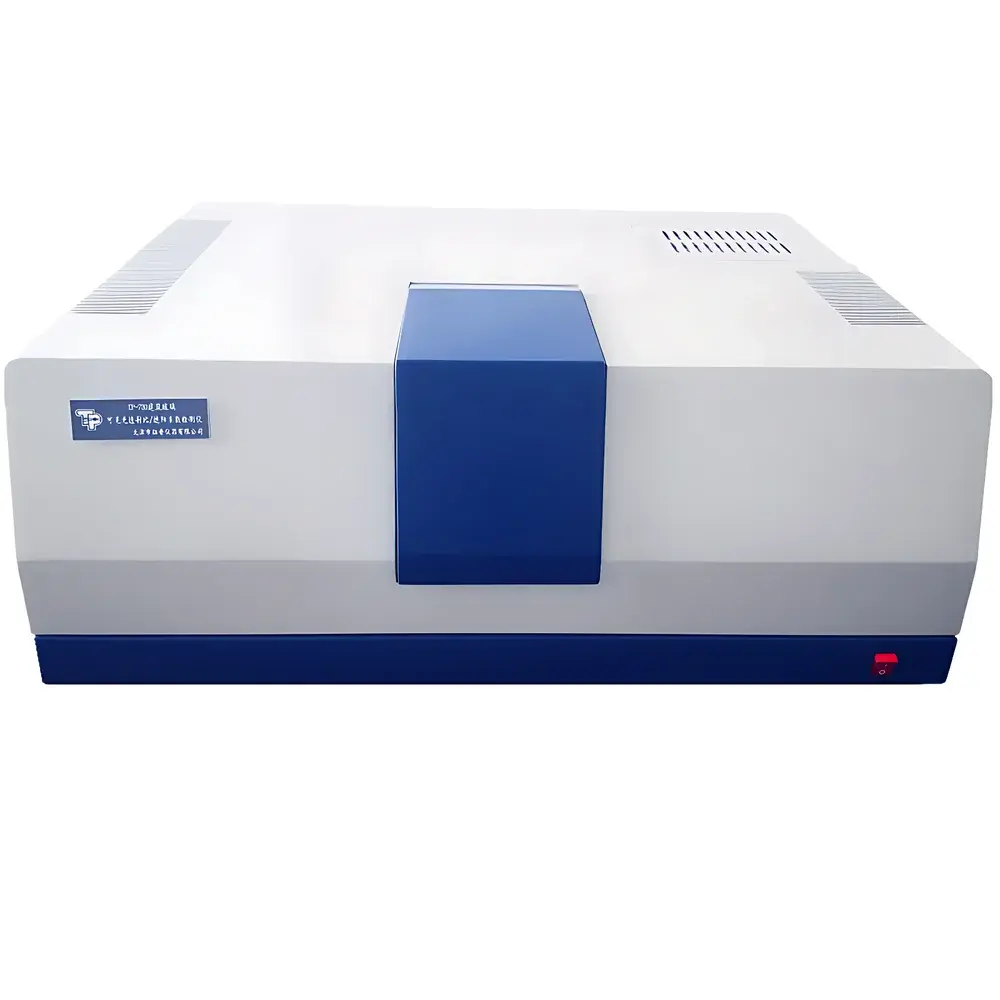
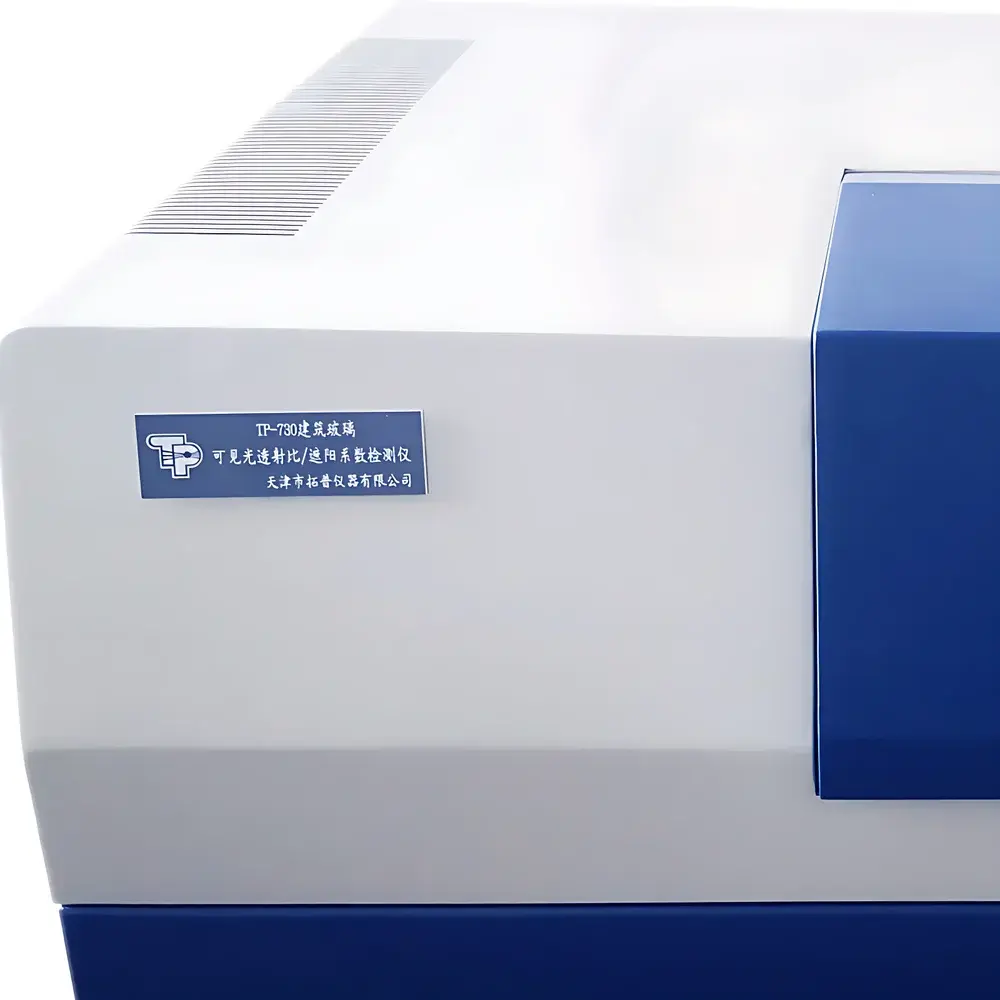
Topo TP730 Building Glass Solar Heat Gain & Visible Light Transmittance Spectrophotometer
| Brand | Topo (TP) |
|---|---|
| Origin | Tianjin, China |
| Manufacturer | Yes |
| Country of Origin | China |
| Model | TP730 |
| Price | USD 22,500 (FOB Tianjin) |
| Wavelength Range | 190–3200 nm |
| Photometric Accuracy | ±0.3%T |
| Wavelength Accuracy | ±0.5 nm (UV/VIS), ±8 nm (NIR) |
| Baseline Flatness | ±0.005 A (200–2500 nm, after 30-min warm-up) |
| Spectral Bandwidth | 0.2–10 nm adjustable |
| Stray Light | ≤0.2%T at 220 nm |
| Photometric Range | 0–2.5 A |
| Sampling Intervals | 0.1, 0.2, 0.5, 1, 1.5, 2, 5, 10 nm |
| Dimensions | 830 × 600 × 260 mm |
Overview
The Topo TP730 Building Glass Solar Heat Gain & Visible Light Transmittance Spectrophotometer is a dual-range UV-Vis-NIR spectrophotometric system engineered for precise optical characterization of architectural glazing materials in accordance with GB/T 2680–1994, the Chinese national standard for determination of visible light transmittance, solar direct transmittance, solar direct reflectance, total solar transmittance, and shading coefficient of building glass. The instrument implements double-beam, grating-based spectral scanning across 190–3200 nm—spanning deep ultraviolet through near-infrared—to quantify photometric responses critical to energy performance modeling, daylighting analysis, and thermal load simulation in building envelope design. Its optical architecture integrates high-stability tungsten-halogen and deuterium light sources, a precision Czerny-Turner monochromator, and thermoelectrically stabilized InGaAs and Si photodetectors optimized for low-noise signal acquisition across both UV-Vis and NIR domains. Calibration traceability is maintained via NIST-traceable reference standards for transmittance and reflectance, supporting compliance with ISO/IEC 17025–2017 requirements for testing laboratories.
Key Features
- Dual-range spectral coverage (190–3200 nm) enables simultaneous measurement of visible light transmittance (380–780 nm), near-infrared solar transmittance (780–2500 nm), and UV blocking performance (190–380 nm)
- Adjustable spectral bandwidth (0.2–10 nm) allows optimization of resolution vs. signal-to-noise ratio for diverse sample types including laminated, coated, and low-emissivity (low-E) glass
- Baseline flatness of ±0.005 A over 200–2500 nm (after 30-minute thermal stabilization) ensures high-fidelity integration of spectral data for accurate calculation of integrated solar parameters per ISO 9050 and EN 410
- Photometric accuracy of ±0.3%T and repeatability of 0.2%T meet ASTM E903 and ISO 9050 validation criteria for optical property measurement of transparent and semi-transparent building materials
- Automated measurement routines compute key regulatory metrics—including visible light transmittance (Tv), solar heat gain coefficient (SHGC), shading coefficient (SC), and g-value—directly from raw spectral data without manual interpolation
- Robust mechanical design with vibration-damped optical bench and sealed monochromator housing minimizes environmental drift during extended measurement campaigns
Sample Compatibility & Compliance
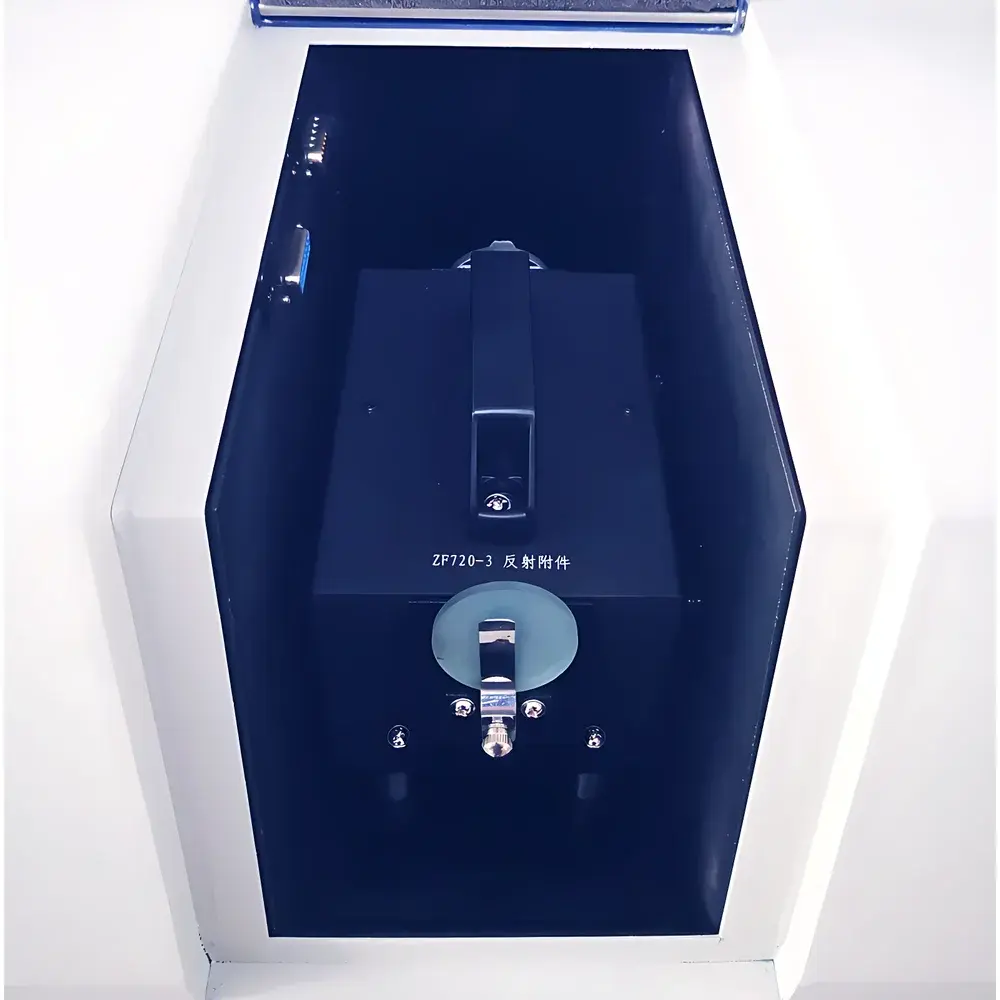
The TP730 accommodates flat, rigid architectural glass specimens up to 300 × 300 mm and 19 mm thickness, using standardized solid-sample holders with precision alignment guides. Optional reflection accessories support bidirectional reflectance distribution function (BRDF)-informed measurements for specular and diffuse components per ASTM E1377 and ISO 13477. All reported optical parameters comply with the calculation methodologies defined in GB/T 2680–1994, ISO 9050:2003 (Glass in building — Determination of luminous and solar characteristics), and EN 410:2011 (Glass in building — Determination of luminous and solar characteristics). Data output formats adhere to ASTM E2914–17 for interoperability with building energy simulation platforms such as EnergyPlus and WINDOW 7. Instrument qualification documentation supports GLP-compliant operation and audit readiness under ISO/IEC 17025 accreditation frameworks.
Software & Data Management
The included ZF720-20 Glass Optical Characterization Software provides a validated, Windows-based interface for instrument control, spectral acquisition, real-time baseline correction, and automated parameter derivation. It implements built-in algorithms aligned with GB/T 2680 Annex B for weighted integration of spectral transmittance/reflectance curves using CIE standard illuminant D65 and solar spectral irradiance (ASTM G173–03). Audit trail functionality records user actions, calibration events, and parameter changes with timestamps and operator IDs—supporting 21 CFR Part 11 compliance when deployed in regulated environments. Raw spectral data are exported in CSV and JCAMP-DX formats; processed reports include metadata (date/time, operator ID, instrument serial number, calibration certificate ID) and are digitally signed to ensure data integrity. Software updates are delivered via secure HTTPS portal with version-controlled release notes.
Applications
- Verification of visible light transmittance (Tv) and solar heat gain coefficient (SHGC) for LEED v4.1 MRc1 and Green Star façade compliance
- Quality assurance of low-emissivity coatings during production line inspection and incoming material verification
- Development and validation of dynamic glazing technologies (electrochromic, thermochromic) under standardized illumination conditions
- Third-party certification testing for CCC (China Compulsory Certification) and CE marking of architectural glass products
- Research on spectral selectivity of novel nanocomposite and plasmonic glazing systems
- Thermal modeling input generation for building energy simulation tools requiring wavelength-resolved optical data
FAQ
Does the TP730 comply with international standards beyond GB/T 2680?
Yes—the instrument’s spectral acquisition protocol, data integration methods, and reporting structure conform to ISO 9050:2003, EN 410:2011, and ASTM E903 for optical property measurement of building glazing.
Is the ZF720-20 software validated for regulated laboratory use?
The software includes configurable audit trails, electronic signatures, and change control logs; when deployed with documented IQ/OQ/PQ protocols, it meets requirements for 21 CFR Part 11 and ISO/IEC 17025 environments.
Can the TP730 measure curved or textured glass?
It is designed for flat, optically homogeneous specimens. Curved or deeply textured surfaces require supplementary goniophotometric characterization not supported by this platform.
What maintenance is required to sustain photometric accuracy?
Annual recalibration using NIST-traceable neutral density filters and spectral reflectance standards is recommended; daily baseline correction and quarterly lamp intensity verification are part of routine operational checks.
Is remote diagnostics or firmware update capability available?
Firmware updates are distributed via encrypted download portal; remote diagnostic support is provided through secure TeamViewer sessions under signed service agreements.
Related Products






