
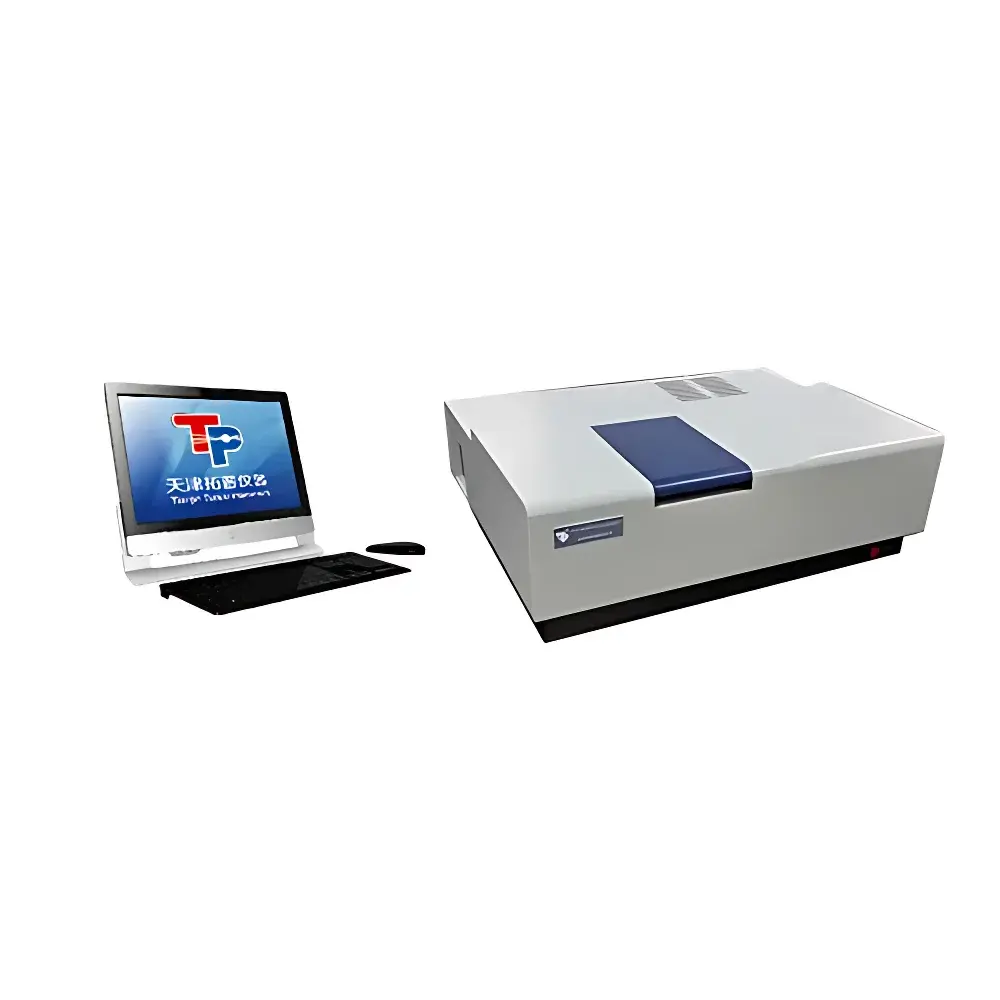
Topo WFZ-26A Dual-Beam Ultraviolet-Visible Spectrophotometer
| Brand | Topo |
|---|---|
| Origin | Tianjin, China |
| Manufacturer Type | Original Equipment Manufacturer (OEM) |
| Instrument Architecture | Dual-Beam |
| Detector | Photomultiplier Tube (PMT) |
| Wavelength Range | 190–900 nm |
| Spectral Bandwidth | 0.15 / 0.3 / 0.5 / 1.0 / 2.0 nm (5 selectable) |
| Wavelength Accuracy | ≤ ±0.3 nm |
| Stray Light | ≤ 0.2%T (at 220 nm, NaI solution) |
| Wavelength Repeatability | ≤ 0.1 nm |
| Photometric Accuracy | ±0.3%T (0.0–100.0%T) |
| Scan Modes | Continuous, Overlap, Time-based |
| Measurement Modes | Transmittance (%T), Absorbance (A), Energy (Single-Beam Reference) |
Overview
The Topo WFZ-26A Dual-Beam Ultraviolet-Visible Spectrophotometer is a precision optical instrument engineered for high-fidelity quantitative and qualitative analysis across the UV-Vis spectrum (190–900 nm). It operates on the principle of dual-beam absorption spectroscopy, wherein a stabilized light source—comprising a deuterium lamp for the ultraviolet region and a tungsten-halogen lamp for the visible/near-IR region—is split into sample and reference beams using a high-stability optical chopper. This architecture compensates for source drift and detector instability in real time, delivering superior photometric reproducibility and long-term baseline stability essential for regulatory-compliant assays.
Key Features
- Czerny-Turner monochromator with holographic grating ensures low stray light (<0.2%T at 220 nm with NaI solution) and high wavelength fidelity (≤±0.3 nm accuracy, ≤0.1 nm repeatability)
- Five-step adjustable spectral bandwidth (0.15, 0.3, 0.5, 1.0, 2.0 nm) enables method optimization for resolution-sensitive applications such as pharmaceutical impurity profiling or narrow-band optical filter characterization
- High-sensitivity photomultiplier tube (PMT) detector with thermally stabilized housing delivers low-noise signal acquisition across the full dynamic range (0.000–3.000 A)
- Dynamic feedback ratio photometry system continuously corrects for intensity fluctuations, minimizing baseline drift during extended kinetic or thermal ramp experiments
- Integrated USB interface supports plug-and-play connectivity to Windows-based control systems without proprietary drivers
- Robust mechanical design includes precision-machined optical mounts, temperature-compensated slit mechanisms, and sealed optical compartment to minimize environmental interference
Sample Compatibility & Compliance
The WFZ-26A accommodates standard 10-mm pathlength quartz cuvettes (supplied), with optional accessories supporting microvolume, flow-cell, and solid-sample reflectance configurations. Its optical path geometry conforms to ISO 6425 and ASTM E275 standards for spectrophotometric performance verification. The instrument supports GLP/GMP-aligned workflows through audit-trail-capable data logging (timestamped spectra, operator ID, parameter history), and its measurement traceability aligns with NIST-traceable calibration protocols. While not pre-certified for FDA 21 CFR Part 11, the software architecture permits configuration of electronic signatures, user access levels, and immutable data archiving when deployed within validated laboratory information management systems (LIMS).
Software & Data Management
Bundled Windows-native software provides full instrument control, spectral acquisition, and post-processing capabilities—including baseline correction, peak detection (with threshold and sensitivity adjustment), spectral smoothing (Savitzky-Golay), derivative spectroscopy (1st/2nd order), arithmetic operations (add/subtract/multiply/divide spectra), and multi-curve overlay. All raw and processed data are stored in open-format ASCII (.txt) and CSV files, ensuring interoperability with third-party analysis tools (e.g., MATLAB, OriginLab, Python pandas). Spectral libraries can be built and searched by peak position, shape, or absorbance ratio; concentration calculations support single-point, multi-point, and non-linear (quadratic/logarithmic) calibration models. Software updates and firmware patches are delivered via secure HTTPS portal with version-controlled release notes.
Applications
- Pharmaceutical quality control: assay validation per USP , dissolution testing, excipient compatibility studies, and degradation product identification
- Materials science: bandgap determination of semiconductors, thin-film thickness calculation via interference fringes, and refractive index modeling
- Environmental monitoring: nitrate/nitrite quantification in water per EPA Method 353.2, formaldehyde detection in air samples
- Academic research: enzyme kinetics (NADH/NADPH monitoring at 340 nm), ligand-binding stoichiometry, and pH-dependent spectral shifts
- Food & beverage: colorimetric analysis (CIE L*a*b* conversion), antioxidant capacity (DPPH assay), and adulterant screening
FAQ
What wavelength calibration standards are recommended for routine verification?
We recommend daily verification using holmium oxide (Ho₂O₃) in 10% perchloric acid (peaks at 241.5, 279.4, 287.5, 333.7, 360.9, 418.5, 460.0, 485.8, 536.2, and 637.5 nm) and didymium glass filters per ISO 6425 Annex B.
Is the instrument compatible with automated sample changers?
Yes—the WFZ-26A supports RS-232 and TTL-level trigger signals for integration with third-party 8-, 16-, or 32-position autosamplers; mechanical alignment fixtures and protocol templates are available upon request.
How is photometric linearity verified across the absorbance range?
Linearity is confirmed using neutral density filters traceable to NIST SRM 930e, or serial dilutions of potassium dichromate in 0.005 M H₂SO₄ (absorbance range 0.2–2.5 A at 350 nm), following ASTM E169 guidelines.
Can spectral data be exported directly to LIMS without manual intervention?
Yes—via configurable ODBC connection or direct file-drop export to designated network folders, with metadata injection (sample ID, method name, timestamp, operator) enabled in software settings.
What maintenance intervals are specified for optical components?
Deuterium and tungsten-halogen lamps require replacement every 1,000–1,500 operating hours; grating and PMT alignment checks are recommended annually or after mechanical shock events, using factory-provided alignment routines.






