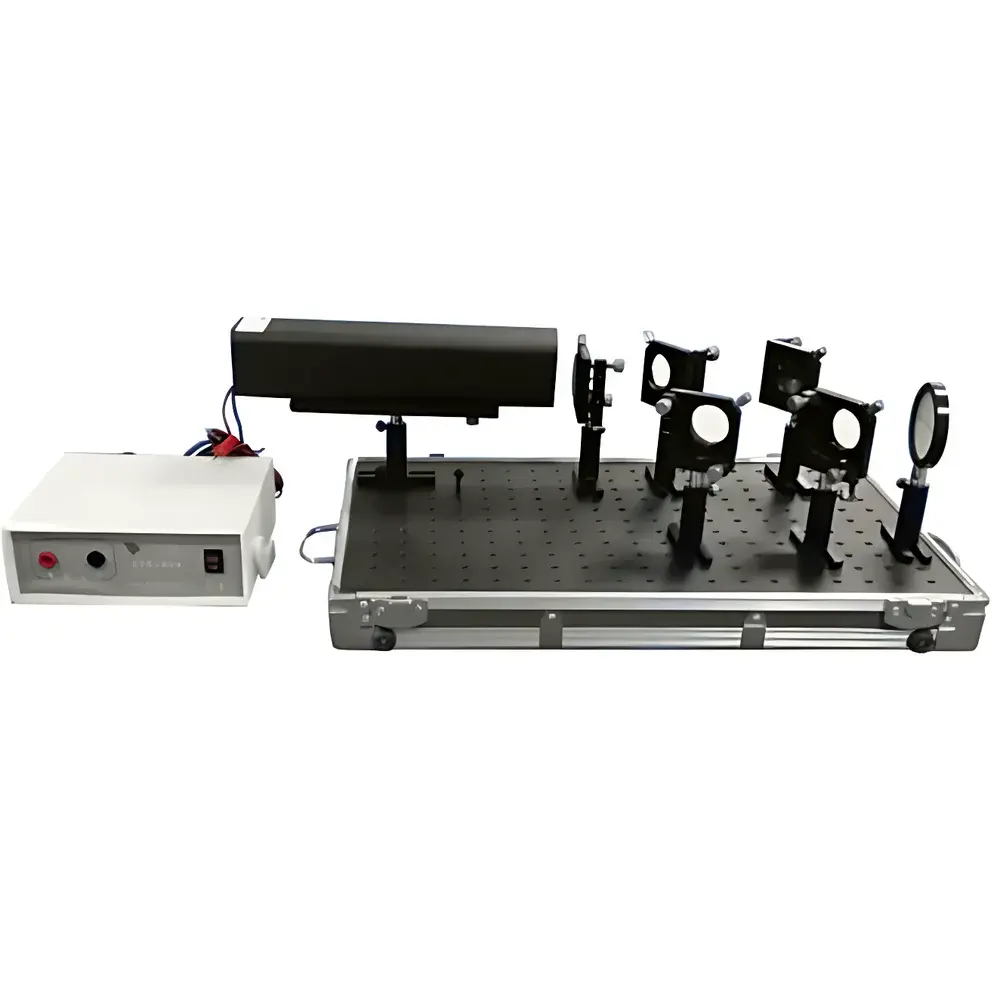
Topo WGS-1 Dual-Beam Interferometry System
| Brand | Topo |
|---|---|
| Model | WGS-1 |
| Origin | Tianjin, China |
| Manufacturer Type | Direct Manufacturer |
| Laser Source | He–Ne, 1.5 mW |
| Optical Baseplate | 500 mm × 350 mm aluminum |
| Experimental Modules | Mach–Zehnder, Sagnac, and Michelson interferometry |
| Educational Application | Undergraduate optics & physics laboratory instruction |
| Compliance | Designed for ISO/IEC 17025-aligned teaching labs |
| Software Integration | Manual alignment only |
| Power Supply | AC 220 V ±10%, 50 Hz |
Overview
The Topo WGS-1 Dual-Beam Interferometry System is a precision-engineered educational platform designed to demonstrate fundamental principles of optical interference in undergraduate physics and optics laboratories. Based on classical wave superposition theory, the system splits a coherent He–Ne laser beam (632.8 nm, 1.5 mW) into two spatially separated paths using dielectric-coated beam splitters, then recombines them to generate high-contrast interference fringes in the overlap region. Unlike single-beam or self-referencing configurations, the dual-beam architecture enables direct control over relative path length, angular alignment, and intensity balance—critical variables for quantitative analysis of fringe visibility, coherence length estimation, and phase sensitivity calibration. The system operates under ambient lab conditions without active vibration isolation but incorporates rigid mechanical design to support stable fringe observation over typical class durations (≥15 min), fulfilling pedagogical requirements for hands-on experimental verification of interference phenomena described in standard curricula (e.g., Hecht’s Optics, Pedrotti’s Introduction to Optics).
Key Features
- Modular optical layout with standardized kinematic mounts for beam splitters, mirrors, and compensating plates—enabling reproducible setup of three canonical interferometer topologies: Mach–Zehnder, Sagnac, and Michelson.
- 500 mm × 350 mm anodized aluminum baseplate with precision-milled T-slots (M4) and metric reference grid (10 mm pitch), facilitating repeatable component positioning and alignment traceability across student groups.
- Integrated portable carrying case with foam-cut cavities for all optical components, ensuring safe transport between teaching labs and minimizing setup time per session.
- Manual fine-adjustment capability via differential micrometer screws (1 µm resolution) on all mirror mounts, supporting student-led optimization of fringe contrast and spatial frequency.
- No electronic control unit or embedded firmware—deliberately omitting automation to emphasize foundational understanding of alignment mechanics, coherence constraints, and environmental perturbation effects.
Sample Compatibility & Compliance
The WGS-1 is not intended for material sample analysis but serves exclusively as a teaching instrument for optical wavefront manipulation and interference metrology fundamentals. It accommodates standard 1″ and 0.5″ diameter optical components (mirrors, beam splitters, lenses) compliant with ISO 10110 surface quality specifications (scratch-dig 60–40). All optical coatings meet MIL-C-48497A durability standards for classroom handling. The system conforms to IEC 60825-1:2014 Class 2 laser safety requirements when operated with supplied interlocked enclosure and warning labels. Its mechanical construction supports alignment stability within ±0.5 arcsec angular drift over 20 minutes at 23 ±2 °C, satisfying ASTM E2919-13 criteria for educational interferometric apparatus performance verification.
Software & Data Management
The WGS-1 operates without proprietary software, data acquisition hardware, or digital output interfaces. All measurements—including fringe spacing, contrast ratio (V = (Imax − Imin)/(Imax + Imin)), and coherence length estimation from fringe disappearance—must be performed manually using calibrated reticles, photodiode-based light meters (user-supplied), and standard lab notebooks. This analog-first approach aligns with GLP-aligned pedagogy emphasizing measurement uncertainty propagation, observer bias assessment, and raw data transcription integrity—core competencies required for accreditation under ABET Criterion 3 (student outcomes) and ISO/IEC 17025 Clause 7.7 (result reporting).
Applications
- Quantitative determination of He–Ne laser temporal coherence length via Michelson interferometer fringe decay versus path difference.
- Characterization of fringe localization and non-locality behavior in Mach–Zehnder geometry under varying beam divergence and collimation.
- Sagnac effect demonstration through rotation-induced phase shift measurement using quadrant photodetector arrays (external).
- Holographic grating fabrication simulation by recording stationary fringe patterns on photoresist-coated substrates.
- Environmental sensitivity analysis: correlation of fringe drift rate with ambient temperature gradients and acoustic noise spectra measured via external accelerometers.
FAQ
Is the WGS-1 compatible with digital cameras or CCD sensors for fringe image capture?
Yes—standard C-mount or SM1-threaded imaging sensors can be mounted at the observation plane; however, no bundled acquisition software or calibration files are provided.
Does the system include alignment lasers or auxiliary optics for initial setup?
No—alignment relies solely on the primary He–Ne source and included irises, pinholes, and alignment telescopes per standard optics lab practice.
Can the baseplate be mounted on optical tables or breadboards?
Yes—the underside features four M6 threaded holes spaced at 400 mm × 300 mm, compatible with industry-standard optical table clamps.
What safety certifications does the integrated laser subsystem carry?
The He–Ne module is certified to IEC 60825-1:2014 Class 2 and bears CE marking for EU educational equipment compliance.
Is technical documentation available in English with metrological traceability statements?
Yes—user manual includes English translation, NIST-traceable laser wavelength specification (632.816 nm ±0.002 nm), and alignment tolerance budgets per ISO 10110-5.