
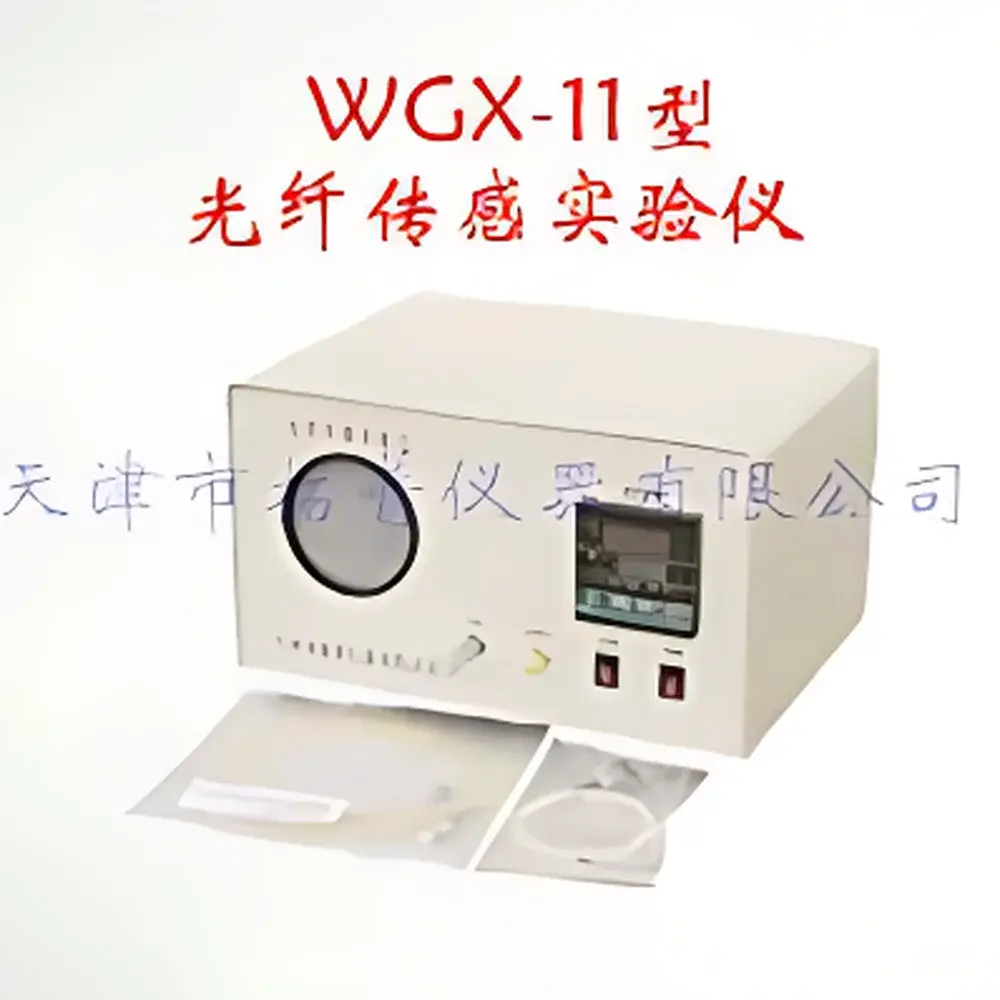
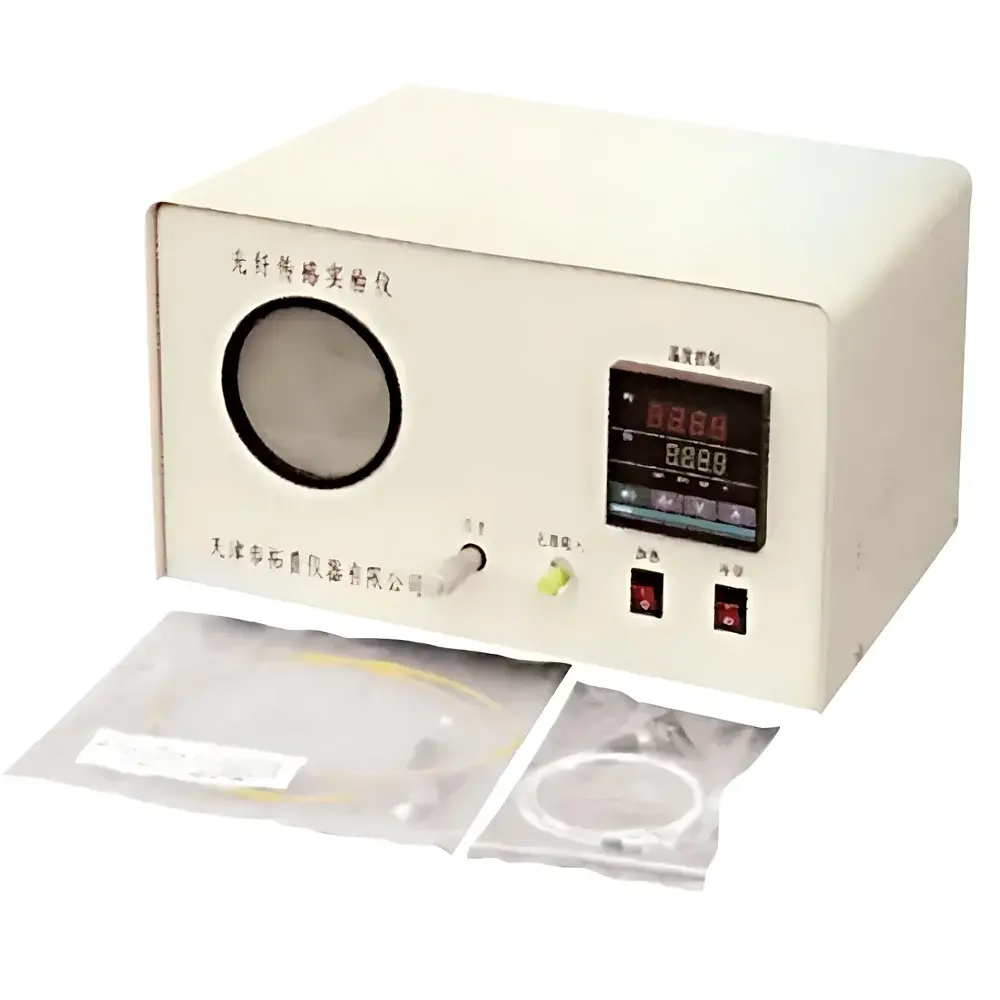
Topo WGX-11 Fiber Optic Sensing Educational Experiment System
| Brand | Topo |
|---|---|
| Model | WGX-11 |
| Light Source | 650 nm FP fiber-coupled laser diode |
| Origin | Tianjin, China |
| Manufacturer Type | Original Equipment Manufacturer (OEM) |
| Category | Educational Optical Measurement Instrument for Fiber Optic Sensing Principles |
| Compliance | Designed for academic laboratory use in accordance with standard undergraduate photonics curriculum frameworks (e.g., IEEE/LEOS recommended teaching modules) |
Overview
The Topo WGX-11 Fiber Optic Sensing Educational Experiment System is a purpose-built optical measurement platform engineered to demonstrate fundamental principles of intensity-modulated and interferometric fiber optic sensing. It operates on the physical basis that external perturbations—such as mechanical strain or thermal expansion—induce measurable changes in optical path length, modal coupling efficiency, or reflected/transmitted light intensity within single-mode or multimode silica optical fibers. The system integrates a stable 650 nm Fabry–Pérot (FP) fiber-coupled laser diode as its coherent light source, optimized for high signal-to-noise ratio in classroom-scale demonstrations. Unlike industrial-grade distributed sensing systems (e.g., OTDR or BOTDA platforms), the WGX-11 emphasizes pedagogical clarity: all optical components—including fiber Bragg grating (FBG)-compatible patch cords, adjustable strain fixtures, and thermally insulated temperature chambers—are modular, labeled, and calibrated for repeatable qualitative and semi-quantitative observation. Its architecture supports both transmission-mode and reflection-mode configurations, enabling students to correlate physical stimuli with real-time photodetector output using analog voltage readouts.
Key Features
- Integrated 650 nm FP fiber-coupled laser source with <1.5 nm spectral linewidth and <±0.2 nm wavelength stability over 8-hour operation
- Dual-experiment capability: Strain-sensing mode (via cantilever-mounted fiber section with calibrated micrometer-driven displacement) and temperature-sensing mode (via Peltier-controlled thermal stage with ±0.5 °C resolution)
- Optical path visualization: Clear acrylic optical bench with labeled fiber routing ports, SMA/FC connectors, and alignment indicators for beam path tracing
- Real-time analog output interface: 0–5 V DC photodetector signal output mapped linearly to relative intensity change (±3% full-scale linearity)
- Educational documentation suite: Includes instructor’s manual with ASTM E2847-aligned experimental protocols, uncertainty budget templates, and ISO/IEC 17025-relevant calibration traceability notes
- Modular design compliant with IEEE Photonics Society undergraduate lab standards for optical sensor education
Sample Compatibility & Compliance
The WGX-11 is designed exclusively for use with standard telecommunications-grade silica optical fibers (SMF-28 or equivalent, 125 µm cladding diameter). It accommodates both bare and jacketed fiber segments up to 2 m in length, with integrated strain-applying fixtures rated for axial loads from 0.1 N to 5 N. Temperature experiments utilize a sealed aluminum thermal chamber compatible with fiber lengths up to 1.5 m and operating range of 15–60 °C. The system does not support polarization-maintaining (PM) or specialty fibers (e.g., photonic crystal or hollow-core), nor does it implement active feedback control or digital lock-in detection—features reserved for research-grade instrumentation. All electrical interfaces meet IEC 61010-1 safety requirements for educational laboratory equipment. While not certified for clinical or industrial process monitoring, the WGX-11 aligns with GLP-aligned pedagogical validation practices for university teaching labs.
Software & Data Management
The WGX-11 operates without proprietary software: data acquisition is performed via standard analog-to-digital converters (e.g., National Instruments USB-6009 or Arduino-compatible ADC modules) interfaced through the 0–5 V output port. Included documentation provides Python and MATLAB script templates for time-series plotting, basic FFT analysis of periodic strain responses, and linear regression fitting of temperature–intensity curves. All scripts are annotated to reflect traceable metrological chains per ISO/IEC 17025 Clause 5.8. No cloud connectivity, firmware updates, or FDA 21 CFR Part 11-compliant audit trails are implemented—consistent with its classification as a non-regulated teaching aid.
Applications
- Undergraduate physics and engineering laboratories: Demonstrating photoelasticity, thermo-optic coefficient (dn/dT), and microbend-induced loss mechanisms
- Sensor fundamentals coursework: Comparing intrinsic vs. extrinsic fiber sensing architectures; analyzing sensitivity limits governed by shot noise and detector responsivity
- Capstone project platforms: Supporting student-designed extensions such as multi-point quasi-distributed sensing using serial FBG arrays (with optional add-on kits)
- Teacher training workshops: Illustrating alignment of optics curricula with ABET Criterion 3 student outcomes (e.g., “ability to design and conduct experiments”)
- STEM outreach programs: Enabling safe, low-power optical experimentation compliant with ANSI Z136.1 Class 1 laser safety standards
FAQ
Is the WGX-11 suitable for quantitative research-grade measurements?
No. It is calibrated for educational repeatability—not metrological accuracy. Uncertainty budgets exceed ±5% for absolute strain/temperature values.
Can third-party lasers or detectors be integrated?
Yes, provided they match the 650 nm center wavelength and maintain FC/PC or SMA-905 compatibility; electrical interface remains analog-only.
Does the system include calibration certificates?
A factory reference report is supplied, documenting laser power stability and photodetector linearity at 25 °C ambient; NIST-traceable calibration is available as an optional service.
What safety certifications does the laser source hold?
The 650 nm FP laser module complies with IEC 60825-1:2014 Class 1 requirements when used with supplied fiber enclosures and termination caps.
Is technical support available for curriculum integration?
Topo provides downloadable syllabus mapping documents aligned to common photonics textbooks (e.g., “Fundamentals of Photonics” by Saleh & Teich) and offers remote lab setup consultation for institutional purchasers.



